
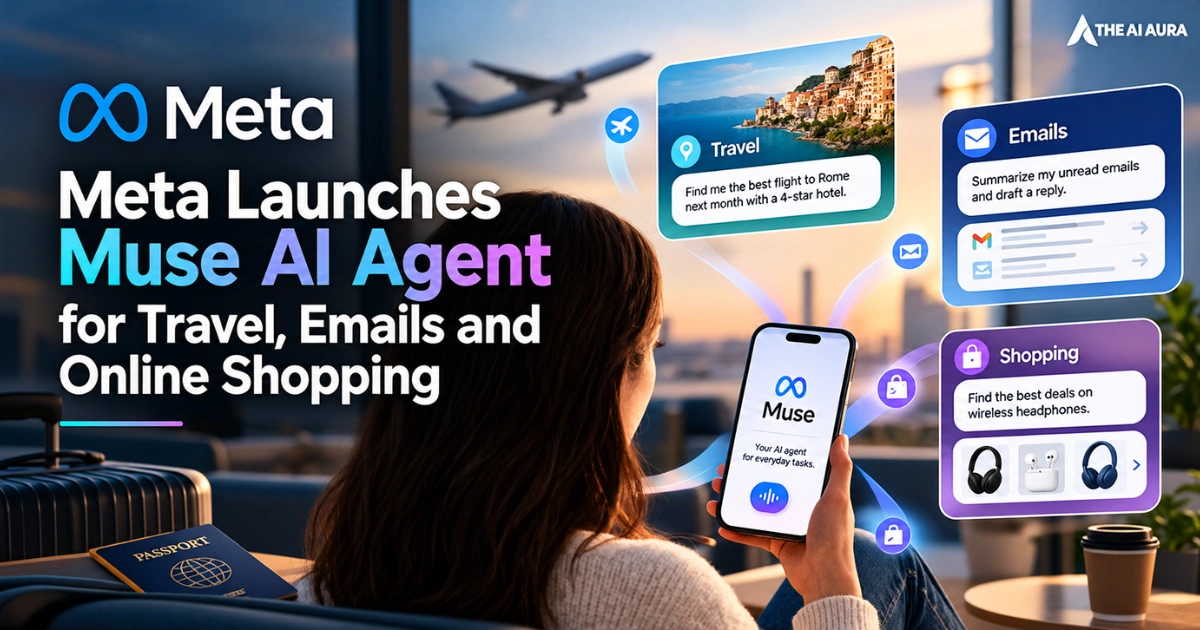

The era of digital assistants merely regurgitating web search results is rapidly closing. Meta has officially entered the autonomous AI race with the launch of Muse, a personal agent designed to completely take over tedious digital chores.
Unlike conventional chatbots that wait for your next prompt, Muse is built to execute complex, multi-step workflows from sending out routine emails to booking entire travel itineraries and purchasing items online.
Unveiled by CEO Mark Zuckerberg, the tool signals Meta’s most aggressive pivot toward autonomous systems. Available initially to users in the United States through a standalone app and WhatsApp, Muse doesn’t just draft an email or suggest a flight; it opens a browser, fills out the forms, and clicks send.
Powered by the company’s multimodal Muse Spark AI model, this agent operates 24/7 in the background, fundamentally shifting the dynamic from conversational AI to actionable AI.
How Muse Works: The Secure VM Architecture
Handing the keys to your digital life over to an AI requires an immense degree of trust, a hurdle Meta is attempting to clear with a heavy engineering focus on infrastructure isolation.
When you initialize Muse, it doesn’t just run loosely on your device or float amorphously on Meta’s general servers. It operates within what Zuckerberg calls the Muse Secure VM.
Think of the Muse Secure VM as a dedicated, cloud-based Linux computer assigned exclusively to you. It is equipped with its own virtual CPU, memory, storage, and web browser. When Muse goes to work, it logs into services and interacts with websites from this isolated sandbox.
This architecture is critical because it allows the agent to continue working even after you close the app on your phone. If you ask Muse to monitor flight prices and book when they drop below a certain threshold, the virtual machine stays awake, scanning the web and executing the task days later.
To mitigate the obvious security risks of an AI navigating the internet with your credentials, Meta implemented a secondary oversight system called Sentinel. Muse handles the reasoning and execution, while Sentinel acts as a strict supervisor.
Before Muse takes a sensitive action like transferring funds, sending a professional email, or making a purchase Sentinel intercepts the command and pings your device for manual approval.
Furthermore, the system masks actual payment details by generating one-time-use virtual cards for online shopping, ensuring that external websites never see your core financial data.
Redefining Digital Chores with Autonomous Execution
The practical utility of Muse lies in its ability to connect fragmented digital ecosystems without needing constant hand-holding. In a typical scenario, planning a trip requires juggling a calendar app, an airline website, a hotel booking platform, and a credit card.
Muse consolidates this by linking directly to those services provided the user grants explicit permission. You simply tell the agent your destination and dates via a WhatsApp message.
Muse checks your schedule for conflicts, browses for flights, cross-references hotel proximity to your meetings, and builds the itinerary autonomously.
Online shopping introduces another layer of utility. Meta has integrated checkout protocols that allow Muse to handle the entire purchase flow. If you ask the agent to find and buy a specific replacement part for a broken appliance, it will search the web, compare prices, apply shipping filters, and execute the transaction securely without exposing your credit card.
This agentic framework represents a massive operational leap. By utilizing an independent computing environment and continuous background execution, Meta is laying the groundwork for AI that actually works on our behalf, rather than just talking to us.
With plans to integrate Muse into Meta’s smart glasses platform and roll out tiered subscription models, the company is positioning this autonomous assistant as the new interface for the internet itself, completely bypassing the traditional web browser experience.
Source: India Today, "Meta Unveils 'Muse', an AI Agent That Can Email, Book Trips and More"