
The remote hiring boom brought unprecedented flexibility to the tech industry, but it also introduced a massive blind spot for hiring managers.
We are now dealing with an influx of candidates attempting to pass complex technical interviews by essentially outsourcing their live responses to generative AI.
The transition from googling answers on a second monitor to feeding live audio into a chatbot has been swift. However, experienced recruiters and engineering leads are adapting just as fast.
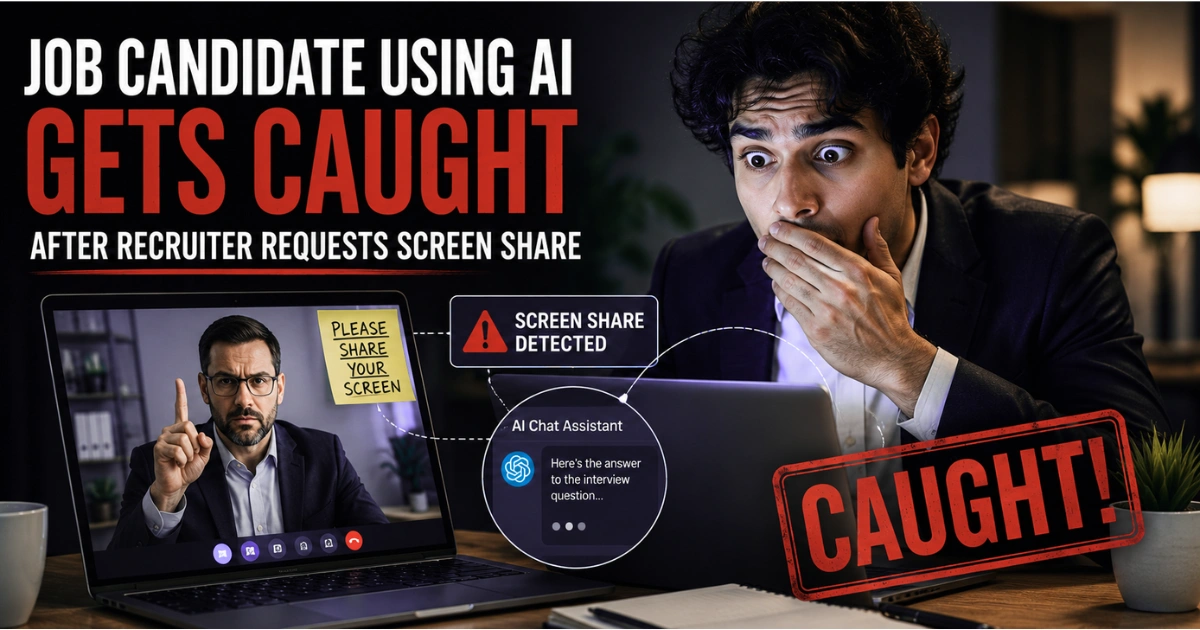
A recent incident shared by California-based tech lead and research scientist Lily Zhang perfectly illustrates how quickly this deceptive tactic falls apart under pressure.
The Anatomy of a Live Interview Bust
During a machine learning (ML) system design interview, Zhang noticed a massive red flag within the first three minutes: the candidate was “talking without thinking.”
In the realm of system design, this is a dead giveaway. Real engineering involves pauses, clarifications, and iterative thinking.
When a candidate immediately launches into a highly polished, uninterrupted monologue of textbook concepts without checking assumptions, they are usually reading off a prompter or an AI window.
Instead of calling it out immediately, Zhang let the candidate proceed through the entire end-to-end design. The trap was set. The actual test of a system design interview isn’t just knowing the terminology; it is the ability to visually map out components and defend the architecture in real-time.
When Zhang asked the candidate to share his screen and draw the architecture, the illusion shattered. The candidate completely froze. A flickering chatbot window on his screen gave the game away, forcing Zhang to terminate the interview on the spot.
This specific tactic—the sudden screen share request—has become the gold standard for tech recruiters trying to verify a candidate’s authenticity. An AI can generate a flawless script explaining a microservices architecture, but it cannot organically whiteboard that same architecture while adapting to live, dynamic constraints thrown out by an interviewer.
Why the “Fake It Till You Make It” Strategy Fails
The incident sparked a massive conversation across social media platforms, with industry professionals pointing out the glaring flaw in using AI to cheat: getting the job is only the first hurdle.
Tech roles, particularly in machine learning and advanced system design, are heavily scrutinized during the standard probation period. A candidate who relies on a chatbot to explain basic architectural concepts will inevitably crash when handed access to a proprietary, complex codebase.
You cannot sneak an AI into a secure, internal company network, nor can a chatbot sit in on a live war room meeting to debug a broken deployment.
The mechanics of cheating are painfully obvious to anyone sitting on the other side of the webcam. The signs are uniform: eyes rapidly tracking left to right on an off-camera monitor, unnatural latency before answering, and the telltale sound of keyboard typing while the interviewer is still asking the question.
Candidates attempting this route fail to realize that hiring managers are testing for problem-solving methodology, not just the correct end answer.
The flickering window on Zhang’s screen share didn’t just expose a cheater; it highlighted a fundamental misunderstanding of what tech companies are actually hiring for.
The industry does not just need people who know how to query an AI; it needs people who have the core competency to fix the things the AI breaks.
Source: NDTV, "Candidate Using AI Freezes During Interview After Recruiter Asks Him To Share Screen: 'I Let Him Talk'"