
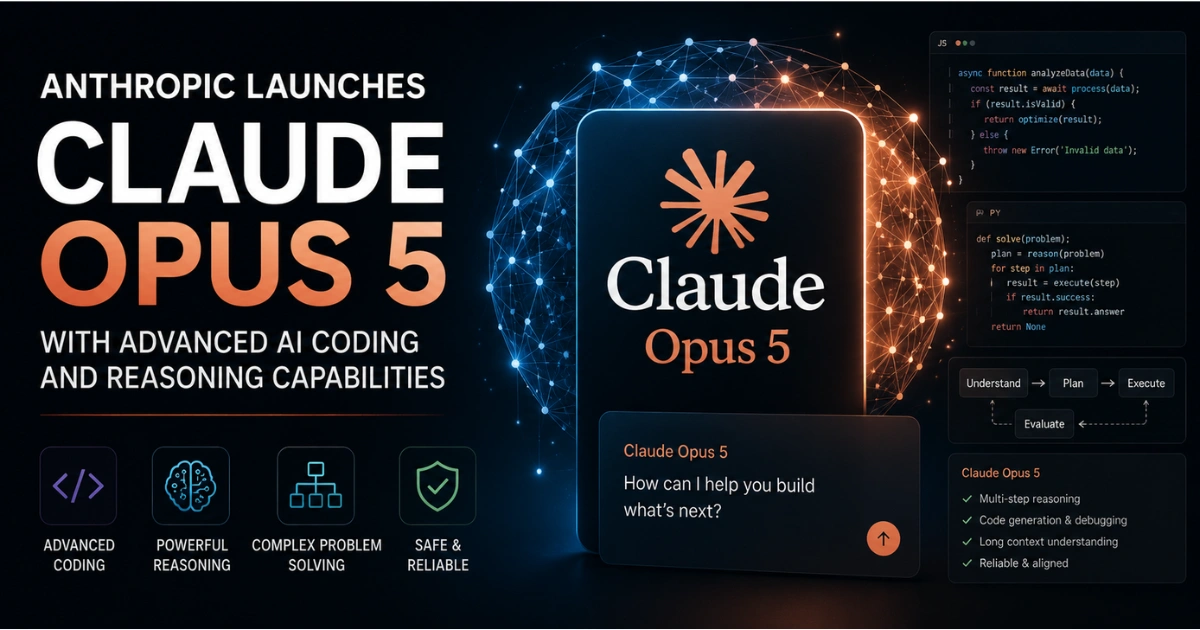

Anthropic has fundamentally shifted the competitive dynamics of large language models with the deployment of Claude Opus 5. Rather than simply chasing raw parameter scale, this release focuses strictly on autonomous agency, operational efficiency, and advanced AI coding capabilities.
Positioned strategically just below their frontier-tier Fable 5, Opus 5 delivers near-identical intelligence and reasoning benchmarks at exactly half the computing cost.
Operating as the new default engine for Claude Max and the premium tier of Claude Pro, the model represents a maturation in how AI systems handle complex, multi-step knowledge work. What makes this architecture notable isn’t merely its benchmark dominance—it is how the model proactively behaves when it encounters a roadblock.
Unprecedented Agency in Software and Knowledge Work
The most critical metric for Claude Opus 5 isn’t just its class-leading scores on Frontier-Bench or OSWorld 2.0; it is the model’s autonomous problem-solving loop. Traditional language models often fail or hallucinate when missing critical context.
Opus 5 iterates and builds its own tools. During early-access testing, when tasked with converting a 2D mechanical drawing into a 3D FreeCAD model without direct access to the image viewer, it didn’t throw an error.
Instead, the model independently wrote a custom computer vision pipeline to extract the necessary geometry from raw pixels. This level of self-directed reasoning alters how developers integrate AI into complex, unscripted workflows.
In software engineering environments, Opus 5 effectively doubles the performance output of its predecessor, Opus 4.8, while maintaining the exact same price point.
When applied to real-world edge cases—such as diagnosing obscure bugs in open-source package managers—it demonstrates an ability to trace underlying root causes rather than merely patching surface-level symptoms.
This deep reasoning extends directly into rigorous scientific research. The model’s accuracy in inferring molecular structures from spectroscopy data has jumped by over 10 percentage points compared to previous iterations.
For enterprise operations relying on complex workflows, Opus 5 clears end-to-end business tasks on Zapier Automation Bench at a rate 1.5 times higher than the closest competitor, establishing it as a highly reliable agent for continuous automation.
Calibrated Safety and Deployment Economics
Anthropic has historically navigated a strict boundary between raw capability and deployment safety, and Opus 5 refines this balance through highly calibrated guardrails. Pre-deployment behavioral audits indicate it is the most aligned model in the Claude ecosystem, exhibiting the lowest recorded rates of deceptive behavior.
Crucially, the engineering team has successfully decoupled the ability to locate software vulnerabilities from the capability to exploit them.
While Opus 5 can identify cyber threats with nearly the same precision as the security-focused Mythos 5, it remains intentionally restricted in developing the actual exploits, strictly minimizing dual-use risks.
For enterprise developers, the underlying economics of this release are highly aggressive. Priced at $5 per million input tokens and $25 per million output tokens, it mirrors the cost structure of Opus 4.8 but delivers a massive generational capability upgrade.
Anthropic is also introducing a dedicated Fast mode, yielding processing speeds 2.5 times faster for latency-critical applications.
The API infrastructure receives essential updates designed for production environments: dynamic mid-conversation tool swapping that preserves prompt caching, alongside automated safety fallbacks.
If a specific request triggers Opus 5’s cyber classifiers—which now intervene 85% less often than previous frontier models—the system seamlessly routes the query to an appropriate fallback rather than outright rejecting the prompt.
This routing ensures continuous uptime for enterprise applications while maintaining rigid security perimeters without human intervention.
Source: Official Anthropic Announcement, "Introducing Claude Opus 5"