
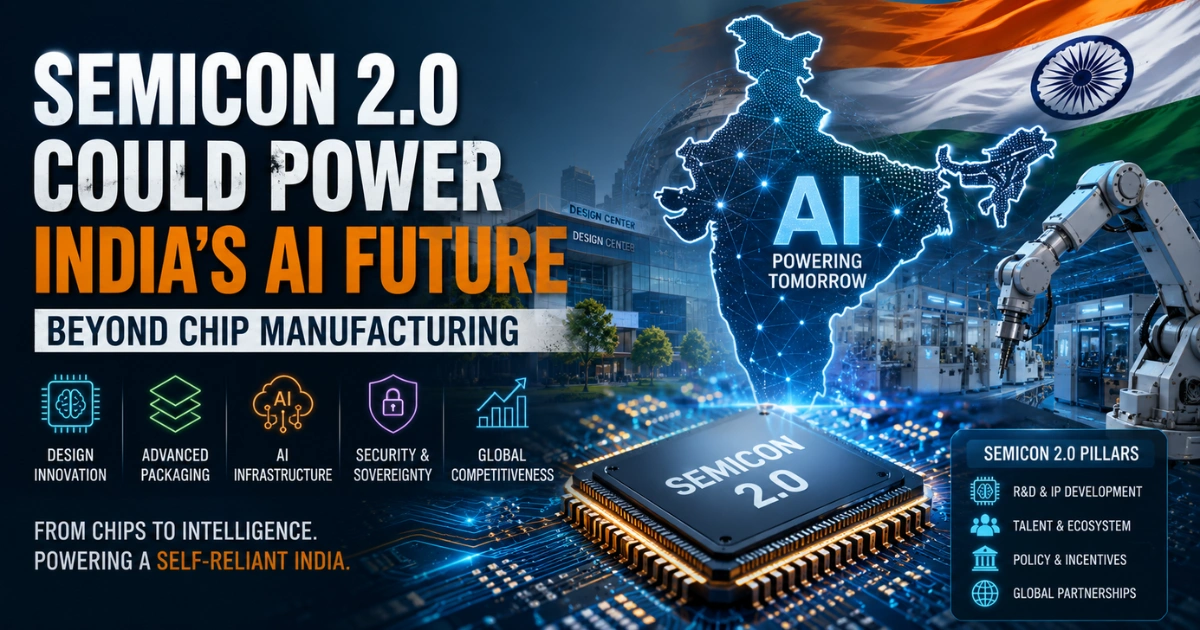

When the Rs 1.3 lakh crore India Semiconductor Mission (ISM) 2.0 secured Union Cabinet approval earlier this month, the mainstream narrative immediately locked onto foundries, government subsidies, and global supply chain resilience.
But if you look past the immediate geopolitical wins of bringing manufacturing onshore, a much more critical strategic play emerges.
This isn’t just about stamping out silicon; it’s about securing the absolute base layer for artificial intelligence.
AI development globally is currently bottlenecked by hardware access. You can engineer the most efficient algorithms in the world, but without the raw compute power to train and execute them, development hits a hard wall.
While the ISM 2.0 framework might lack explicit AI terminology in its initial policy documents, industry insiders—from neural network architects to hardware executives—recognize exactly what this infrastructure means.
By subsidizing the entire silicon supply chain, India is quietly assembling the domestic engine required to process, train, and deploy AI models at scale.
Breaking the Compute Dependency
Right now, the trajectory of the global AI race is dictated by who controls advanced processing units. Indian AI startups and enterprise tech divisions face steep capital costs and significant wait times relying heavily on imported hardware or foreign-hosted cloud infrastructure.
Semicon 2.0 disrupts this dynamic by incentivizing the complete value chain—moving beyond basic fabrication to encompass advanced packaging, testing, and crucial design elements.
In practical terms, this translates to a gradual but vital easing of the compute bottleneck. As domestic manufacturing and packaging capabilities mature, the ecosystem will inevitably pivot to support specialized AI hardware, including neural processing units (NPUs) and custom accelerators.
This localized production inherently lowers the operational overhead for domestic AI firms. When high-performance hardware becomes accessible and cost-effective within our own borders, companies can shift their runway capital away from simply renting foreign server time.
Instead, those resources go directly into refining proprietary models and expanding datasets. It creates a closed-loop advantage where localized silicon accelerates local AI training, keeping data sovereignty intact while dropping latency to an absolute minimum.
The Push Toward Custom Edge Silicon
Perhaps the most transformative aspect of this policy is its potential to drive custom silicon designed specifically for India’s unique technological landscape.
We operate in a highly specific environment—requiring real-time multilingual voice processing, massive agricultural data analytics, and localized financial networks that often function in low-bandwidth rural areas.
Routing all of these applications through massive, cloud-based Large Language Models is computationally inefficient and economically unviable.
The real scale of AI in India relies heavily on Edge AI—running smaller, highly optimized models directly on endpoint devices like smartphones, smart tractors, and regional point-of-sale terminals.
Semicon 2.0’s renewed focus on design-linked incentives encourages local fabless startups to architect Application-Specific Integrated Circuits (ASICs).
Instead of forcing generic, imported chips to process complex, localized tasks inefficiently, Indian engineers can design silicon explicitly optimized for Indic language translation or hyper-local predictive analytics right at the hardware level.
This bypasses connectivity blackouts, slashes power consumption, and ultimately creates a localized hardware ecosystem that actually matches the specific software demands of the region.
Source: Moneycontrol, "Beyond Fabs: Why Semicon 2.0 Could Become India's Most Important AI Policy"