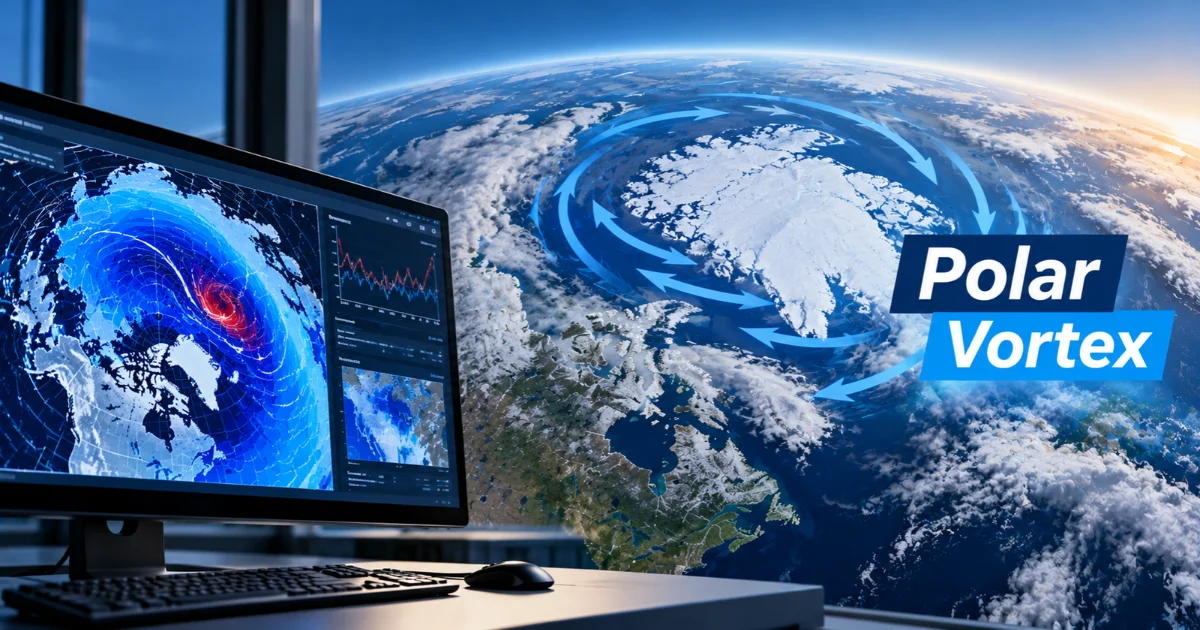

The polar vortex, a swirling mass of cold air encircling the North Pole, is sometimes disrupted by sudden stratospheric warming (SSW) events, unleashing waves of frigid air that penetrate farther south than usual.
Temperatures across North America and Europe drop precipitously when this happens, but such events remain hard to predict, meaning we can’t easily warn people when SSW is imminent.
Standard meteorological forecasting models rely heavily on rigid thermodynamic equations that do an excellent job predicting general circulation patterns over a short window.
Yet, when it comes to the extreme, rapid morphological shifts associated with sudden stratospheric warming, traditional numerical weather prediction routinely falters.
We are essentially trying to catch a highly erratic atmospheric breakdown using a net designed for slow-moving, predictable weather fronts. This is where advanced neural networks step in, offering a completely different computational paradigm.
By shifting away from purely physics-based modeling and embracing data-driven pattern recognition a prime example of the ongoing debate in specialized vs. generalist AI models researchers are finally mapping the complex interactions that precipitate these brutal cold snaps, completely rethinking how we approach long-range climate modeling.
Decoding Non-Linear Atmospheric Shifts
To understand how artificial intelligence cracks this meteorological puzzle, we have to look at the invisible energetic exchanges happening miles above the Earth.
Conventional models often miss the subtle, non-linear couplings between the magnetosphere, ionosphere, and stratosphere because they simply cannot parameterize those localized interactions fast enough.
Machine learning changes the equation by processing vast historical climate datasets to identify latent structural changes in the vortex before they visibly fracture.
According to recent findings detailed at Phys.org, specialized deep learning frameworks have successfully isolated an early warning signal by tracking chaotic energetic particle fluxes alongside standard atmospheric indices.
These models utilize spatiotemporal memory networks capable of separating spatial and temporal dependencies with remarkable precision. Even though the inner workings of such architectures can raise classic AI black box transparency questions, the practical gains are undeniable.
Instead of rigidly calculating what the atmosphere should do next based on fixed physical rules, the algorithm learns the exact morphological precursors of a vortex collapse. It identifies the microscopic flow anomalies, anomalous heat transfers, and pressure fluctuations that historically snowball into a massive stratospheric warming event.
Because the neural network focuses purely on recognizing the signature of impending instability rather than running a highly resource-intensive atmospheric simulation, it spots the warning signs far earlier than conventional supercomputers ever could.
Shifting the Forecasting Paradigm
Capturing that faint precursor signal translates into a massive advantage for long-range climate prediction and risk mitigation. We are looking at the very real possibility of extending our forecast horizons for sudden stratospheric warming events from a mere few days out to several weeks.
Spotting a vortex disruption twenty days in advance gives energy grids, agricultural sectors, and municipal governments actual time to prepare for catastrophic cold surges, potentially saving lives and preventing billions in infrastructure damage.
The beauty of this machine learning approach lies in its hybrid architecture. It does not completely discard traditional atmospheric physics but rather intricately augments it.
The algorithms consume the raw physical data such as proton flux, ozone concentrations, and jet stream velocity and calculate the residual non-linear interactions that human-coded thermodynamic equations simply leave behind. We are actively moving from a reactive forecasting stance to a deeply predictive one.
By successfully emulating the stochastic nature of polar vortex breakdowns, artificial intelligence bridges the long-standing gap between theoretical climatology and actionable, real-time meteorology. The frigid air will inevitably still spill south across the continents, but we will finally have the technological capability to see it coming before the first freeze hits.