
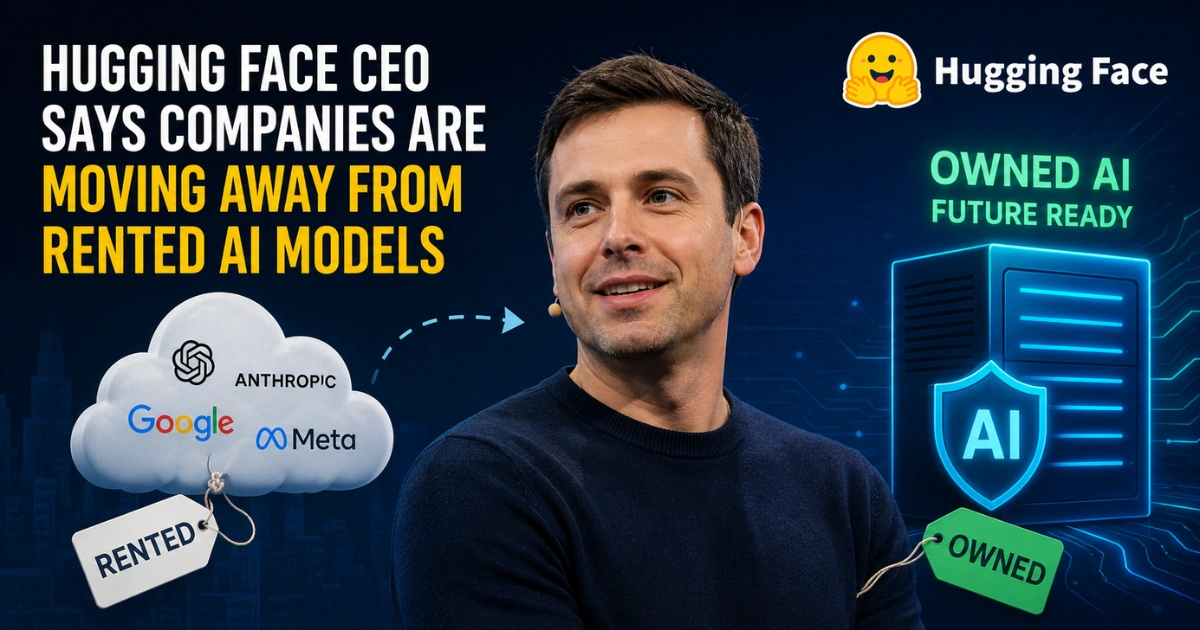

Clem Delangue says he has seen the same pattern repeat across Hugging Face’s enterprise customers.
Companies often begin by building applications with proprietary AI APIs, but as usage grows and costs increase, many migrate to open-weight models they can host, customize, and control themselves.
Speaking on TechCrunch’s Equity podcast, the Hugging Face CEO argued that this transition is becoming the standard approach for enterprise AI rather than a niche developer preference.
He added that roughly half of the Fortune 500 now uses Hugging Face to deploy private or open AI models.
Why More Companies Are Choosing Open-Weight AI Models
The trend is becoming visible across several AI platforms. Chinese open-weight models accounted for 41% of Hugging Face downloads this spring, surpassing U.S.-developed models for the first time.
On OpenRouter, the six most-used models all come from Chinese companies, including Tencent, Xiaomi, DeepSeek, MiniMax, and Z.ai, while Anthropic’s Claude Opus 4.7 ranked seventh.
Vercel’s platform data shows a similar shift. Open-weight models handled nearly one-third of AI requests in June, serving as the low-cost layer for production applications while frontier models remained reserved for more specialized workloads.
Although those figures exclude traffic hosted directly by companies such as OpenAI and Anthropic, they still indicate growing enterprise adoption of open models.
Delangue points to releases like Z.ai’s GLM-5.2, which competes with leading proprietary models in coding and vulnerability detection, as evidence that the performance gap between open and closed AI continues to narrow.
He also noted that Hugging Face now hosts nearly three million public models, with developers creating a new repository every seven seconds. Microsoft CEO Satya Nadella recently echoed a similar theme by warning businesses against becoming overly dependent on a single AI provider.
The Debate Over Open AI Models Is Far From Settled
Despite growing adoption, open-weight AI remains the subject of an ongoing safety debate. Anthropic CEO Dario Amodei has argued that releasing advanced model weights publicly creates long-term risks because they cannot be recalled once distributed.
He has warned that open models could increase misuse in areas such as cybersecurity and biological research.
Delangue disagrees with that view. He argues that concentrating powerful AI capabilities inside a small number of closed companies does not eliminate security risks.
Instead, he believes transparency allows researchers to identify weaknesses, improve defenses, and reduce the concentration of power among a handful of AI providers. He also notes that closed AI systems have experienced model-weight leaks despite their proprietary nature.
The disagreement over openness and safety is unlikely to end soon. However, enterprise adoption trends suggest many organizations are already making infrastructure decisions based on cost, flexibility, and control rather than waiting for the broader policy debate to reach a conclusion.
Source: TechCrunch, "Hugging Face's CEO on Why Companies Are Done Renting Their AI"