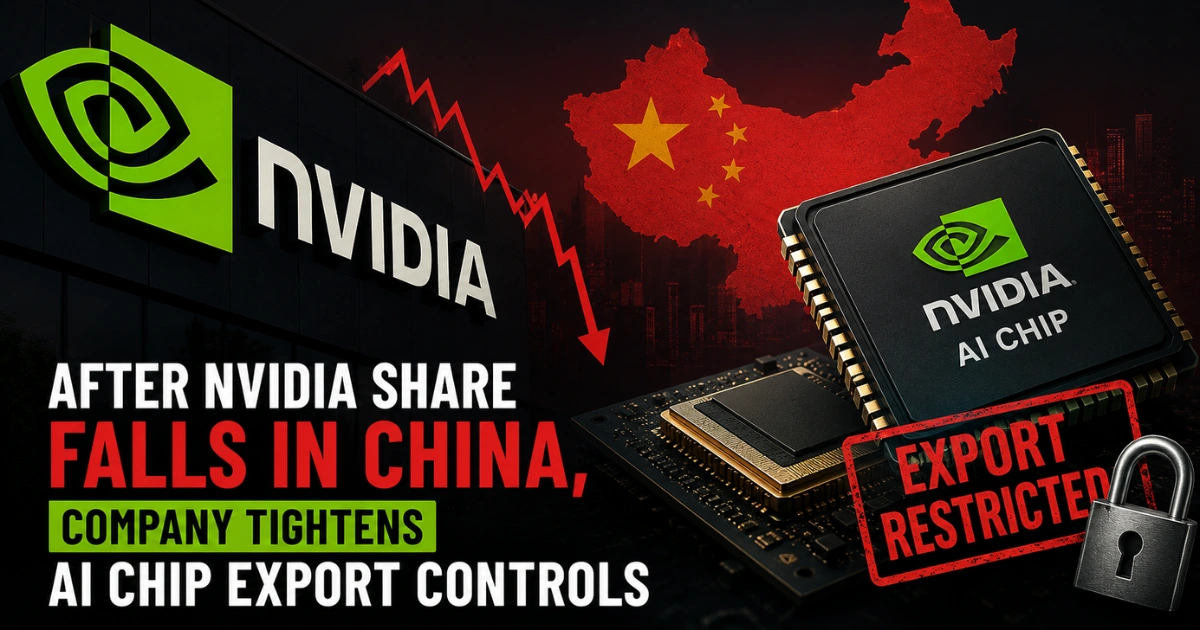

Nvidia has cut off more than half of its approved buyers across three major Asian hubs, according to a Financial Times report published Monday and picked up by Reuters.
The move centers on a new “white list” system built to close the gap smugglers have been using to route American AI chips into China despite years of export bans, and it marks Nvidia shifting from paperwork-based compliance to something closer to in-house enforcement.
How the Vetting Actually Escalated
Over the past few months, Nvidia intensified due diligence specifically in Singapore, Malaysia, and Japan, according to the FT’s sources, and more than half of its existing customer base in the region, disproportionately neocloud providers that rent out AI computing capacity, failed the initial review and were removed from the approved list.
Cut customers can reapply, but only after making changes Nvidia is satisfied with. The checks themselves got dramatically more hands-on: rather than relying on submitted documentation, Nvidia staff are now visiting customer data centers directly, verifying corporate contracts, and interviewing end users, with the US Department of Commerce providing direct oversight.
The trigger is fairly traceable. The Commerce Department issued guidance in May aimed specifically at stopping advanced chips from reaching Chinese entities through overseas subsidiaries, and in March, US prosecutors charged a Supermicro co-founder and two employees over an alleged $2.5 billion scheme that used a Southeast Asian company as a pass-through entity to move Nvidia chips from Taiwan into China.
It’s worth acknowledging the limits of what we can confirm. The Financial Times report does not identify the affected distributors, explain how long the reapplication process takes, or clarify whether the white-list approach extends beyond the three named countries.
Reuters also said it could not independently verify the report. Treat the “more than half” figure as a reported claim rather than an audited result.
The Bind This Creates Back in China
The crackdown lands on top of a market where Nvidia already has almost nothing to sell.
Years of escalating US export bans have pushed Nvidia’s share of top-tier AI processors in China to effectively zero, and Beijing has compounded that by blocking domestic firms from buying even Nvidia’s deliberately downgraded H200 chip, already two generations behind the company’s current lineup, in an effort to force local buyers toward Chinese-made hardware instead.
That policy is now creating a real computing shortage inside China just as its tech industry pushes into AI agents, workloads that demand meaningfully more compute than a standard chatbot.
Some Chinese tech firms are reportedly lobbying Beijing directly to lift the H200 restriction, while Beijing’s own bet is that domestic chip manufacturers can triple production capacity by the end of the year, fast enough to close the gap without reopening the door to US hardware.
The result squeezes both sides at once. Nvidia is tightening control over who in Asia can legally buy its chips, while Beijing is separately blocking chips that Nvidia could otherwise sell.
Whichever side gives first—tighter US enforcement finally choking off the smuggling routes, or Chinese production scaling fast enough to make the standoff moot—will do more to shape China’s AI compute supply over the next year than any single policy announcement has so far.
Source: The Times of India, "After Nvidia Share Falls to Zero in China, Company Closing 'Back Door' to Keep Its AI Chips Out of Chinese Companies"