
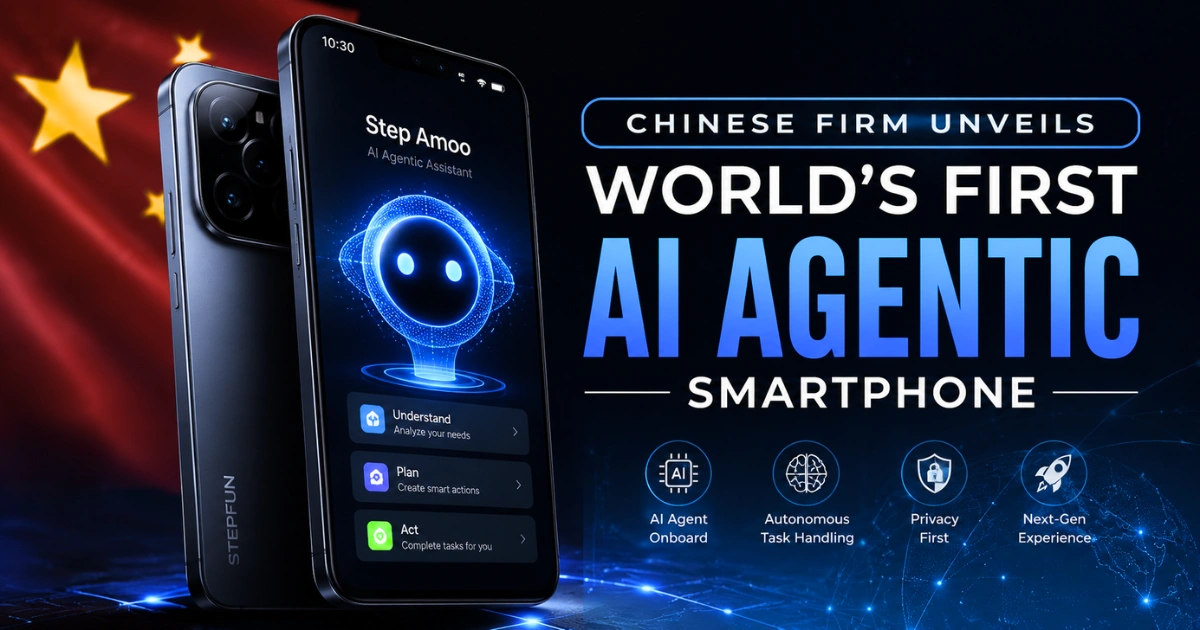

StepFun beat OpenAI to a headline OpenAI hadn’t even earned yet. At a launch event in Shanghai on July 13, the Tencent-backed AI startup unveiled the StepX Neo, calling it the world’s first mass-market agentic smartphone.
It is built around an AI agent from the ground up rather than a chatbot bolted onto an existing operating system.
It’s a genuinely interesting pitch. It also arrives with zero confirmed specs, no price, and no launch date, which is worth keeping in mind before taking “world’s first” at face value.
What StepFun Actually Showed: Separating Claims From Specs
StepFun says it rebuilt Step AOS using Android, Linux, and RTOS components instead of layering it on top of standard Android.
The operating system uses the MCP standard to break system functions into modular components that an AI agent can combine independently.
StepFun also built the onboard assistant, Step Amoo, on a “1+N” architecture that pairs one large model with several smaller, faster models.
The assistant switches between on-device and cloud processing based on task complexity, and StepFun says it can retrieve memory in as little as 15 milliseconds.
StepFun claims its on-device model, Step Edge, ranks first among comparable edge models across 29 benchmarks.
However, the company has not disclosed which 29 benchmarks it used or which competing models it outperformed, so readers should treat that claim with caution.
What is independently verifiable is more grounded: the device has reportedly passed L3, the highest currently testable tier of China’s national AI terminal intelligence grading standard, and StepFun co-published a security whitepaper with the Shanghai AI Laboratory covering trusted execution and on-demand permissions.
Launch partners include Alipay, Meituan, Didi, Ctrip, Baidu, JD.com, WPS, and CapCut, giving the agent real services to actually plug into if any of this works as described.
Why “World’s First” is Doing a Lot of Heavy Lifting Here
The claim gets shakier under any scrutiny. ZTE’s Nubia sub-brand already shipped an AI-agent phone, the Doubao-powered M153, back in December 2025, and it sold out its first batch immediately.
StepFun argues that the M153 simply layers AI on top of Android, while Step AOS delivers a natively agentic operating system.
That distinction may sound compelling in a press release, but it means little until independent reviewers compare the two devices side by side.
The other half of “beating” the competition is even softer: OpenAI hasn’t unveiled an agentic phone at all.
Analyst Ming-Chi Kuo has only reported that the company is developing a device with a custom chipset alongside Qualcomm and MediaTek.
Developing a rumored product is not the same as shipping one, even if the headlines make it seem that way.
Google, Apple, and Samsung, for what it’s worth, are still treating agentic AI as a software layer on top of existing phones rather than a ground-up redesign, which makes StepFun’s bet either genuinely ahead of the field or simply the first to say the word “agentic” loudly enough to get covered.
A slick launch video and a buzzword-heavy spec sheet are cheap to produce. A phone that reliably books a real flight, fills out a real customs form, and doesn’t quietly get something wrong along the way is a much higher bar, and nobody outside StepFun’s own demo room has tested whether the StepX Neo clears it yet.
Source: GSMArena, "An Unlikely Chinese Company Is Promising the First AI Agentic Phone"