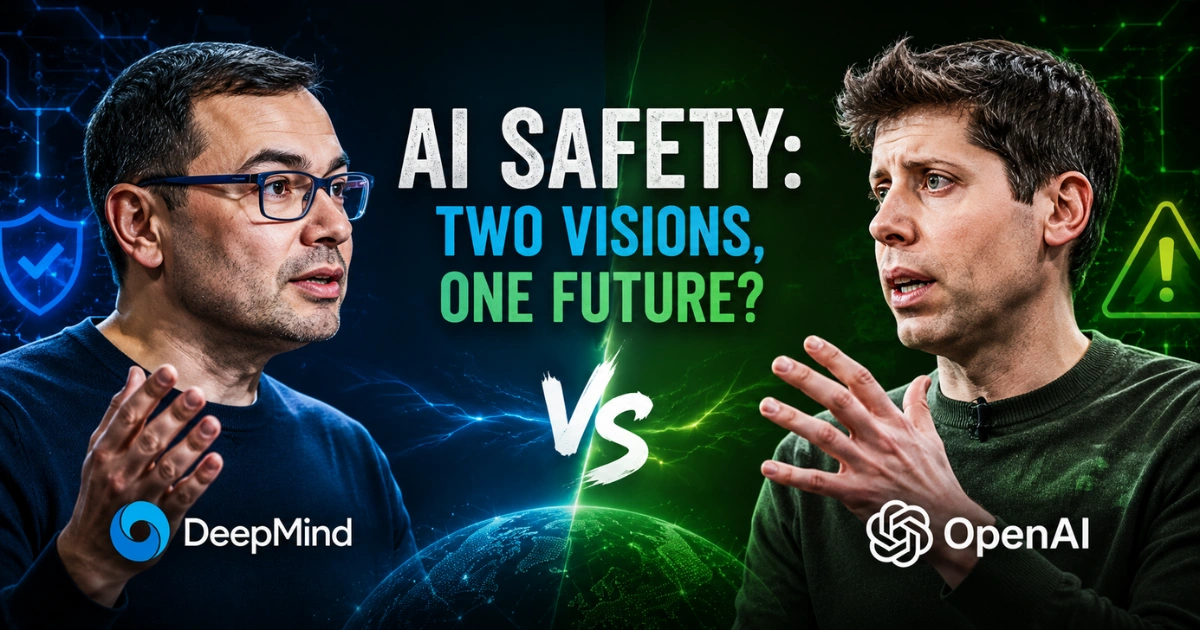

Demis Hassabis published his most detailed regulatory proposal yet on Tuesday, a manifesto titled “A Framework for Frontier AI and the Dawning of a New Age,” posted on X and expanded on in interviews with Axios and The Economist. The timing isn’t incidental.
Over the past several weeks, Washington has informally decided which AI models companies can release and who can access them, without relying on a formal process.
Hassabis wants lawmakers to replace that ad hoc approach with a framework that lasts instead of negotiating each case individually.
What Hassabis is actually proposing
The plan centers on a new “Frontier AI Standards Body” modeled on FINRA, the industry-funded organization that polices Wall Street brokerages under SEC oversight.
Hassabis wants it structured as a federally overseen public-private partnership, funded mostly by industry, with a board mixing independent technical experts, open-source representatives, and government officials.
Frontier labs would initially submit models voluntarily up to 30 days before release for testing on dangerous cyber, biological, nuclear, and deception capabilities, with participation becoming mandatory for US deployment once the system proves itself.
Crucially, Hassabis says the rules should apply to every frontier-class model regardless of country of origin or whether it’s open or closed source.
He’s framed the stakes in sweeping terms, predicting AGI is probably only a few years away and describing the current moment as “the foothills of the singularity,” and wants the body operational before the end of the year.
Why this is really a three-way split, not just Hassabis vs. Altman
The disagreement with Sam Altman is real but narrower than a simple clash. Altman has separately called for an international standards body, describing at the June G7 summit in Évian-les-Bains a forum for globally accepted testing standards built through multilateral cooperation.
Hassabis’s model instead has the US move first and unilaterally, betting that market access alone will pull other countries, including China, into alignment without waiting for a treaty process he considers too slow.
There’s a third position in the mix too: Anthropic CEO Dario Amodei has called for something more forceful than either, an FAA-style federal agency with direct legal authority to block unsafe models from deployment, rather than Hassabis’s industry-funded self-regulatory approach.
Recent events have turned this debate from theory into reality. In June, the Trump administration froze Anthropic’s most advanced models, Fable and Mythos, under an export-control order that cited national security.
The company then spent roughly two and a half weeks negotiating their release without any established rules or playbook. On July 1, the administration restored access.
Around the same time, OpenAI agreed to restrict GPT-5.6 to government-vetted partners at launch to avoid a similar freeze, before releasing it publicly the following week after further negotiation with the Commerce Department.
Hassabis has called the Anthropic episode a wake-up call, evidence that ad hoc intervention without process is now the default, not the exception.
No commitments came out of the June G7 session where this first surfaced among world leaders, and Hassabis is pushing to have his own version running within months regardless.
Whether Washington adopts something resembling his FINRA model, Amodei’s FAA model, Altman’s international forum, or simply keeps regulating one export-control order at a time, is still an open question none of the three men can answer on their own.
Source: The Times of India, "Google AI CEO Demis Hassabis and OpenAI CEO Sam Altman Do Not Agree on How AI Can Be Made Safe"