
The shift toward edge computing in artificial intelligence just took a massive leap forward. The original EmbeddingGemma launched last year. It gave developers a lightweight tool for generating high-quality text embeddings directly on consumer hardware.
This model quietly became a foundational layer for privacy-first Retrieval-Augmented Generation architectures. It racked up over twenty million downloads. Builders clearly needed smarter on-device search without cloud latency.
Now, the landscape is shifting again. We are moving past the constraints of text-only vectorization. Google has officially released EmbeddingGemma 2. This marks a radical expansion. It brings code, images, video, and audio together into a single, unified embedding space.
It is built on the highly capable Gemma 4 architecture. This new iteration is not just an incremental update. It completely reimagines local hardware capabilities. Enterprise-grade semantic search no longer requires massive server farms.
Unifying Modalities on the Edge
The technical foundation of this release is engineered specifically for constrained environments without sacrificing analytical depth. Operating entirely under a commercially permissive Apache 2.0 license, the full multimodal model sits at an incredibly efficient 740 million parameters.
What makes this architecture particularly compelling is its inherent modularity. Developers building text-only workloads can strip the requirement down to a mere 270 million parameters, selectively adding the vision or audio encoders only when necessary for specific application demands.
According to the official announcement detailing the release at Google, this model boasts an expanded 8K token context window. That is quadruple the capacity of its predecessor.
In practical terms, this allows the system to process up to five and a half minutes of audio or dozens of interleaved image and video frames directly on local hardware.
We are looking at a model that can hunt down a specific visual frame from a lengthy video clip or scrub through hours of audio recordings based purely on a semantic text query.
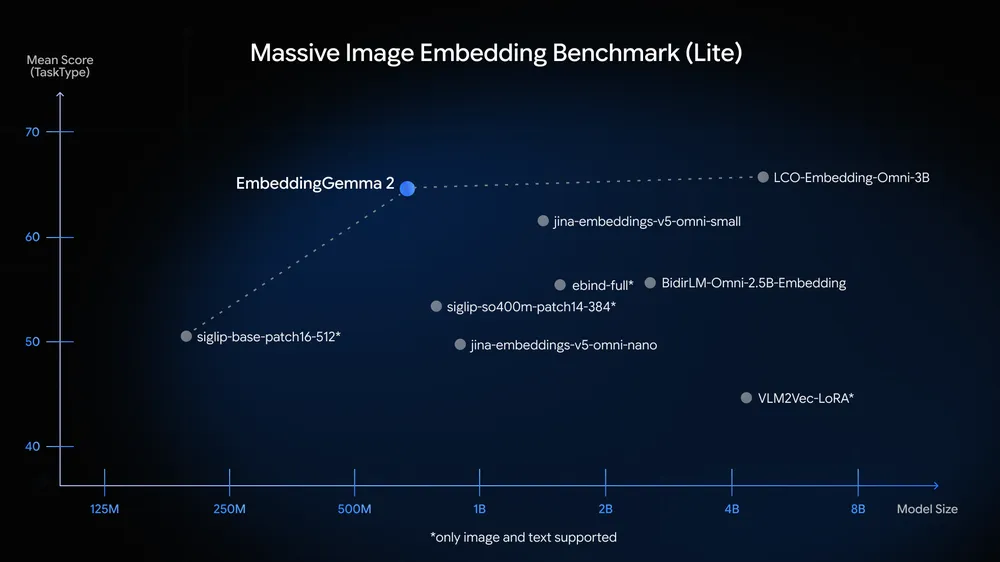
Img source: Google
By matching the multilingual prowess of the original model while delivering nearly a ten-point leap in code performance benchmarks, it sets a completely new standard for local codebase indexing and coding agent retrieval among sub-1B parameter models.
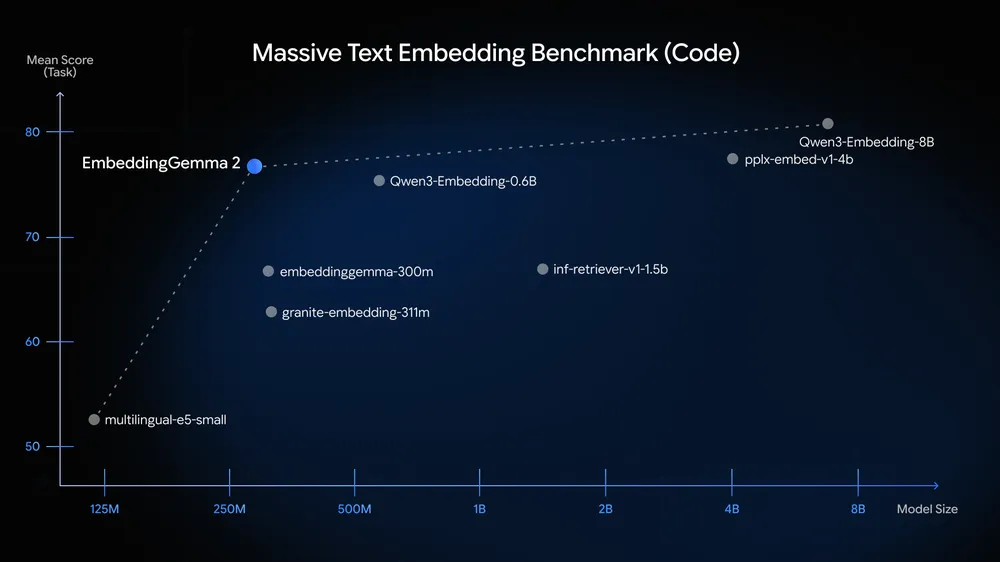
Img source: Google
Redefining Semantic Search Architecture
Bringing this level of robust capability to edge hardware fundamentally alters how developers will approach privacy and data pipeline latency. Processing embeddings locally means sensitive user information never has to leave the device, enabling offline semantic routing that feels instantaneous.
Google tackled the notorious issue of vector storage bloat by implementing Matryoshka Representation Learning, a technique that allows developers to dynamically truncate output vectors.
Instead of being locked into rigid 768-dimension arrays, engineers can scale down to 512, 256, or even 128 dimensions, effectively shrinking local vector database requirements and memory consumption by up to six times.
The optimization for mobile hardware is staggering, requiring just over half a gigabyte of active RAM to run the full multimodal suite on a device like the Pixel 11 Pro. When developers pair this embedder with a generative counterpart like Gemma 4, the efficiency compounds rapidly.
Because they share the exact same text tokenizer and audio encoder, they can operate simultaneously within a unified on-device pipeline.
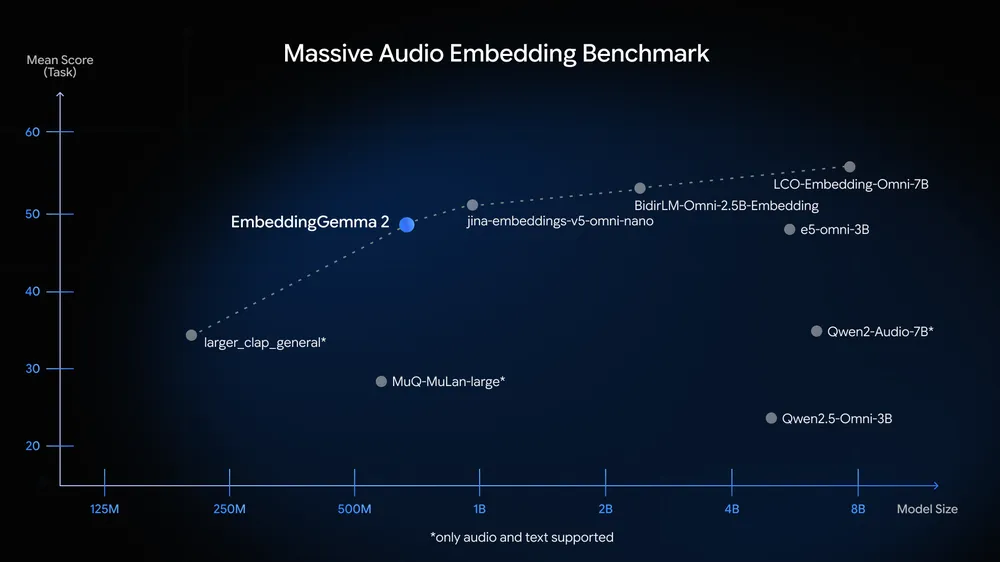
Img source: Google
The resulting ecosystem allows for highly complex, cross-modal data interpretation that runs smoothly on everyday consumer devices, breaking down the final technical barriers between advanced AI research and practical offline software deployment.