

A couple of years ago, education entrepreneur Boris But had a sudden realization. It mirrored the broader sentiment across China’s tech landscape. His clients were wealthy parents planning overseas studies for their children. They walked into his office carrying detailed advice from chatbots, not rival consultants.
He responded pragmatically by building his own AI study tool. He knew that resisting artificial intelligence was a losing battle. This ground-level adaptation reflects a clear national urgency.
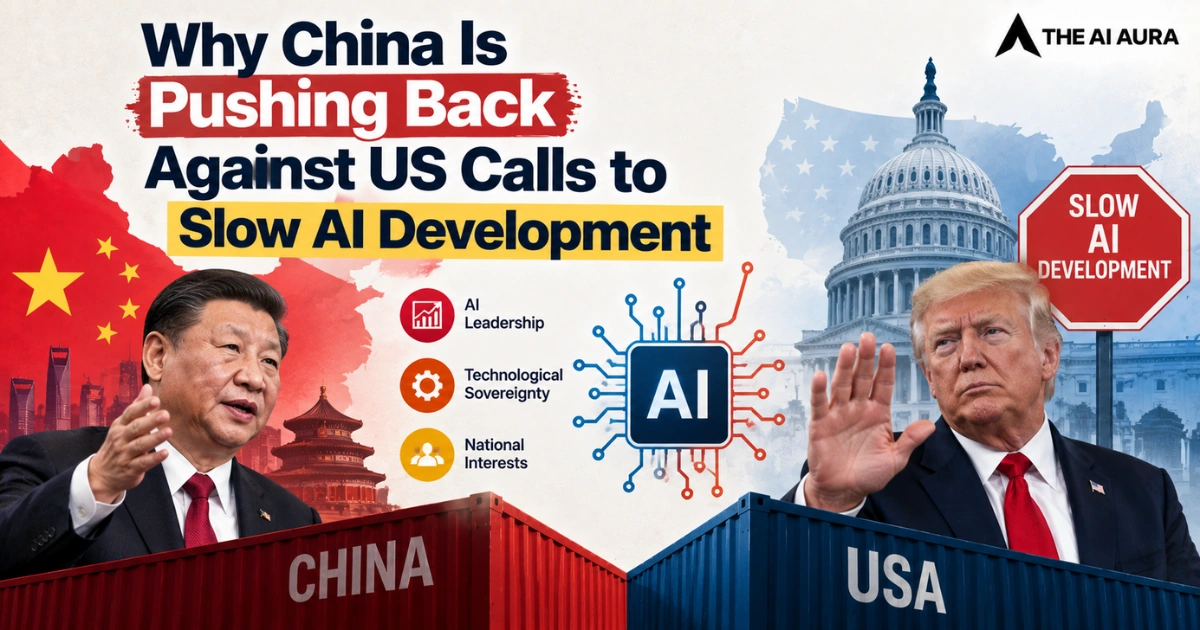
Today, China is the only true peer competitor to the United States in AI. Yet Silicon Valley insiders increasingly sound alarms over existential risks. In contrast, Beijing views American calls to slow down with deep suspicion.
Sovereignty over Slowdowns
Anthropic CEO Dario Amodei recently proposed a coordinated global pacing for cutting-edge AI models. He acknowledged that any real pacing would require Chinese cooperation.
However, he also argued that democracies must maintain a lead over autocracies. To achieve this, he advocated continued export controls on advanced computer chips. For Beijing, artificial intelligence is far more than a commercial market. It represents a core sovereignty capability.
Consequently, Chinese officials view these American appeals for a slowdown less as a genuine safety initiative and more as a strategic maneuver designed to freeze the current US advantage.
According to a recent geopolitical analysis published by the Guardian, China’s foreign ministry quickly dismissed Amodei’s perspective, warning that vicious competition and fearmongering would only destabilize global AI governance.
Despite this diplomatic friction, it would be a mistake to assume Beijing is ignoring the dangers of unchecked AI. The Chinese government is actually highly attuned to the risks, recently releasing the third iteration of its AI safety governance framework.
This updated document directly tackles complex threats like recursive self-improvement and the cybersecurity vulnerabilities posed by autonomous agents.
While American tech leaders debate existential doom and US President Donald Trump dismisses AI extinction fears as a complete hoax ahead of his upcoming meeting with Xi Jinping, China’s regulators are quietly shifting their focus.
They are moving away from merely censoring what an AI says toward strictly controlling what an AI can autonomously do.
Pragmatic Adoption Across the Economy
The Chinese approach represents a delicate balancing act between maintaining rigid political control and unleashing aggressive economic growth.
The ruling Communist party has ensured that domestic AI development remains firmly within state-defined boundaries, utilizing tools like an algorithm registry established back in 2022 and recent regulations aimed at preventing emotional dependency on companion bots.
Because of this centralized authority over digital infrastructure, researchers argue that China might actually be better positioned than the United States to contain a sudden AI disaster.
Simultaneously, artificial intelligence integration is being heavily subsidized and encouraged as a central pillar of the latest Five-Year Plan.
Local governments are offering lucrative incentives to tech startups, while the country’s massive manufacturing base is actively upgrading its factory floors with industrial agent platforms. On the consumer side, daily life is becoming increasingly intertwined with automated systems.
Digital health platforms featuring AI versions of prominent doctors have amassed hundreds of millions of users, thriving in an environment where data privacy concerns take a back seat to technological convenience.
For the average citizen and enterprise in China, AI is not viewed as an abstract threat that needs to be paused. It is seen as an immediate, practical tool that the nation must master to secure its economic future, rendering any prospect of a voluntary slowdown highly unlikely.