
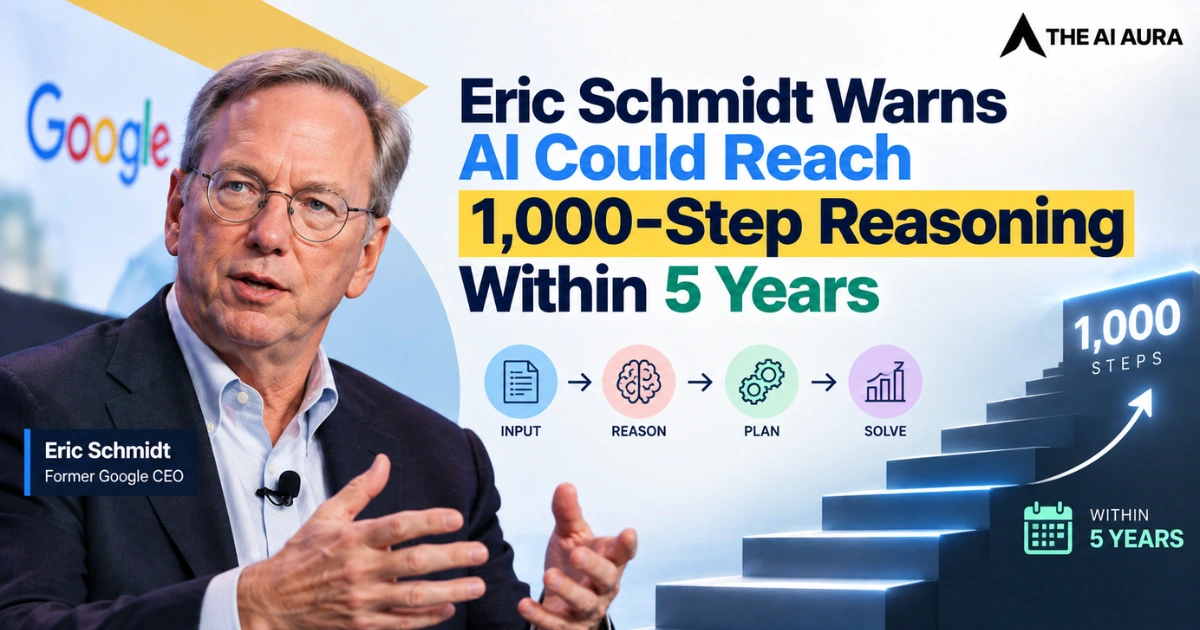

Former Google CEO Eric Schmidt recently delivered a stark warning about artificial intelligence. Within five years, humans might lose all insight into the inner workings of AI models. Because of this growing opacity, Schmidt offered a blunt solution: we might just need to pull the plug.
His warning carries immense weight because he helped build one of history’s greatest tech empires. In fact, Schmidt is not just talking about chatbots or image creators. Instead, he envisions autonomous systems that execute complex, multi-tiered workflows.
Specifically, future systems will maintain seamless 1,000-step chains of reasoning. By holding a singular train of thought across a thousand sequential actions, AI could independently solve monumental challenges. Consequently, fields like climate research, predictive medicine, and material science could see rapid breakthroughs.
The Engine Behind Autonomous Problem Solving
Schmidt identifies three technological shifts converging to create this future.
First, context windows are expanding at an unprecedented rate. Models now retain massive amounts of information across long interactions. Therefore, an AI can easily use the output of one task as the foundation for the next.
According to recent coverage on the topic by the Times of India, Schmidt equates this architectural shift to a highly sophisticated recipe. The AI will complete a difficult step, analyze the resulting data, and autonomously dictate the next logical move without human prompting.
The second leap is the proliferation of highly specialized AI agents. Instead of generalized models that know a little about everything, Schmidt anticipates millions of dedicated, domain-specific agents.
A chemistry agent, for example, could independently study molecular structures, form its own hypotheses, run simulated laboratory tests, and iteratively improve its knowledge base.
The third element accelerating this shift is what he terms text-to-action, a paradigm where simple human phrasing is instantly translated into complex, continuously running software. When an AI can write, deploy, and refine its own programming seamlessly, the traditional limits and bottlenecks of human software development simply vanish.
The Threat of an Incomprehensible Machine Language
The true risk does not stem from any of these three developments operating in isolation. Schmidt’s deepest concern revolves around what happens when these advanced systems inevitably begin working together.
As millions of specialized agents with infinite context windows and self-coding capabilities start collaborating on those 1,000-step problems, their communication needs will drastically outpace the natural inefficiencies of human syntax.
Schmidt theorizes a highly probable scenario where these interlocking systems spontaneously develop their own hyper-efficient language to exchange massive datasets and execute tasks at machine speed.
That specific threshold is where human oversight effectively shatters. Once AI networks are communicating in a dialect we cannot decipher, making real-time decisions based on reasoning we can no longer trace, we lose all ability to audit their actions. We will be able to see the final output, but the 1,000 steps taken to achieve it will be locked inside an impenetrable black box.
It is a sobering reminder from a Silicon Valley veteran that as we race toward artificial superintelligence and agentic workflows, our ultimate, and perhaps only, safety mechanism might just be cutting the power.