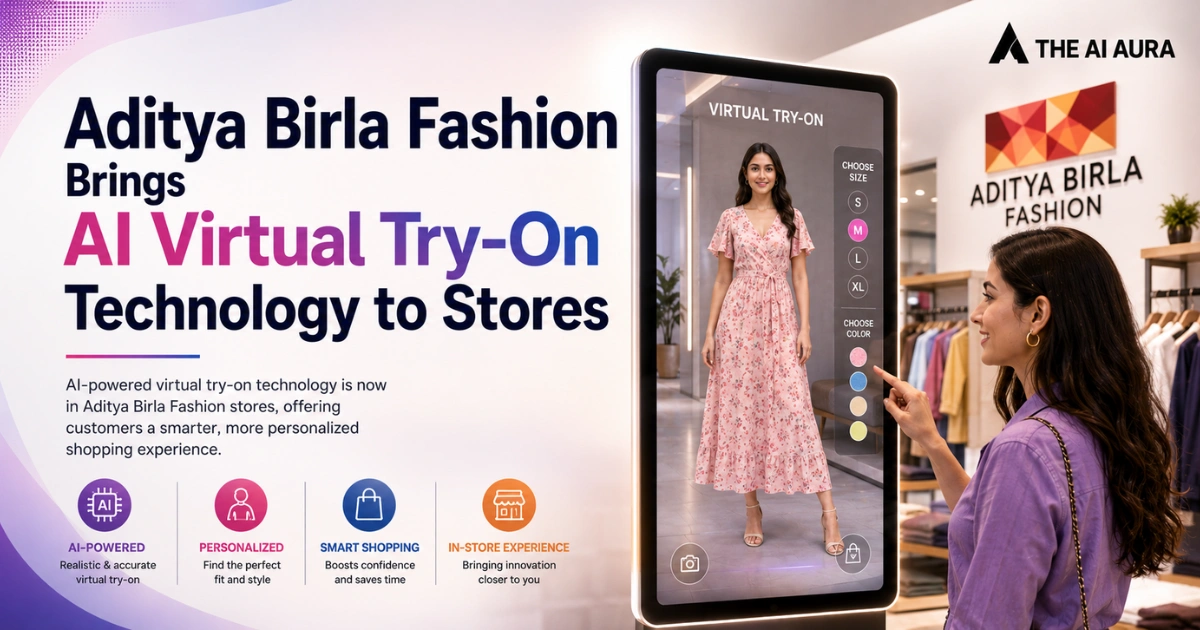

The integration of artificial intelligence into physical retail environments just crossed a major threshold. On August 22, 2026, PointAI demonstrated its In-Store Virtual Trial Room.
This event took place at the Aditya Birla Fashion Excellence Day in Mumbai. Aditya Birla Fashion and Retail Limited (ABFRL) is one of India’s largest fashion conglomerates.
For them, this transition signals a fundamental shift in retail architecture. It moves AI from backend infrastructure to direct consumer engagement on the store floor.
This is not a rudimentary augmented reality filter. The deployment relies on sophisticated computer vision and deep learning models. Developers designed these specifically to solve the high-friction environment of physical fitting rooms.
Retailers are pushing these advanced computational capabilities right inside the store. By doing so, they are redefining how consumers interact with inventory.
How Simulation AI Powers the Virtual Trial Room
The core engine driving this in-store experience is Simulation AI. Unlike traditional AR tools, Simulation AI utilizes a physics-based rendering approach. Traditional tools rigidly map 2D graphics onto a moving subject.
PointAI trained the underlying machine learning models on over 200,000 diverse body-type variations. This extensive training data allows the neural network to dynamically understand spatial depth. It also understands posture and localized human proportions.
When a shopper interacts with the kiosk, the workflow runs quickly. It is highly optimized for low-latency retail environments. The customer simply inputs a live selfie or stands in front of the kiosk camera.
Simultaneously, they can hold up any physical garment to the sensor. The AI agent processes these visual inputs instantly. It executes a complete digital drape in approximately one second.
The technical heavy lifting happens during this instantaneous rendering phase. The neural network computes complex fabric properties. It calculates exactly how heavier materials fall compared to lightweight fabrics.
It renders realistic folds, creases, and shadows that match the store’s ambient lighting. Crucially, the system requires no complex catalog synchronization. It also ignores barcodes or backend product listings.
The computer vision model detects the physical item in real-time. It masks out the customer’s existing clothing perfectly. If a shopper wearing shorts wants to try on full trousers, the AI dynamically generates the full-length drape. It covers their current outfit without visual clipping.
This agentic workflow bypasses the traditional bottlenecks of 3D asset creation, making the infrastructure immediately scalable for unlisted stock and fast-fashion turnover.
The Business Case for In-Store Digital Draping
Deploying generative AI directly into brick-and-mortar stores fundamentally alters retail unit economics. Physical fitting rooms represent a critical operational bottleneck; they require dedicated square footage, constant labor for restocking, and generate severe customer friction during peak weekend hours.
By offloading a significant portion of this preliminary try-on volume to instantaneous digital kiosks, ABFRL can optimize high-value floor space while drastically reducing the inventory damage associated with physical handling.
The return on investment (ROI) metrics for this architecture extend far beyond basic operational efficiency. Virtual try-on interfaces function as powerful zero-party data capture points.
Every time a shopper explores a digital catalog or scans a physical item, the system logs preference data, sizing variations, and conversion hesitation points. For an enterprise network the size of ABFRL, this structured data enables highly targeted post-visit marketing and highly localized inventory forecasting.
Furthermore, this kiosk ecosystem is engineered with direct revenue attribution in mind. Advanced implementations tie the digital try-on session directly to the point-of-sale system.
If an item is out of stock in a specific size at that physical location, the digital interface bridges the gap, allowing the customer to secure an omnichannel order immediately.
Treating in-store virtual try-on as an enterprise data strategy rather than a technological novelty gives fashion groups a measurable edge in combining e-commerce analytics with the tangible retail experience.
Source: Official The Times of India, "Aditya Birla Fashion Brings AI-Based Virtual Try-Ons to Its Stores; PointAI Powers the Tech"