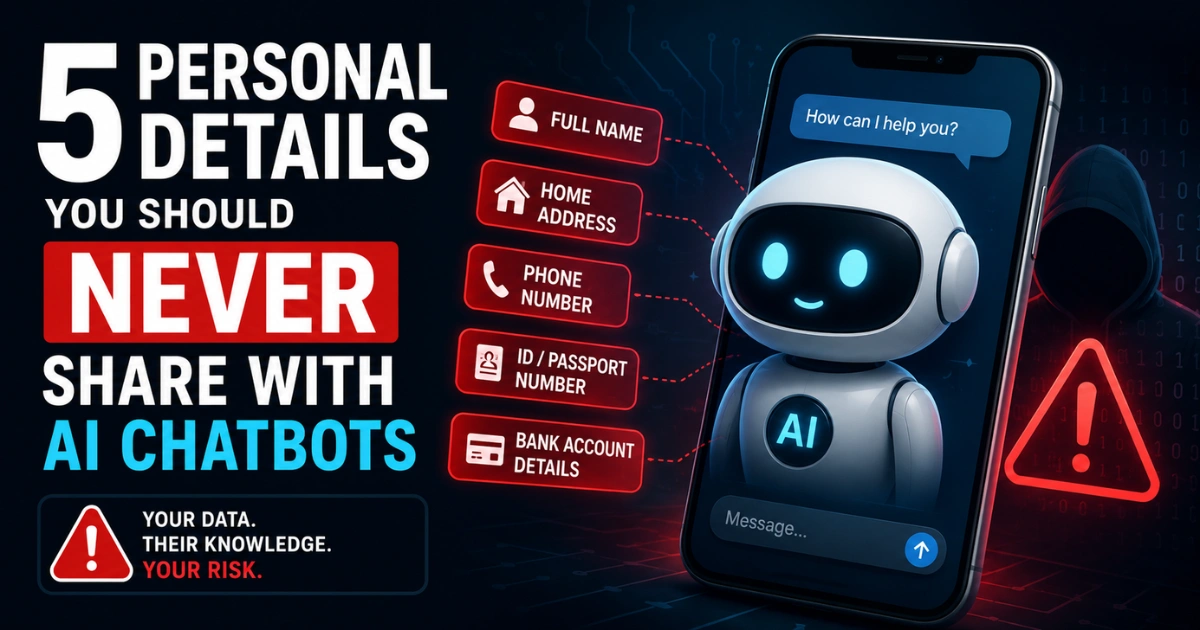

You copy a block of text, paste it into your favorite language model, and hit enter. It has become a modern reflex.
We use AI to summarize dense documents, draft polite emails to frustrating clients, and debug code. But behind that clean, conversational interface is a massive data-processing engine and treating it like a private diary is a massive security risk.
When you feed a prompt into a chatbot, you aren’t whispering into a void. You are transmitting data to corporate servers where it is parsed, logged, and frequently reviewed by human annotators or used to train future iterations of the model.
Oversharing isn’t a minor slip; it is a permanent data handover. Before you hit send, you need to understand exactly how this tech works—and scrub these five specific details from your prompts.
1. Passwords, OTPs, and Authentication Tokens
It sounds obvious, yet the number of developers and users who paste raw error logs containing database passwords or active session tokens is staggering. If an account is locked or a script fails, describe the error code.
Do not paste your PIN, one-time passwords (OTPs), or the answers to your security questions.
AI models process text as mathematical tokens. If your password becomes a token sequence tied to your specific user session, it sits in a server log—often unencrypted in the prompt history—waiting to be exposed if the AI provider suffers a data breach.
2. Unredacted Banking and Financial Data
AI is exceptionally good at turning a messy list of expenses into a categorized spreadsheet. However, it absolutely does not need your raw financial statements to do so.
When users upload unredacted banking PDFs, they hand over account numbers, credit card details, CVVs, and UPI IDs. To get financial analysis safely, you must sanitize the document. Replace your real account number with a placeholder like “ACCT-1” and strip out routing information.
The AI relies entirely on the structural relationship of the data—the debits, credits, and dates—to give you budgeting advice. The actual credentials are dead weight that only compromise your security.
3. Government ID Documents
People frequently use chatbots to translate foreign visa forms, summarize legal terms, or fill out bureaucratic paperwork. In the process, they inadvertently upload photos or text from [Government ID Redacted], PAN cards, passports, and driving licenses.
These documents are the foundation of identity theft. Large language models do not have a selective “forget” button for specific data points once ingested.
If a server is compromised, your unique document numbers, residential address, and date of birth are exposed. Always black out or delete these specific fields before asking an AI to analyze official forms.
4. Confidential Corporate Secrets
Major corporations have actively banned commercial chatbots because employees routinely pasted proprietary code or unreleased financial reports into them.
When you ask an AI to “make this strategy document sound more professional,” you are uploading your company’s intellectual property to a third-party server.
Client details, internal business plans, and raw meeting notes should be thoroughly scrubbed.
Use generic placeholders like [Company X] or [Client Y]. The model understands context and syntax perfectly well without knowing the actual names, margins, or trade secrets involved in your project.
5. Other People’s Private Information
Data privacy isn’t just about protecting yourself. Dumping a messy email thread or a WhatsApp export into a chatbot to “summarize the argument” exposes the names, phone numbers, and private thoughts of everyone in that conversation.
Those individuals did not consent to having their data ingested by a tech company’s algorithm.
If you absolutely must use AI to analyze interpersonal communications, anonymize the names and scrub the contact details first. Respecting the data boundaries of your friends, clients, and colleagues is non-negotiable.
Source: News18, "5 Personal Details You Should Never Share With an AI Chatbot"