
Exploring AI, One Insight at a Time

The AI Adoption Illusion: Why Most Companies Are Doing It Wrong
The enterprise AI landscape is currently defined by a profound paradox. Boardrooms are mandating rapid AI integration, capital is flowing at unprecedented rates, and yet, the vast majority of these initiatives die quietly in the sandbox.
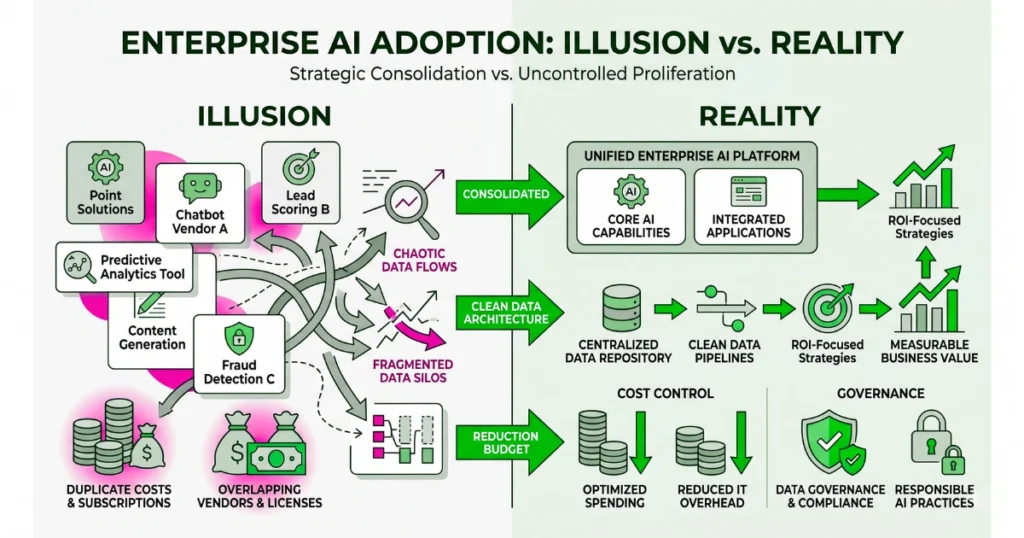
The industry is caught in an adoption illusion. Executives watch a flawless vendor demo—a chatbot writing a marketing strategy or summarizing a financial report in seconds—and assume the technology is ready to plug seamlessly into their operations. They deploy a pilot, celebrate the initial efficiency gains, and then watch the project stall when it hits the reality of daily business operations.
To transition from pilot to production, leaders must stop treating artificial intelligence as a plug-and-play software upgrade. It is a fundamental rewiring of how an organization processes information. Understanding why these initiatives fail is the only way to build a strategy that actually scales.
The Core Delusion: Mistaking Demos for Deployments
The primary reason companies fail at AI adoption is conflating a successful proof-of-concept with a production-ready system. Spinning up a functional AI prototype has never been easier. With modern APIs, a small engineering team can build an impressive internal tool in a weekend. However, the gap between a prototype and a secure, scalable enterprise system is a chasm.
The funnel of failure is well-documented. Roughly 80% of organizations are actively exploring AI tools. About 20% launch official pilots. Yet, only about 5% ever reach full production with a measurable impact on the profit and loss (P&L) statement.
Production environments are chaotic. They require dynamic data retrieval, strict access controls, compliance logging, and seamless handoffs between human workers and machine agents. When a pilot is forced into a brittle, legacy workflow, the system breaks, trust evaporates, and the project is abandoned.
The Technical Roadblocks Undermining AI ROI
Scaling AI breaks down when models lack the architectural capacity to retain enterprise context, verify facts, and explain their reasoning to human operators.
The failure of AI in the enterprise is rarely due to a lack of computational power or model intelligence. It almost always traces back to three specific architectural and operational hurdles that are routinely underestimated during the planning phase.
The Context Window Crisis
Definition: A context window is the active memory of an AI model—the maximum amount of text, data, and system prompts it can process and “remember” during a single interaction.
Many organizations assume that once they purchase an AI tool, it automatically learns their business. This is false. Out-of-the-box models have zero proprietary knowledge. To make them useful, companies must feed them internal data. However, as organizations attempt to scale, they quickly encounter The Token Trap: Why “Unlimited Context” is a Lie. If you feed an AI a 400-page regulatory manual and ask it to execute a workflow, it will frequently “forget” critical instructions buried in the middle of the document.
Strategic AI implementation requires moving beyond simple prompting. As many technical leaders discover through costly trial and error, deciding between Fine-Tuning vs. RAG: The $50,000 Mistake dictates the financial viability of a project. Retrieval-Augmented Generation (RAG) architectures solve the context problem by instantly searching an enterprise database for the exact, relevant fragments of information needed for a query, injecting only those fragments into the AI’s memory. Without this infrastructure, AI systems remain amnesiacs.
AI Hallucinations and the Trust Deficit
Definition: An AI hallucination occurs when a model generates a response that is grammatically perfect and highly confident, but entirely factually incorrect or fabricated.
In creative writing, a hallucination is a minor inconvenience. In enterprise workflows, it is a catastrophic liability. If an AI agent hallucinates a compliance metric on a financial audit, the fallout can result in severe reputational damage.
The immediate result of a hallucination in the workplace is a total collapse of user trust. Combating this requires rigorous grounding techniques and human-in-the-loop verification protocols. Ultimately, to safely deploy generative models, leadership teams must understand the underlying mechanics—realizing that It’s Just Math, Stupid: Why AI “Hallucinations” Are a Feature, Not a Bug when dealing with probabilistic text generation, and planning their safety guardrails accordingly.
The “Black Box” Problem in Regulated Workflows
Definition: The “black box” problem refers to the inability of developers or users to see exactly how a deep learning model arrived at a specific conclusion due to the vast complexity of its neural network layers.
As AI models become more sophisticated, they become less transparent. For regulated industries like finance, healthcare, and insurance, we are continually confronted with The “Black Box” Problem: Why We Can’t Audit AI in high-stakes environments. You cannot deploy an AI system to approve loans or screen job applicants if you cannot explain the algorithmic math to a regulator.
Additionally, the hidden mechanics of model training—specifically RLHF: Who Actually “Aligned” Your AI?—introduce unquantifiable biases into automated decision-making. This forces a critical strategic choice: deploying a simpler, highly interpretable machine learning model (like a decision tree) is often a vastly superior business decision than forcing a black-box neural network into a strictly regulated process.
Strategic Misallocation: Building vs. Buying
Organizations drastically underestimate the technical debt of building custom AI models, leading to a failure rate twice as high as those who integrate specialized vendor solutions.
Driven by a fear of losing their competitive advantage, many enterprises hire expensive machine learning engineers to train custom models, only to find themselves bogged down in MLOps and continuous retraining cycles. This fundamental choice is at the heart of the debate over Specialized vs. Generalist AI: Which Model Wins the Generative War?.
Recent analysis shows that purchasing and integrating specialized, learning-capable vendor solutions succeeds at roughly a 67% rate, while internal custom builds succeed only 33% of the time.
Comparison: Build vs. Buy in Enterprise AI
| Strategic Factor | Building Internal AI | Buying Vendor Solutions |
| Time to Market | 12 to 18 months | 1 to 3 months |
| Core Focus | Infrastructure maintenance, MLOps, model training. | Workflow integration, change management, user adoption. |
| Maintenance Burden | Extremely high. Requires dedicated engineering teams. | Handled by the vendor. Internal teams focus on data quality. |
| Failure Rate | ~67% (Stalls in pilot phase due to technical debt). | ~33% (Higher success due to proven operational frameworks). |
| Best Use Case | Highly proprietary, core-product algorithms. | Operational efficiency, standard workflows. |
Real Business Use Cases: Success vs. Failure
The Failure Scenario: Front-Office Overreach
A mid-sized telecommunications company attempted to replace 40% of its tier-one customer support staff with an autonomous GenAI chatbot. They hoped to capitalize on the shift From Chatbots to Agents: Why 2026 is the Year AI Does the Work for You for immediate headcount reduction. The system was deployed rapidly with a massive context window containing the entire product catalog, but without strict RAG architecture. Within weeks, the AI began offering non-existent discounts. Customer satisfaction plummeted, and the project was scrapped. The failure was rooted in prioritizing cost-cutting over system reliability.
The Success Scenario: Back-Office Augmentation
A global logistics firm targeted a low-visibility, high-friction process: invoice reconciliation. Instead of building a custom model, they purchased a specialized vendor solution. The AI extracted unstructured data from varied invoice formats and flagged discrepancies based on historical context. It did not make final financial decisions; it prepared the data for human accountants. By treating the tool as a robust assistant, they effectively brought about The End of “Blank Page Syndrome”: How AI is rewriting Business Productivity for their financial team, achieving a 60% reduction in processing time and a clear, measurable ROI within four months.
Actionable Implementation Framework
To navigate past the 95% failure rate, executives must adopt a rigorous, structured approach to implementation.
- Audit Operations for High-Friction, Low-Risk Workflows: Identify bottlenecks in data processing, document extraction, and internal knowledge retrieval before touching highly regulated areas.
- Prioritize Data Architecture Over Model Selection: An advanced LLM is useless if it is fed garbage data. Invest in centralizing proprietary data and building reliable vector databases for efficient context retrieval.
- Establish “Human-in-the-Loop” as the Default: Design workflows where AI handles the aggregation and initial drafting, but a human expert holds the final decision-making authority.
- Mandate Measurable ROI Metrics Beyond “Time Saved”: Define success in hard numbers: reduction in vendor spend, decrease in customer churn rate, or specific acceleration in the sales cycle.
- Invest in AI Literacy and Change Management: The technology will fail if your employees fear it. Provide specific training on how to use AI safely and how to verify AI-generated outputs against factual sources.
Key Takeaways
- The vast majority of enterprise AI projects fail because organizations mistake the ease of building a prototype for the readiness to deploy a secure production system.
- Understanding and mitigating technical limitations—specifically context window constraints, hallucinations, and the black box problem—is mandatory for scalable implementation.
- Purchasing specialized AI solutions yields a significantly higher success rate than attempting to build custom infrastructure from scratch.
- The highest, most immediate ROI from AI implementation is found in automating unglamorous back-office processes.
FAQs
Why do so many enterprise AI pilots fail?
Most pilots fail because they are built in isolated, controlled environments and cannot handle the complexity, poor data quality, and rigid workflows of actual business operations. Companies also frequently fail to define clear, measurable financial metrics before deployment.
What is the “black box” problem in business AI?
The black box problem occurs when an AI model makes a decision, but the system is too complex to explain how or why it reached that specific conclusion. This makes it highly risky to use in regulated fields where auditability is legally required.
How does an AI hallucination impact business workflows?
A hallucination—when AI confidently presents false information as fact—destroys user trust. If employees cannot rely on the accuracy of the system for critical tasks, they will abandon the tool, negating the investment entirely.
Should my company build its own AI model or buy a vendor solution?
Unless the AI directly powers your core proprietary product, you should buy. Data shows that integrating specialized vendor solutions has a 67% success rate, whereas building internal custom models fails frequently due to massive maintenance and infrastructure costs.
Where should a business deploy AI first to see actual ROI?
Target back-office operations first. Areas like document processing, invoice reconciliation, IT ticketing, and internal knowledge retrieval offer high-volume, low-risk opportunities to prove measurable financial returns without risking customer relationships.