Exploring AI, One Insight at a Time

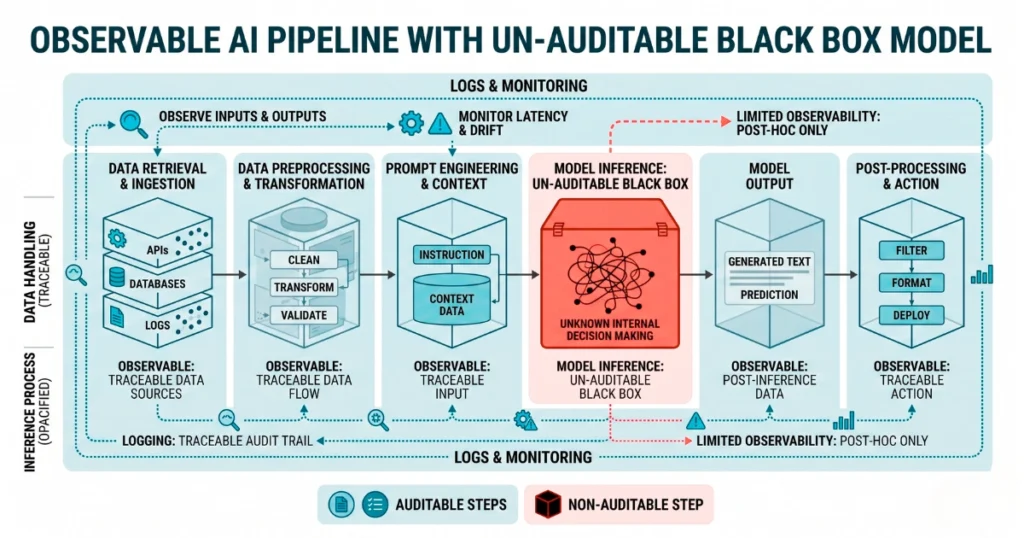
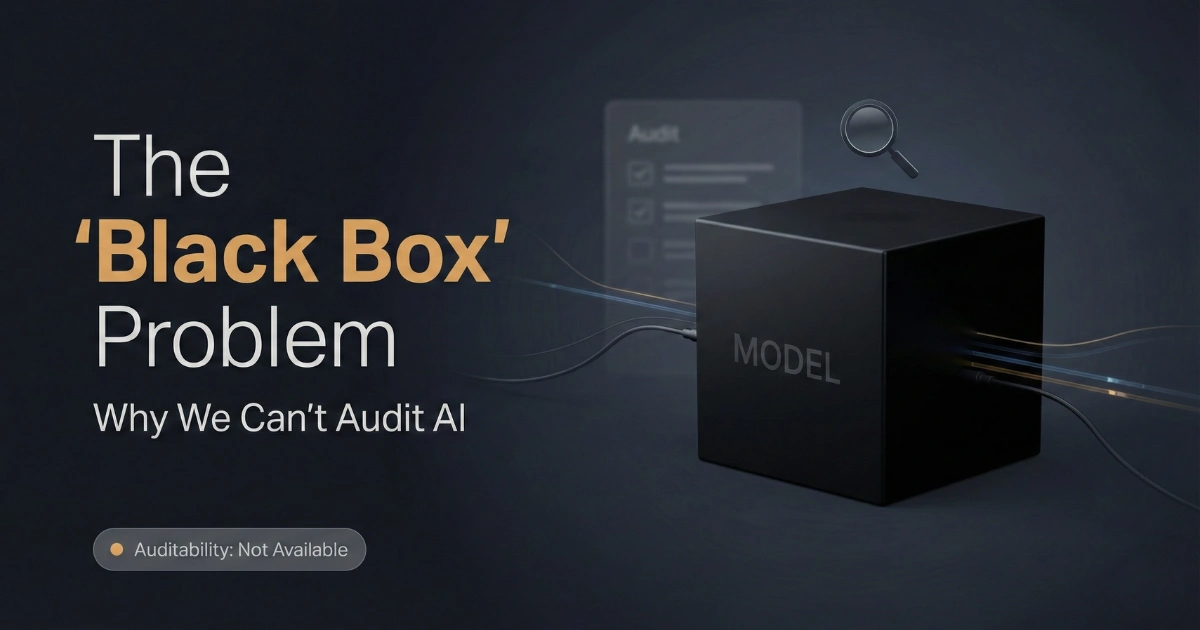
The “Black Box” Problem: Why We Can’t Audit AI
Executive Summary
- The Core Issue: Modern AI models are probabilistic, not deterministic. We cannot trace their logic like traditional software code.
- The Reality: “Auditing” an LLM is effectively impossible in the strict sense. We can test outputs, but we cannot guarantee internal reasoning.
- The Trade-off: The “Black Box” problem is the cost of high-performance AI. We sacrificed explainability for capability.
- The Fix: Current “Red Teaming” is insufficient. The future lies in Mechanistic Interpretability—reverse-engineering the “neurons” of the model.
If you’ve ever tried to debug a neural network, you know the specific flavor of existential dread I’m talking about.
In traditional software development—the world we lived in for the last fifty years—code was deterministic. If a banking app crashed, you could trace the stack, find the line where a null pointer exception occurred, and fix it. The logic was transparent: If A, then B.
But when I first started digging into the outputs of large language models (LLMs) a few years back, I realized that the “debugging” toolset I had relied on for a decade was useless. I wasn’t looking at logic trees; I was staring at a matrix of floating-point numbers that somehow, through sheer statistical force, added up to a sentence.
This is the “Black Box” problem. It isn’t just a buzzword used by regulators to sound important. It is the fundamental architectural reality of deep learning, and it is the single biggest hurdle to trusting AI in high-stakes environments.
We have built a god, but we have no idea how it thinks.
The Death of Deterministic Logic
To understand why we can’t audit AI, you have to understand what we actually built.
We didn’t write the rules for Claude 3.5 Sonnet or ChatGPT-4o. We wrote an architecture—a skeleton—and then fed it the internet. The model “learned” by adjusting billions (or trillions) of internal parameters (weights) to minimize the difference between its guess and the actual data.
The resulting software isn’t a list of instructions. It’s a dense, multidimensional web of mathematical relationships.
How AI Decision-Making Differs from Code
When an AI denies a loan application or misdiagnoses a tumor, there is no specific line of code that says: if (income < 50000) return DENY. Instead, the decision is the aggregate result of a billion micro-calculations firing in a pattern that correlates with “denial.”
Here is the ugly truth: The engineers who built the model cannot tell you exactly why it made that specific decision. They can tell you the probability distribution. They can show you the attention weights. But they cannot point to the “logic.” This probabilistic nature is also why “errors” aren’t bugs in the traditional sense; often, AI “hallucinations” are actually a feature, not a bug—a byproduct of how the math works.
The “Saliency Map” Illusion (And Why It failed)
A few years ago, the industry pinned its hopes on Explainable AI (XAI). The most common tool was the saliency map—those heatmaps you see overlaid on images, showing which pixels the AI focused on.
If an AI classified a photo as a “Wolf,” the saliency map would highlight the animal’s face. Great, we thought. It’s looking at the snout.
Then, researchers started adversarial testing. They found that in many cases, the AI was actually classifying the image as “Wolf” because of the snow in the background. It had learned that wolves are usually photographed in snow.
The saliency map was a comfort blanket. It gave us the illusion of understanding, but it didn’t reveal the causal mechanism. We were looking at symptoms, not the disease.
Why Traditional Audits Fail for Generative AI
I talk to enterprise CTOs who are desperate to deploy GenAI but are terrified of the compliance implications. They ask, “How do we audit this?”
The answer usually makes them uncomfortable: You don’t audit the model; you audit the vibe.
In traditional software, an audit looks like this:
- Review source code for vulnerabilities.
- Verify logical paths for consistency.
- Ensure 100% reproducibility.
In AI, those three pillars crumble.
- Source code: The training code is simple. The model weights are the software, and they are unreadable to humans.
- Logical paths: There are no discrete paths, only activation patterns.
- Reproducibility: Most LLMs are non-deterministic by design.
We have moved from Structural Auditing (checking the bridge’s blueprints) to Behavioral Auditing (driving a truck over the bridge and seeing if it collapses).
The “Red Teaming” Trap
So, how does the industry “audit” right now? We use Red Teaming. We hire smart people to scream at the AI, trick it, and try to make it generate hate speech or build a bomb.
If the AI resists, we call it “safe.”
This is akin to testing a car’s brakes by driving it around the block a few times. If it doesn’t crash, you assume the brakes work. But you haven’t actually inspected the brake pads.
A Contrarian View: Maybe We Shouldn’t Want Transparency
Here is an opinion that might get me kicked out of the next ethics conference: Demanding full transparency might be the wrong goal.
There is a trade-off in deep learning between Interpretability and Performance.
- Linear Regression is 100% interpretable. You can see exactly how much the “Square Footage” variable affects the “House Price” prediction. But it’s limited.
- Deep Neural Networks are 0% interpretable (intuitively), but they are incredibly capable.
If we force AI to be fully explainable—to operate using logic we can audit—we effectively lobotomize it. The power of AI is precisely that it can find patterns too complex for us to hold in our heads. If you want an AI that can cure cancer, you might have to accept that you won’t understand how it figured out the protein folding.
The Future: Mechanistic Interpretability
Is it hopeless? Not entirely. There is a small, obsessive sub-field of AI research called Mechanistic Interpretability.
Think of this as neuroscience for AIs. Instead of treating the model as a black box, researchers are trying to reverse-engineer what individual neurons and layers are actually doing.
Anthropic recently made a breakthrough here, mapping specific patterns of neuron activations to concepts. They are trying to decompose the “soup” of weights into a “dictionary” of features. This is the only path forward. We need to build MRI machines for LLMs.
Surviving the Black Box Era: 3 Steps for Devs
For now, if you are a founder or a dev building on top of these models, you need to be realistic.
- Stop promising “accuracy.” You cannot guarantee it. Instead, focus on workflows where the AI acts as an agent that assists rather than decides—a shift we are seeing as we move from chatbots to agents in 2026.
- Keep a Human in the Loop (HITL). Since you can’t audit the process, you must audit the output.
- Use “Grounding” aggressively. Don’t let the model rely on its internal training data or its context window, which can be unreliable (often called The Token Trap). Instead, force it to use Retrieval Augmented Generation (RAG) so you can at least see which documents it referenced, avoiding the costly mistake of trying to fine-tune knowledge into the model itself.
The Black Box problem isn’t going away. It is the price of admission for the intelligence revolution. We have traded certainty for magic. Just make sure you know that’s the deal you signed.
FAQ
1. Can’t we just look at the code to see why AI made a mistake?
No. Modern AI isn’t programmed with explicit rules like “If X, do Y.” It uses billions of numerical parameters. “Looking at the code” just shows you the mathematical architecture (the factory), not the decision-making pathways (the product).
2. Will AI ever be fully explainable?
Likely not in the way humans understand “explanation.” We may develop better tools to visualize its internal state (like Mechanistic Interpretability), but the complexity of a trillion-parameter model exceeds human cognitive bandwidth.
3. Is open-source AI safer because we can audit it?
Not necessarily. Open source allows you to inspect the weights, but as mentioned, the weights are just numbers. You can run the model locally and test it without limits (which is a form of auditing), but having the file on your hard drive doesn’t mean you understand its internal psychology any better than a closed model.