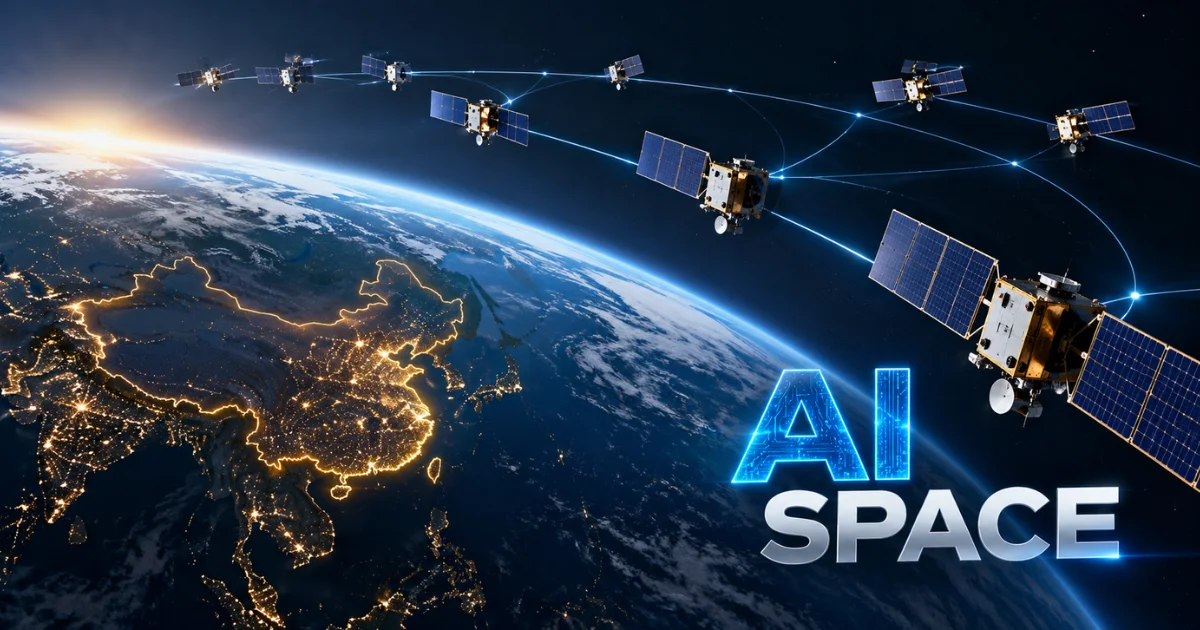

For decades, artificial intelligence in space operations remained heavily anchored to Earth. Satellites captured massive volumes of raw observation data. Then, they beamed it down through narrow communication windows. Ground-based data centers finally analyzed everything.
Today, that traditional architecture is undergoing a radical shift. Chinese aerospace firm ADA Space recently deployed eight specialized computing satellites. Consequently, this marks a defining moment in orbital infrastructure. The industry is moving closer to a reality where data centers live directly in space.
A commercial Zhuque-2E Y4 rocket launched the spacecraft from the Dongfeng space innovation pilot zone. These platforms are far from standard observation tools. In fact, they represent the leading edge of ADA Space’s “Star Compute” initiative.
This ambitious project will blanket the Earth with a constellation of 2,800 AI computing satellites. Furthermore, the mission pushes orbital capabilities beyond basic inference. It aims to train foundation models directly in orbit.
Bringing Foundation Models to Orbit
Operating artificial intelligence models in space fundamentally eliminates the latency and bandwidth bottlenecks that have historically plagued satellite networks. By processing complex calculations directly at the edge, these satellites can analyze data instantly and make autonomous decisions without relying on a constant tether to ground control.
The newly launched batch is specifically tasked with establishing a high-speed, interconnected orbital network using advanced laser communications. This technology will eventually allow multiple spacecraft to pool their processing power, effectively functioning as a distributed, floating supercomputer.
According to a mission report detailing the technical specifications at Global times, this deployment builds on an aggressive development timeline over the past year.
Following the successful integration of the Qwen3 large language model on earlier hardware, engineers have already proven that space-based AI can directly control intelligent agents down on Earth mirroring the terrestrial shift seen in From Chatbots to Agents: Why 2026 is the Year AI Does the Work for You.
The overarching ambition here extends beyond managing space-generated telemetry. By dedicating 2,400 satellites to AI inference and 400 specifically to heavy-duty AI training, the program aims to offer a robust alternative computing infrastructure for terrestrial applications, reducing global reliance on ground-based server farms.
Overcoming the Orbital Heat Barrier
Putting high-performance computing payloads into orbit introduces a brutal physics problem. Down on Earth, sprawling data centers rely on ambient air circulation and massive mechanical cooling systems to keep server racks from melting. In the near vacuum of low Earth orbit, there is no air to carry the heat away.
The only way to cool high-end electronics is through thermal radiation, which requires entirely different hardware architectures a major consideration for teams examining How to Reduce AI Latency: Faster Responses for Scalable AI Apps (2026 Guide) while managing edge compute constraints.
To solve this, the eight new satellites are serving as critical testbeds for next-generation thermal management. They are equipped with a cutting-edge 10-kilowatt-class liquid cooling system paired with massive deployable radiator panels. Managing the immense thermal output of AI processing units is arguably the single biggest technical hurdle to scaling orbital computing.
If these in-orbit cooling experiments prove successful, they will validate the hardware needed to deploy the first thousand commercial computing satellites before the end of the decade.
The rapid cadence of these missions is just as notable as the payloads themselves. This launch occurred a mere month after a previous Zhuque-2E mission by Lands pace, signaling a highly standardized, parallel production approach taking root in the commercial aerospace sector.
As the global race for satellite internet and orbital computing accelerates, the ability to launch power-hungry and thermally complex payloads on a recurring, reliable schedule will dictate who leads the next era of computing. The hardware is now active in orbit, and the engineering data gathered over the coming months will determine exactly how fast this space-based network can scale.