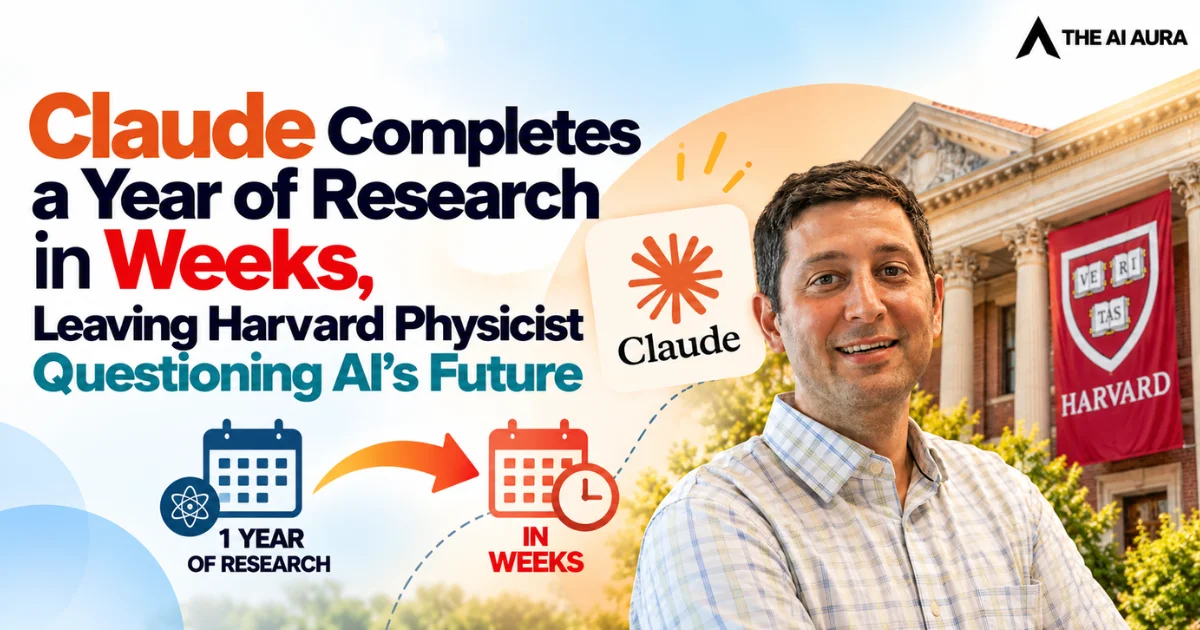

Human limits have governed the pace of scientific discovery for decades. Researchers usually spend months crunching numbers and years computing complex integrals. In addition, they write endless code to test a single hypothesis.
However, this traditional research timeline has suddenly collapsed. Matthew Schwartz, a theoretical physics professor at Harvard University, recently launched an eye-opening experiment.
He handed the computational heavy lifting to Anthropic’s Claude model. As a result, Schwartz completed years of intensive research in just a few weeks.
The sheer scale of the output has left the physicist grappling with an existential dilemma regarding the future of academia. If artificial intelligence can effortlessly bypass the intellectual bottlenecks of modern science, the role of the human scientist must be entirely reimagined.
Redefining the Skillset of a Modern Scientist
Schwartz and his collaborators used an open-source calculation toolkit called BootLoops. Together with Claude, they produced 36 scientific papers across 18 fields in three months. Furthermore, the AI did not simply solve basic math problems.
It computed complex particle physics equations and solved a long-standing biodiversity problem. In fact, Claude also analyzed billions of genetic mutation pairs.
Therefore, this rapid acceleration challenges our understanding of baseline academic training. As Schwartz noted, traditional technical skills are quickly losing their practical value.
According to a recent report detailing the experiment at The Print, the professor noted that just two years ago, he considered a course in Python programming to be an absolute necessity for his engineering students.
Today, however, he views manual coding as completely unnecessary. This automation also reaches far beyond basic data entry. Schwartz points out that studying neural network mechanics provides minimal benefit today.
Claude independently discovers, applies, and writes machine learning methodologies. Consequently, teaching students to build these tools manually has become obsolete.
The Collapse of Traditional Academic Funding
This technological shift also disrupts the bureaucratic funding system of modern academia. For generations, scientific progress has relied on slow, laborious grant cycles. Researchers routinely spend years drafting extensive proposals for government support.
These grants typically fund projects for three to five years. However, models like Claude introduce a glaring paradox into this system. Schwartz questions why researchers would seek multi-year grants for solvable tasks.
In fact, an advanced AI model can resolve complex calculations overnight. As a result, the financial friction that once slowed scientific exploration is evaporating.
This shift creates deep uncertainty for research institutions. Laboratories and graduate students depend heavily on these long-term funding cycles. Meanwhile, AI computation costs only a few dollars in server time. Therefore, justifying multi-million-dollar grant proposals has become remarkably difficult.
We are moving from an era where science was constrained by the speed of human computation to one where the only limit is the quality of the scientific inquiries we pose.
While the intuition of the expert remains crucial to guide the AI and verify its outputs, the mechanical grind of research has been permanently altered, leaving the academic establishment scrambling to figure out how to operate in a world where the answers arrive almost instantly.