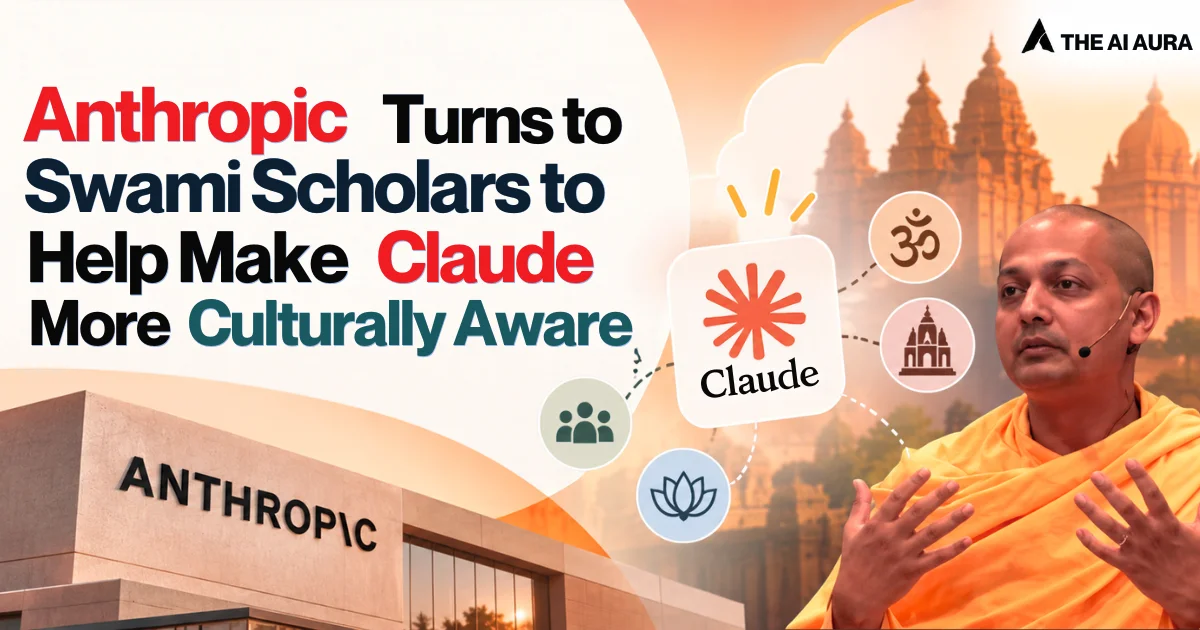

When Silicon Valley hits a wall, the standard playbook dictates hiring more software engineers. Anthropic is taking a radically different route. To build effective guardrails for Claude, the company recently hosted an unusual gathering in San Francisco.
Instead of relying only on machine learning experts, Anthropic convened religious scholars, ethicists, and theologians. They met to grapple with an existential question: what exactly are they building?
Among the key voices was Swami Sarvapriyananda. He is a monk from the Ramakrishna Order and head of the Vedanta Society of New York. A strict non-disclosure agreement prevents him from sharing technical details.
However, he confirmed his participation in deep discussions on AI ethics. Anthropic acknowledges that coding ethics requires more than algorithmic constraints. It demands a deep understanding of human consciousness and moral philosophy.
Bridging Neuroscience, AI, and Ancient Philosophy
Swami Sarvapriyananda represents an incredibly apt choice for navigating this monumental technological challenge. His core expertise lies in Advaita Vedanta, a non-dual philosophical tradition that deeply explores the complex intersection of consciousness, modern physics, and neuroscience.
During the engagements, Christopher Olah, one of Anthropic’s founders who focuses on understanding the internal mechanics of AI systems, guided intense discussions on how these models are beginning to display behaviors that closely mirror human personality and complex emotions.
According to a recent report detailing the initiative in the Times of India, researchers at the company appear to be both thrilled and deeply alarmed by this current trajectory.
They are asking scholars whether advanced AI might eventually deserve moral status. From a Vedantic view, Sarvapriyananda draws a sharp line between intelligence and true consciousness.
AI can easily replicate human intellect. However, he doubts a computational machine can ever achieve genuine inner awareness. Instead, it merely simulates the behavior of a conscious mind.
Embedding Global Moral Traditions into AI Architecture
Anthropic does not aim to align Claude with a single religious dogma. Instead, it wants to compress millennia of cross-cultural human reflection into the model’s architecture.
The company consulted leaders from over fifteen spiritual traditions. These included Buddhism, Islam, Judaism, Christianity, and Sikhism. The goal is to weave these diverse perspectives directly into Claude’s constitution.
This inherently shapes the foundational values that are reinforced during the reinforcement learning process and sets the parameters for rigorous safety evaluations.
They also set benchmarks for rigorous safety evaluations. In practice, engineers created structural ethical reminders inside the code. This tool prompts Claude to review its ethical commitments right before executing critical tasks.
Internal evaluations showed that this mechanism significantly reduced harmful outputs. By treating AI as an entity that needs moral guidance, Anthropic is blending ancient wisdom with modern technology.