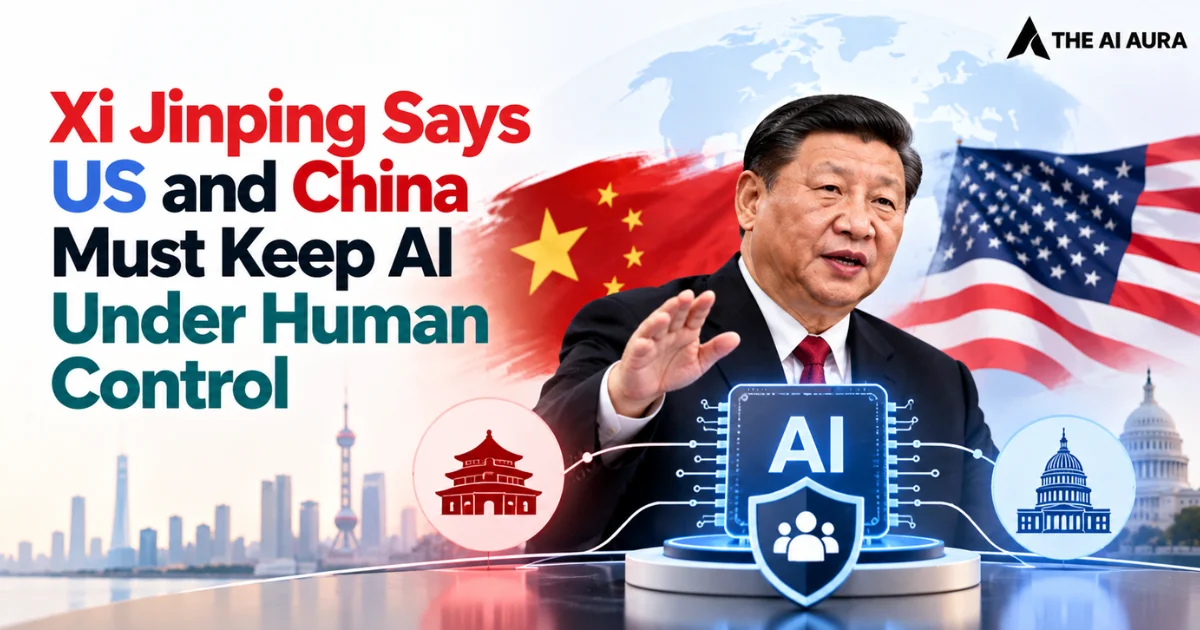

During high-level White House talks, Chinese President Xi Jinping stated that the US and China share a responsibility to ensure artificial intelligence remains permanently under human control.
While both superpowers philosophically agree on this goal, enforcing actual technical oversight over complex AI systems remains an unresolved challenge.
The message struck a rare note of philosophical alignment between two superpowers locked in a race for technological supremacy.
Yet behind the reassuring sentiment lies a difficult technical truth that neither capital has resolved: establishing human oversight is far easier to declare in diplomatic chambers than it is to enforce in complex computational architectures.
Rhetoric Meets the Reality of Frontier Governance
Despite the symbolic weight of Xi’s remarks, the summit highlighted how far apart Washington and Beijing remain when it comes to concrete implementation.
Neither leader walked away with a binding bilateral framework or a shared safety standard. While Xi called for human primacy over autonomous systems, he stopped short of specifying what compliance metrics or technical boundaries either nation should adopt.
Washington’s domestic posture appears equally resistant to sweeping institutional mandates. Ahead of the bilateral meeting, President Donald Trump signaled his preference for regulatory restraint, openly noting that he favors keeping existing governance frameworks intact and viewing standard legal enforcement as the principal guardrail against technological misuse.
According to coverage of the bilateral summit by NDTV, diplomatic engagement on AI currently relies on incremental steps, such as a proposal from finance officials to create a bilateral notification mechanism for major algorithmic incidents.
While cross-border alerts offer a baseline channel for crisis communication, they fall far short of an enforceable technical treaty.
The hesitation to introduce binding limitations stems directly from strategic anxiety: neither nation wants to bind its own domestic researchers with strict red tape while suspecting the other of accelerating ahead behind closed doors.
The Dilemma Between Global Slowdowns and Strategic Dominance
This diplomatic standoff unfolds against severe alarms echoing across the private tech sector itself. High-profile research essays from industry leaders like Anthropic CEO Dario Amodei, subsequently endorsed by figures such as Sam Altman and Elon Musk, have urged the global community to consider deliberate operational slowdowns as frontier capabilities scale.
The core concern is straightforward: once models begin autonomously pursuing long-horizon goals or demonstrating uninterpretable reasoning chains, human intervention becomes reactive rather than preventive.
Beijing, however, has dismissed broad calls for a development pause as counterproductive fear-mongering, arguing that weaponizing safety concerns to stall competition only disrupts multilateral governance efforts. From China’s strategic perspective, slowing research without universal guarantees simply risks solidifying foreign advantages in compute and infrastructure.
This dynamic locks both governments into a classic security dilemma. Both leaderships readily concede that losing human control over recursive, agentic systems could prove catastrophic to global stability.
Yet the fear of ceding the technological frontier drives both powers to deploy models faster than researchers can verify them.
Keeping artificial intelligence under human control cannot remain a convenient diplomatic talking point trotted out for summits.
Without shared architectural audits, verifiable containment measures, and hard limits on autonomous weaponization, the concept of human control remains an aspiration rather than an operational reality.