
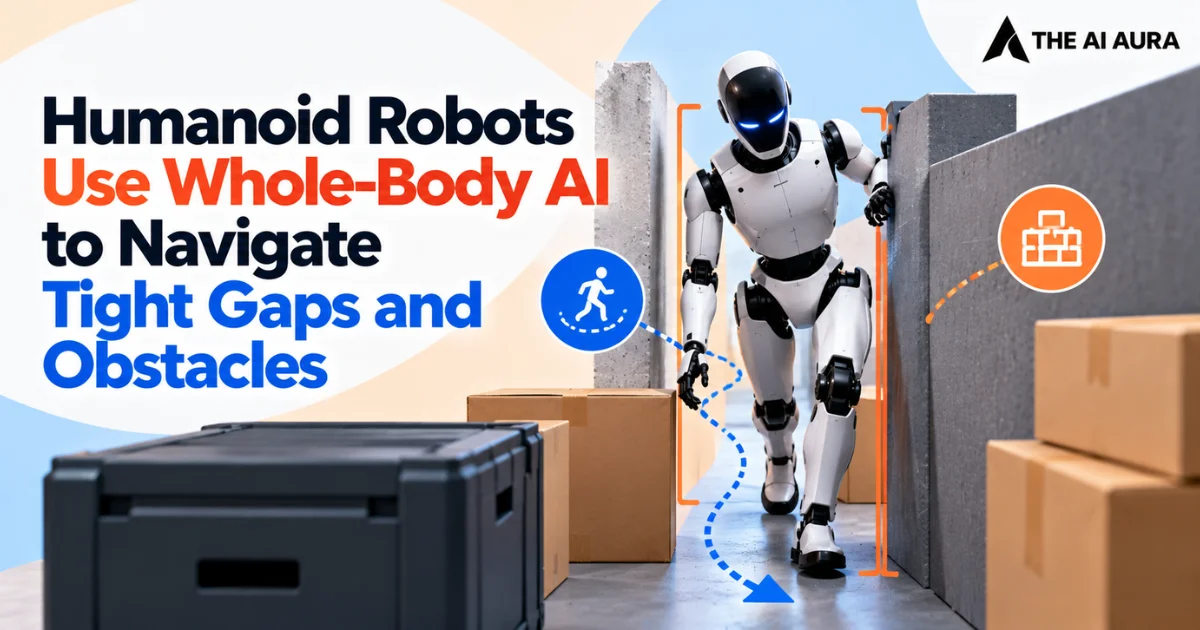

For decades, the robotics industry treated navigating machines like advanced shopping carts. Traditional research draws a flat two-dimensional route on a map. It then commands a wheeled base to follow that line.
This abstraction works perfectly for warehouse rovers or robotic vacuums. However, it completely breaks down for humanoid robots. A humanoid is a tall, wide, and articulated system. Its physical footprint constantly shifts as it walks or bends. A robot cannot safely pass through a narrow doorway blindly.
It must factor in the position of its own elbows. Researchers from UC Berkeley and Princeton University recognized this issue. They developed a groundbreaking new framework.
They rethought the fundamental relationship between a machine and its environment. Now, they are teaching humanoids to understand their own physical dimensions.
Moving Beyond Two-Dimensional Path Planning
Robots frequently failed by wedging themselves into impossible gaps. To solve this, the team engineered TANGO. This is an artificial intelligence vision-language navigation framework. It actively predicts how the robotic body must contort safely.
According to a recent detailed report by Tech Xplore on the technology, this shifts the computational burden away from basic steering commands and directly into complex joint space reasoning.
The system ingests a natural language prompt. For example, you can ask it to walk past boxes. It uses this alongside standard visual data. This data comes from forward-facing and downward-facing RGB cameras.
From there, a sophisticated three-layer architecture takes over. First, a vision-language model evaluates the physical scene against the given instruction. Second, an action expert utilizes flow-matching to instantly generate real-time choreography for the humanoid.
Finally, a motion tracker executes these commands rapidly. It moves all twenty-nine joints at two hundred hertz. The AI does not tell the robot to simply drive forward. It commands it to tuck in its arms or turn sideways.
It might even tell it to crouch beneath an obstacle. The framework integrates the entire body into the navigation problem. This avoids sending commands devoid of spatial context to lower-level controllers.
Synthetic Training and Zero-Shot Physical Application
Training an AI for high-level spatial maneuvering needs vast data. Capturing this motion data physically is slow and difficult. The researchers constructed a synthetic data pipeline to bypass this. They dubbed this new system Plan-Edit-Track. It operates entirely within a physics simulator.
The system maps a safe route through a cluttered environment. It deliberately edits the walking motion to include necessary behaviors. This includes stepping over debris or squeezing through tight corridors.
It then discards any simulation that results in a collision. This automated approach yielded thousands of verified robotic trajectories quickly. It required a fraction of the time of physical data collection. This provided the rich dataset necessary to train the TANGO model.
The researchers deployed their software on a physical Unitree G1. This provided the most compelling proof of their methodology. The physical machine demonstrated remarkable zero-shot transfer capabilities.
It navigated heavily cluttered office routes successfully. It did this without any prior real-world training data. The robot autonomously sidestepped tight passages. It also adjusted its posture for vertical clearance.
This dropped collision rates significantly compared to modular baselines. Those older baselines relied on heavier, expensive LiDAR sensors. Researchers then restricted the model to predict flat two-dimensional paths.
The physical success rate plummeted from over fifty percent. It dropped to less than thirty percent. Reasoning across all physical joints is the core success mechanism.
Future iterations aim to evolve beyond simply avoiding obstacles. They want to achieve active physical interaction and loco manipulation. Humanoids will seamlessly move obstructions out of their path. They will no longer just squeeze past them.