
The manufacturing sector has spent the last decade drowning in Industry 4.0 buzzwords. Predictive maintenance, digital twins, and autonomous robotics sound fantastic in boardroom pitch decks, but deploying them on a live, high-stakes factory floor carries massive operational risk.
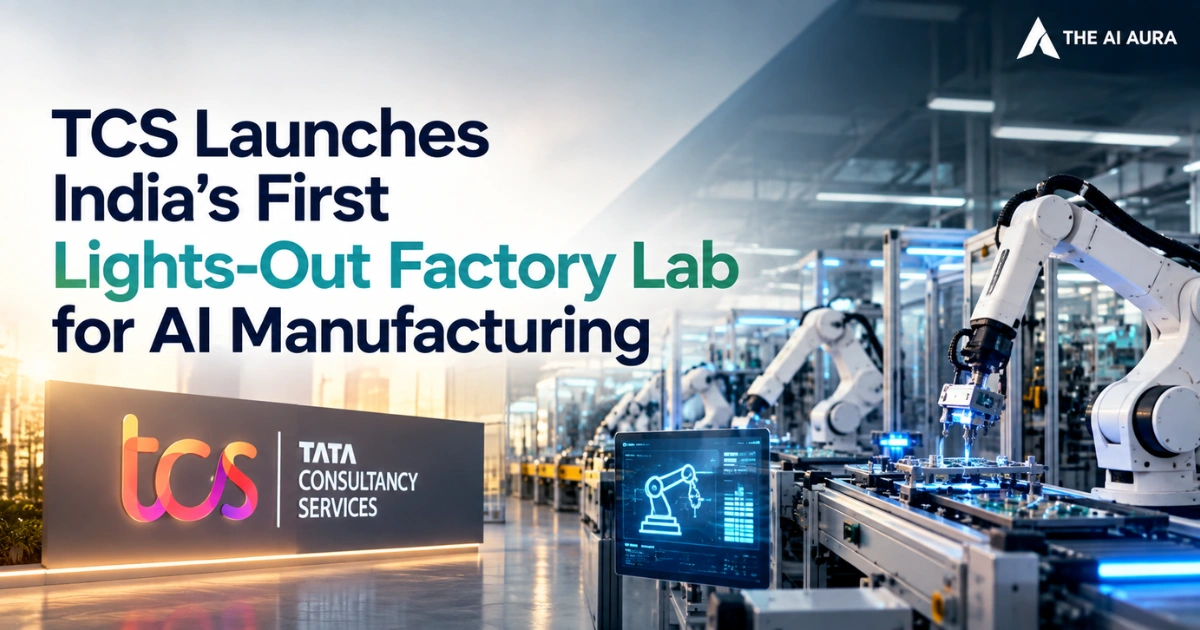
Tata Consultancy Services (TCS) is aiming to bridge this exact gap. The technology giant recently opened the TCS Industrial Autonomy & Engineering Lab – Lights-Out Factory at its Sahyadri Park campus in Pune.
As India’s first facility dedicated to fully autonomous manufacturing, it provides a crucial sandbox for enterprises trying to figure out how AI actually scales in heavy industry without disrupting their current output.
Translating AI Theory into Live Operations
A “lights-out” factory is exactly what it sounds like: a manufacturing unit that operates with such minimal human intervention that the lights can literally be turned off while machines run the floor.
Reaching that level of autonomy, however, is incredibly complex. To prove it works, TCS has built a live, multi-stage robotic battery pack assembly line in Pune to serve as a tangible proving ground.
Instead of isolated automation where a single robot arm does one repetitive task this lab integrates the entire production lifecycle. Manufacturers are constantly under pressure to optimize operations and stay agile, but they cannot afford to break existing workflows to test new software.
By simulating self-optimizing factory operations, enterprise clients can test the TCS Human+AI Service Autonomy Model in a risk-free setting.
Sreenivasa Chakravarti, TCS’s Global Head of Industrial Autonomy and Engineering, emphasized that the goal is to reimagine legacy environments and build AI-first production systems.
Clients get to deliberately test edge cases, prototype industrial scenarios, and validate their operational return on investment before attempting a live factory deployment.
This drastically reduces the friction of adopting advanced tech a critical hurdle that industry leaders like SKF note is central to the next wave of reliable, energy-efficient manufacturing.
The Core Tech Powering Autonomous Manufacturing
Behind the robotic assembly line in Pune is a deeply integrated technology stack that moves far beyond basic industrial automation. The facility is essentially a physical manifestation of software-defined engineering.
It connects raw, shop-floor physical signals with edge and cloud computing to enable real-time, context-aware decisions without a human supervisor pulling a lever.
The lab leans heavily on digital twin technology. Before a physical robot even moves, virtual models run exhaustive simulations to validate the production scenario. Once physical production starts, Vision AI and machine perception take over.
These systems execute automated quality inspections and dynamically adjust adaptive workflows on the fly. This sensor-to-cloud intelligence means the factory continuously learns and evolves through AI-driven data loops.
This Pune facility is a strategic expansion of TCS’s industrial footprint, following the recent launch of their Bengaluru AI lab powered by NVIDIA.
Together, these investments signal a major shift in how we approach enterprise modernization. We are moving past the era where artificial intelligence merely analyzes historical data on a dashboard.
In the lights-out model, AI actively commands the physical machinery, manages anomalies in real-time, and drives continuous, autonomous production.
Source: Official TCS, "TCS Launches India’s First Lights-Out Factory Lab to Advance AI-First Manufacturing"