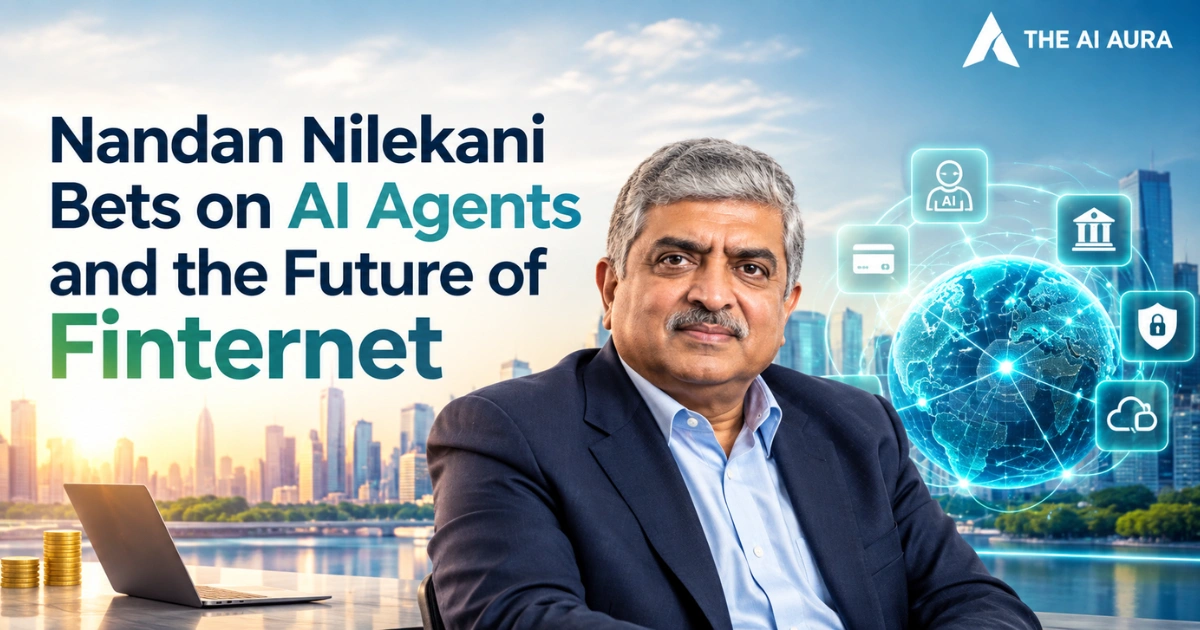

When Nandan Nilekani outlines a new trajectory for financial technology, the market pays attention.
Having helped architect India’s foundational digital public infrastructure from universal digital identity rails to the Unified Payments Interface (UPI) Nilekani’s focus has now shifted toward what the Bank for International Settlements calls the “Finternet.”
This next evolution converges real-world asset tokenization with autonomous AI agents. The objective is practical: dismantle the structural friction that prevents small businesses from unlocking liquidity and accessing formal credit at population scale.
Tokenizing Real-World Assets to Unlock Trapped Capital
The core engine of the Finternet is tokenization. In other words, it converts rights to physical or financial assets into verifiable digital tokens. These tokens then operate across open, interoperable networks.
Historically, borrowing against illiquid assets has been difficult. Pledging land parcels, inventory, or machinery requires heavy physical audits and long title inspections. In addition, weeks of underwriting overhead slow down the process. Therefore, this friction disproportionately penalizes micro-enterprises. If an asset cannot be verified quickly, the borrower loses access to institutional liquidity.
State-level implementations are already moving into statutory frameworks. For example, Maharashtra is introducing the DELTA (Digitisation and Exchange of Land Token Asset) Act. This framework builds the legal foundation to tokenize land and immovable property.
In practice, a farmer or merchant can pledge fractional portions of digital title deeds. They can use this collateral for short-term working capital. Because settlement happens programmatically across networks, counterparty risk shrinks. As a result, lenders can disburse credit against real-world assets without manual due diligence.
Autonomous AI Agents and the Micro-Merchant Economy
While tokenization establishes the programmable ledger, AI agents provide the operational execution layer. In Nilekani’s framework, economic growth cannot depend solely on tech conglomerates that automate to compress headcount; sustainable job creation requires millions of self-sustaining micro-enterprises.
For high-volume, low-margin lending to work for these businesses, the marginal servicing cost must collapse.
Agentic AI addresses this bottleneck. Unlike static algorithms or traditional rule engines, autonomous software agents can interpret intent, analyze non-traditional cash-flow indicators, and automate loan monitoring in real time.
As State Bank of India chairman CS Setty noted during the Global Fintech Fest, while developing agentic frameworks requires high fixed upfront investment, the incremental operating cost per transaction approaches zero.
This operational efficiency directly changes front-end market dynamics:
- Voice-Driven Financial Interfaces: As an estimated 150 to 200 million users in India migrate from legacy feature phones to entry-level smartphones, voice-native AI agents dismantle literacy barriers, executing balance queries, invoicing, and invoice financing via conversational vernacular interfaces.
- Autonomous Back-Office Operations: Modern payment platforms already resolve over 90% of routine queries and automate the vast majority of fraud workflows using machine learning models. Moving to agentic workflows allows routine regulatory reporting, risk verification, and compliance checks to run autonomously.
The Finternet represents a shift from simple peer-to-peer payment routing to the autonomous orchestration of value.
By layering intelligent software agents on top of tokenized real-world property, the ecosystem aims to turn idle assets into verifiable, programmable collateral giving small merchants the capital velocity previously reserved for corporate treasuries.
Source: Moneycontrol, "Cows, Loans, AI Agents: Nandan Nilekani’s Next Finternet Bet, Advent’s Role in OP Bhatt’s Coforge Ouster and More"