
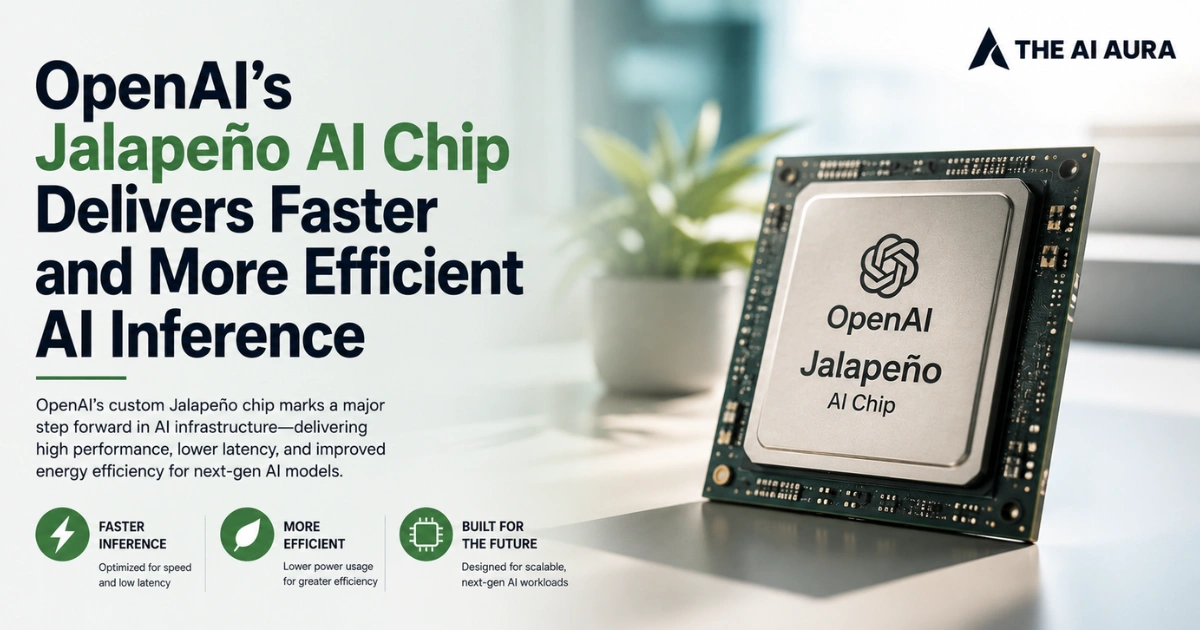

For years, a stubborn compromise defined the AI hardware landscape. You could process a massive volume of requests efficiently.
Alternatively, you could process a single request blazingly fast. You had to pick one. OpenAI’s first custom silicon, the Jalapeño AI chip, erases this fundamental tradeoff.
As someone who tracks AI infrastructure and the severe bottlenecks of serving massive models at scale, I see Jalapeño as much more than a cost-saving measure for ChatGPT.
It is a heavily researched architectural pivot designed specifically for the impending era of autonomous AI agents.
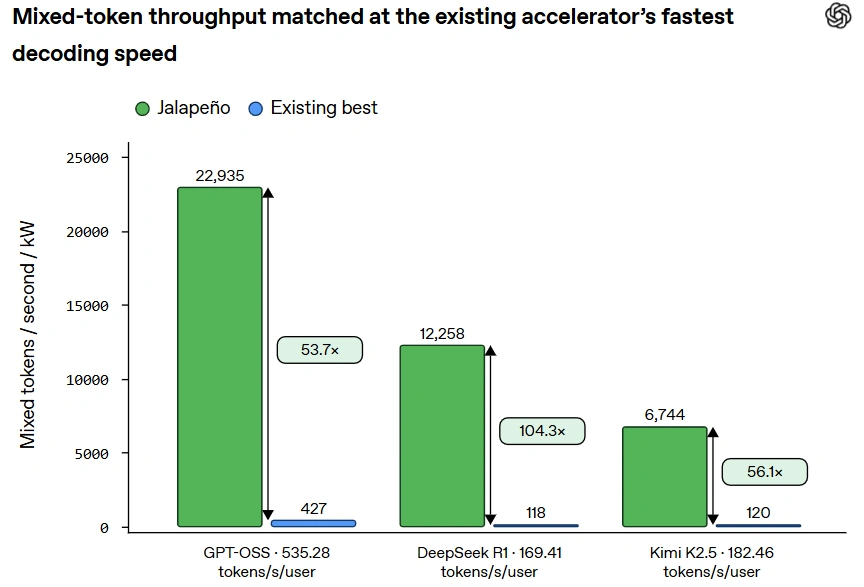
The raw numbers reflect a massive leap. When tested against existing commercial hardware on public benchmarks like SemiAnalysis’s InferenceX, Jalapeño pushes 1.5 to 1.9 times more AI work per watt while slashing end-to-end latency by up to 3.6 times.
But the real story isn’t found in a simple benchmark flex; it lies in the structural philosophy behind the silicon and how it fundamentally changes AI inference.
Architecting for the Agentic Era
Jalapeño gains its mechanical advantage by focusing on the unique lifecycle of language model inference. Traditional hardware often chokes as an AI query shifts between operational phases.
The initial “prefill” stage absorbs and processes your prompt. This stage requires intense compute power. Next, the “decode” stage generates the response token by token.
Memory bandwidth heavily limits this second stage. Older architectures move data across separate cores between these phases. This transfer leaves valuable processing units sitting idle.
OpenAI solved this by designing the chip, memory, networking, and serving software as a single, tightly integrated stack.
By aggressively minimizing data movement and explicitly keeping the model state (specifically the KV cache) local, Jalapeño stops wasting clock cycles waiting for data transfers. The network itself is an integral domain rather than an external bridge, keeping the entire workload within one connected system.
This hardware design is critical for interactive, agentic workloads. When an AI agent has to complete dozens of sequential steps to execute a complex task, a slight delay in each step compounds into a massive, user-frustrating lag. Jalapeño eliminates this friction by excelling at both prefill and decode dynamically.
It establishes a new standard on the Pareto frontier, operating efficiently at a measured 550 watts despite a 700-watt rating, all while delivering up to 4.1 times higher performance for highly interactive tasks.
The Meta-Shift: AI Designing Its Own Engine
Jalapeño’s development also represents a fascinating self-referential loop. OpenAI used its own AI models to design the hardware that runs them.
By leaning on earlier models, the engineering team took the chip from design to tapeout in just nine months. AI helped shorten verification loops and optimize arithmetic circuits to pack maximum compute into the die.
Today, OpenAI uses frontier models like GPT-Astra and Codex to write custom software kernels. Engineers built Jalapeño with a predictable structure for parallel programming.
Because of this, AI systems can map and schedule tasks across the hardware with ease. In internal tests, AI-written kernel implementations ran up to 1.8 times faster than human-coded versions.
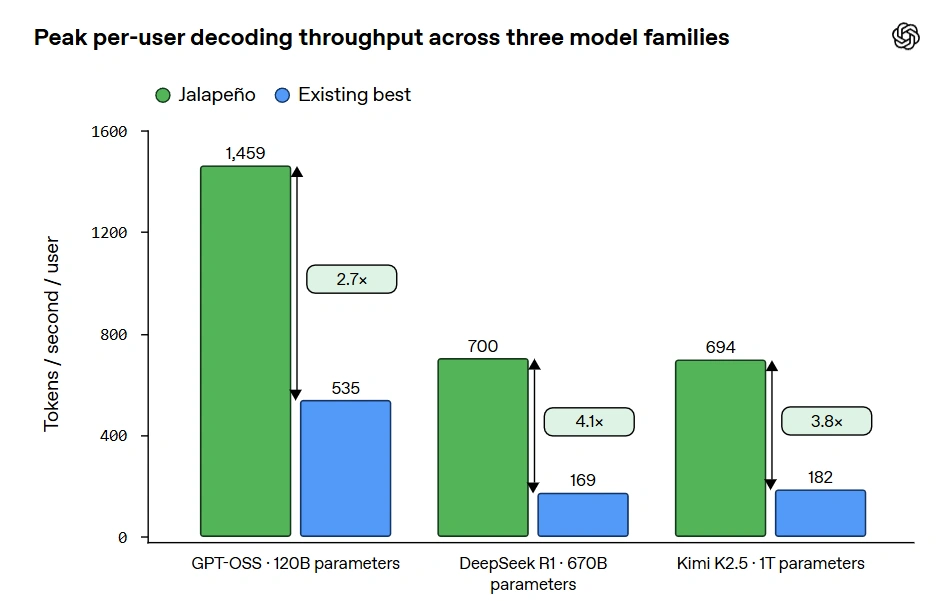
Importantly, OpenAI did not build a closed garden. Benchmark testing shows this efficiency gains extend directly to open-weight models like DeepSeek R1 and Kimi K2.5. OpenAI will deploy Jalapeño later this year alongside NVIDIA hardware. This milestone starts a new era where AI actively builds and optimizes its own physical infrastructure.
Source: Official OpenAI, "Jalapeño’s First Results Show Industry-Leading Speed and Efficiency in AI Inference"