
For the last three years, the tech industry has been holding its breath, waiting for the seismic economic shockwave promised by OpenAI. Sam Altman has consistently been the loudest voice in the room, setting a high-speed countdown to radical disruption.
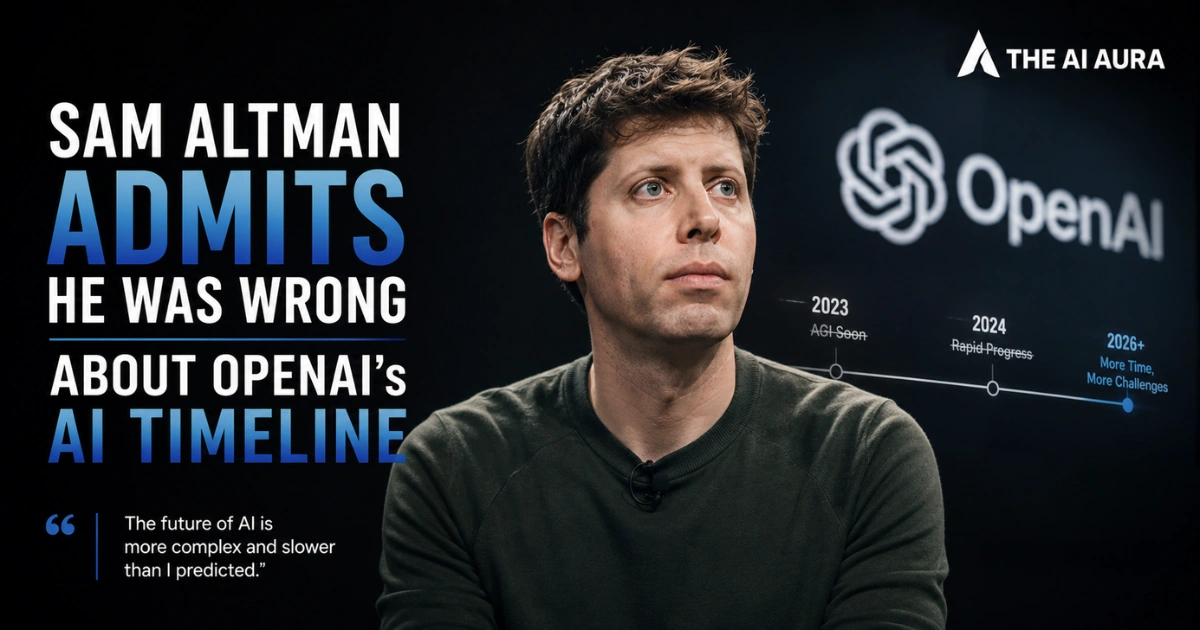
But in a remarkably candid moment on David Senra’s podcast, the OpenAI chief executive admitted what enterprise software veterans have known all along: he miscalculated the clock.
“I thought when we got to GPT-4, which was back in 2023, that very quickly after that there was going to be much more disruption,” Altman confessed. He originally envisioned legacy software businesses being gutted and rebuilt almost overnight.
Instead, the revolution looks more like a slow, bureaucratic integration. The core issue isn’t that the underlying technology failed to deliver on its cognitive promises. According to Altman, the ultimate bottleneck is us.
Why the AI Revolution Stalled at the Office Door
If you want to understand why artificial general intelligence (AGI) isn’t doing your job yet, look closely at how businesses actually operate.
Altman correctly identified that the global economy possesses massive, unyielding inertia. Organizations do not just rip and replace their entire operational infrastructure because a highly capable neural network drops on a Tuesday.
People are creatures of habit. They keep renewing contracts with the same vendors, utilizing the same legacy tools, and clinging to familiar workflows. Altman framed this stubborn human resistance as an unexpected blessing, noting that it will ultimately make the inevitable transition “smoother and slower.”
He stated plainly, “Even with this incredible technology, society and the economy will adapt more slowly.”
This admission is a stark departure from the aggressive roadmaps he was publishing just months prior. In his January 2025 essay Reflections, he boldly claimed AI agents would join the workforce and drastically alter corporate output by the end of the year.
By June, his Gentle Singularity manifesto laid out a meticulous schedule: cognitive agents in 2025, novel insights by 2026, and physical robotics by 2027. Yet, the real-world economy barely flinched.
The grand vision collided directly with the mundane reality of enterprise sales cycles, compliance reviews, and employee training programs.
The Billion-Dollar Pivot to Patience
The quiet shifting of the AGI goalposts from 2025 to 2030 isn’t happening in a vacuum; it aligns perfectly with OpenAI’s shifting financial realities. The company is currently sitting on a valuation nearing $500 billion, yet it reportedly bled $5 billion against $3.7 billion in revenue recently.
Actual profitability isn’t expected until at least 2029. Furthermore, their complex partnership with Microsoft reportedly ties the contractual achievement of AGI to a staggering $100 billion profit threshold.
Every time Altman revises the timeline backward, it acts as a dual-purpose signal: resetting public expectations while subtly managing investor anxiety.
Interestingly, the rest of the AI industry is looking at Altman’s revelation with a collective shrug. Rival executives have been aggressively tempering expectations for years. Microsoft’s AI chief Mustafa Suleyman has consistently warned that the uncertainty around AGI is too high for categorical declarations.
Yann LeCun of Meta regularly reminds the public that AGI won’t arrive as a single, dramatic switch-flip.
DeepMind’s Demis Hassabis puts human-level reasoning at least a decade away, while Andrew Ng has practically begged the market to ignore claims of imminent AGI.
Now, the artificial intelligence race finds its chief accelerationist actively preaching patience.
Altman claims he is thankful for the delay, pivoting his narrative from an overnight societal upending to a measured, multi-year integration. The models might still work exactly as he hoped, but the humans tasked with using them are taking their time.
Source: The Times of India, "Sam Altman Admits He's Been 'Very Wrong' on the Timeline That He Always Says Is the Goal of OpenAI"