
Most tech fortunes are built on a straight line: a visionary idea, relentless execution, and an eventual public offering.
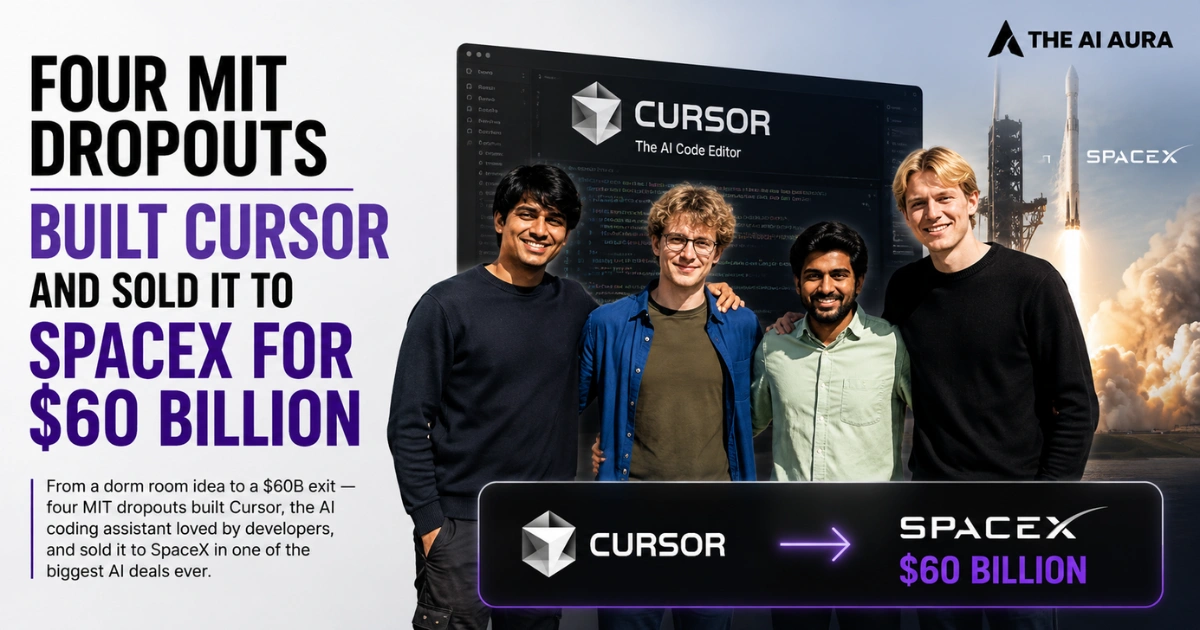
The story of Cursor, however, shatters that conventional mold. In August 2026, SpaceX acquired Anysphere the parent company of the AI coding assistant Cursor in an all-stock transaction valued at a staggering $60 billion.
This landmark deal turned four former Massachusetts Institute of Technology students into multi-billionaires before any of them hit their late twenties. But Michael Truell, Aman Sanger, Sualeh Asif, and Arvid Lunnemark did not strike gold on their first attempt.
Instead, their rapid ascent reveals a masterclass in market timing, radical product pivots, and a deep understanding of how artificial intelligence is fundamentally rewiring the software industry.
The Pivot That Redefined AI Software Development
When the four MIT dropouts launched Anysphere in 2022, they actively avoided the software engineering space. Assuming the market for developer tools was already too saturated by heavyweights, they focused their early efforts on building an AI copilot tailored specifically for mechanical engineers.
The traction simply wasn’t there. Recognizing the dead end early, the founders abandoned the project and turned their attention to the very sector they had initially feared: AI-powered coding.
Understanding exactly how Cursor works illuminates why it became so valuable so quickly. Cursor is not merely a standard text editor slapped with a generic ChatGPT wrapper. It fundamentally altered the paradigm of how developers interact with large codebases.
While early competitors focused on basic, single-line intelligent autocomplete, the Anysphere team realized the immediate future lay in autonomous, agentic AI.
Cursor operates by ingesting and indexing a user’s entire repository. This allows the underlying artificial intelligence to understand the complex, hidden dependencies within a massive software project.
If an enterprise developer needs to refactor a payment gateway or debug a legacy system, Cursor doesn’t just guess the next word; it writes, tests, and modifies entire functions autonomously across dozens of files simultaneously.
By transitioning the developer’s role from writing manual syntax to acting as a high-level architectural reviewer, the tool created massive productivity multipliers. This technical superiority allowed Cursor to bypass standard growth metrics, driving annualized revenue to a massive $4 billion by June 2026.
Why SpaceX Dropped $60 Billion on an AI Coding Startup
Valued at just $2.6 billion in late 2024, Cursor’s valuation exploded as enterprise adoption skyrocketed. But scaling an AI product in a hyper-competitive landscape battling well-funded giants like OpenAI and Anthropic requires more than just brilliant software. It demands raw, unadulterated compute power.
The SpaceX acquisition was a highly strategic marriage of software ingenuity and hardware infrastructure.
For SpaceX, the move was twofold. First, they acquired a best-in-class enterprise AI engine to aggressively accelerate their own internal aerospace software development.
Second, it positioned SpaceX to capture a massive slice of the global enterprise AI market, expanding the aerospace company’s footprint into the broader tech ecosystem.
For Cursor, the acquisition solved their most critical operational bottleneck. Integrating with SpaceX granted the Anysphere team immediate access to what they described as the world’s largest fleet of GPUs.
Training next-generation autonomous coding agents requires astronomical computing resources, and this merger provided the exact infrastructure needed to maintain a defensive moat against deep-pocketed Silicon Valley rivals.
Leaving each founder with an estimated net worth of $2.7 billion, the transaction is historic. Yet the underlying takeaway extends far beyond the financial windfall. Their trajectory proves that startup survival heavily relies on the brutal willingness to kill a failing concept.
They leaned into a highly competitive arena, built a technically superior product that understood the nuanced workflows of modern developers, and secured the hardware backing necessary to dominate the space.
Source: The Times of India, "Four MIT Dropouts, All Under 27, Built Cursor and Sold It to SpaceX for $60 Billion: How a Failed Idea Became an AI Giant"