
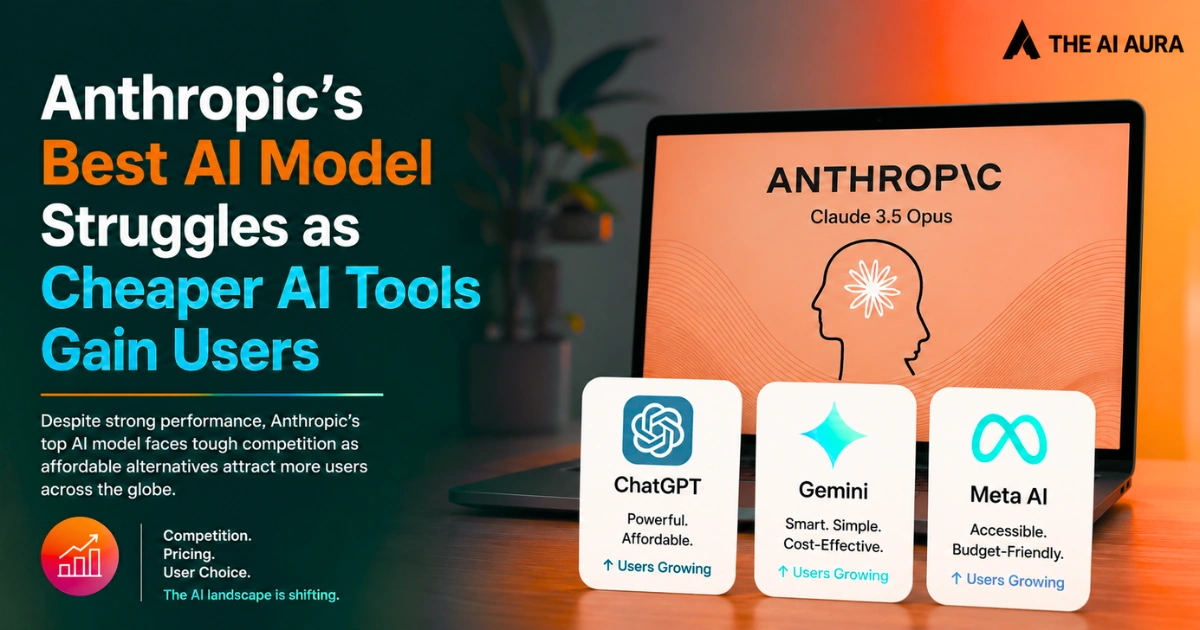

The artificial intelligence arms race is undergoing a brutal reality check. For years, the Silicon Valley playbook was built on a singular, unquestioned assumption: engineer the smartest, most expensive AI model possible, and enterprise customers will blindly pay the premium.
Yet, as Anthropic preps for what Wall Street anticipates will be the most lucrative IPO of all time a projected $2 trillion valuation a totally different narrative is playing out on the ground.
Businesses are walking away from the company’s bleeding-edge flagship, Fable 5, and pivoting hard toward cheaper, highly capable AI tools.
The End of the Default Frontier
Let’s look at the actual spend. Ramp’s recent financial data, pulled from 70,000 corporate clients, reveals that Fable 5 constitutes just 11 percent of Anthropic’s total customer outlay well over two months after its debut.
This violently breaks the historical pattern of tech buyers instinctively defaulting to “frontier” models for their enterprise software deployments.
The catalyst behind this plateau is pure economics. Corporate CTOs have finally realized that the vast majority of their daily business demands do not require a multibillion-dollar supercomputer.
They aren’t asking the software to synthesize new pharmaceutical drugs or solve complex logistics equations; they need accurate data parsing, automated reporting, and customer service triage.
For these utilitarian tasks, smaller and cheaper AI tools are perfectly adequate.
The internal cannibalization at Anthropic proves the point. Opus 5, a highly efficient, budget-friendly model launched in late July, has already overtaken Fable 5 in business spend.
Furthermore, Sam Altman’s OpenAI is heavily exploiting this enterprise shift. By pricing their newly launched GPT 5.6 aggressively low, OpenAI has jolted its own annualized revenue past $40 billion after a sluggish early 2026.
When you add the influx of cheap, open-weight models flooding in from international markets, the enterprise message is deafening: cost efficiency has officially replaced raw intelligence as the primary buying metric.
Rethinking the Multibillion-Dollar Playbook
If this market behavior solidifies, it radically rewrites the business strategy for every major AI lab. Historically, these firms funneled all their capital into training massive neural networks.
But as Accel partner Miles Clements recently observed, the assumption that every client needs to operate at the extreme edge of AI capability was a flawed, temporary era.
Moving forward, massive frontier models like Fable 5 will serve primarily as high-end showcases necessary for pushing scientific boundaries and recruiting top-tier researchers, but secondary to the actual revenue-generating workhorses.
Political friction also played a minor role, with the Trump administration briefly halting Fable’s initial June rollout over national security fears before a July greenlight. However, analysts note that buyers aren’t avoiding the model today out of political caution; they are simply avoiding the invoice.
Even with its marquee product struggling to dominate, Anthropic’s financial momentum remains terrifyingly strong. The Dario Amodei-led giant hit a $65 billion annualized revenue run rate last month.
While slightly shy of the most hyper-bullish $80 billion estimates, that is a sevenfold explosion since January. Crucially, the company posted an adjusted operating profit in the second quarter and locked in 6,000 enterprise clients spending deep into the six figures annually.
The looming mega-IPO will almost certainly succeed, but it marks the end of the AI hype cycle. Corporate buyers are no longer paying for magic; they are paying for margins.
Source: Official Financial Times, "Anthropic’s Best AI Model Struggles to Attract Users as Cheaper Tools Thrive"