

Right now, the tech industry is caught in a collective trance over generative text. We have machines that can mimic Shakespeare, pass the bar exam, and spit out complex code in seconds. But ask that same trillion-parameter model to clear a coffee cup from your desk, and it’s completely useless.
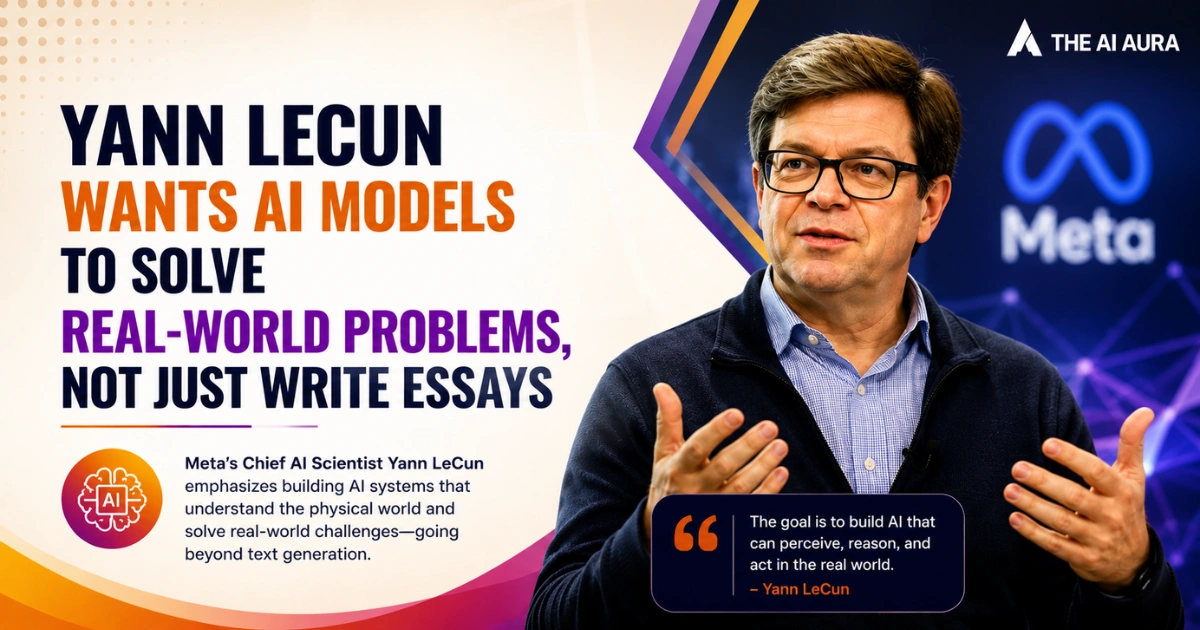
This jarring disconnects between digital fluency and physical incompetence is exactly what Meta’s Chief AI Scientist, Yann LeCun, is calling out.
Recently, Y Combinator co-founder Paul Graham sparked a conversation on X, noting that if he were 17 today, he’d focus entirely on building and training Large Language Models (LLMs) from scratch. LeCun, widely regarded as one of the “Godfathers of AI,” shot back with a fundamentally different perspective.
He wouldn’t just build another chatbot. Instead, he’d want to figure out why an AI can write a graduate-level essay but lacks the basic spatial reasoning to clean a bedroom. It’s a blunt critique that strikes at the heart of our current AI trajectory: we are pouring billions into building savants that are entirely trapped behind a screen.
The Illusion of Intelligence in Text
When an LLM generates a brilliant essay, it isn’t actually thinking in the way humans understand it. It is predicting the next most statistically likely word based on an ocean of human-generated training data.
When you break down how modern language models really work, that statistical mechanism operates beautifully for syntax and grammar, but the physical world doesn’t operate on text tokens.
Gravity, friction, spatial geometry, and object permanence are non-verbal realities that cannot be mastered simply by reading about them.
LeCun’s frustration lies in the industry’s blind conflation of language mastery with actual intelligence.
An average house cat possesses more physical adaptability than the most advanced neural network currently sitting in a server farm. The cat can navigate a cluttered room, estimate the force needed to jump onto a counter, and adapt instantly if it slips. Current LLMs cannot.
This is why LeCun emphasizes the urgent need to study disciplines outside of pure computer science to bridge this gap. If we want machines to perform physical tasks as efficiently as biological creatures, we have to stop treating every AI problem as a language processing issue.
This debate also bleeds into how the industry categorizes its own progress. In a related exchange with Jitendra Malik a former Meta colleague who recently moved to Amazon’s robotics division Malik criticized the sloppy use of buzzword acronyms like VLM (Vision-Language Models) and VLA (Vision-Language-Action).
The terminology is getting muddy as companies try to make their text models sound like physical agents. Precision matters.
You can’t just slap the word “Action” onto a language model and expect it to understand how to fold laundry.
Architectures Designed for the Physical World
How do we actually get out of the chatbot rut? LeCun is actively pushing for architectures that completely bypass the limitations of current LLMs. He argues that whether you are 17 or 66, the most valuable problem to solve right now is building AI that actually understands the mechanics of reality.
To solve real-world problems, AI models need internal “world models.” They require the ability to simulate a physical action in their digital minds, predict the outcome, and adjust their movements before they even fire a robotic actuator. This demands a radical shift in how we train artificial intelligence.
Instead of feeding systems billions of scraped web pages, future architectures must learn through observation, intuition, and interaction much like a human toddler learns that a glass will shatter if pushed off a table edge.
We are fast approaching the point of diminishing returns with purely text-based AI. The next massive leap in technology won’t be a chatbot that writes a slightly better marketing email.
As the industry transitions from chatbots to agents, the focus will shift to intelligent systems that can navigate a chaotic factory floor, assist in physical elderly care, or actually clean that bedroom.
LeCun’s message serves as a necessary reality check for an industry high on its own text-generated supply. Real intelligence has to interact with reality.
Source: Official The Times of India, "Godfather of AI Yann LeCun Wants AI Models to Upgrade From Writing His Essays to Solving This 'Big Bedroom Problem'"