

Proteins are the absolute workhorses of biology. They dictate almost every process in the human body, from how our muscle fibers contract to how our immune system recognizes and neutralizes novel viruses.
But a protein’s biological function isn’t just about the raw ingredients it’s made of; it is entirely dictated by its physical shape its complex, origami-like 3D structure.
For decades, mapping, comparing, and predicting these complex molecular folds has been one of science’s most computationally exhausting bottlenecks.
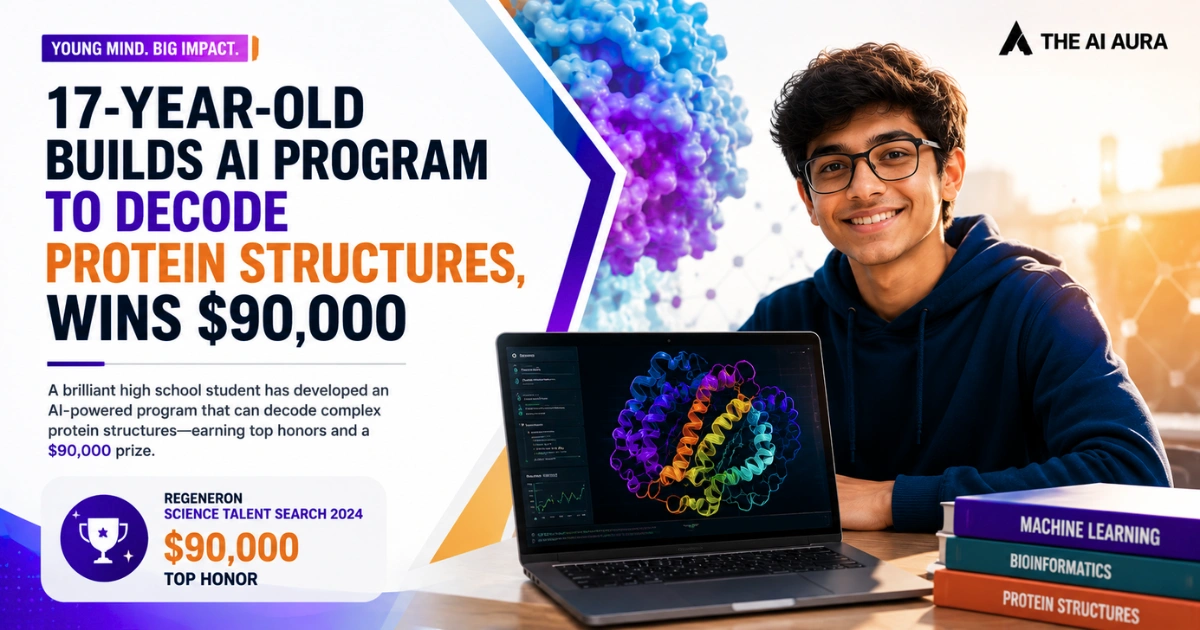
Enter Jerry Xu, a 17-year-old student from Lexington, Massachusetts. While most high school seniors are mapping out their college applications, Xu was busy writing an artificial intelligence program that essentially teaches computers to speak the physical language of proteins.
His project recently earned him $90,000 at the highly prestigious Regeneron Science Talent Search. But beyond the impressive prize money and the headlines, what stands out to anyone working in computational biology is the sheer elegance of his approach.
Xu didn’t just throw massive amounts of raw computing power at the protein problem. Instead, he found a way to fundamentally translate biological architecture into streamlined mathematics, solving a major data issue that has plagued researchers for years.
Translating 3D Folds into Mathematical Strings
Let’s look under the hood of what Xu actually built, officially titled “A Unified Protein Embedding Model With Local and Global Structural Sensitivity.” The traditional problem in bioinformatics is that comparing molecular frameworks requires massive server farms crunching spatial data for days or weeks.
Current molecular databases are heavily bloated. If a researcher uses a fast search method, it usually glosses over critical structural nuances. If they opt for a highly detailed search, the system moves at a glacial pace.
Xu bypassed this long-standing trade-off by converting the 3D coordinates of proteins and their underlying amino acids into simplified numerical representations effectively transforming them into a string of numbers. Think of it like compressing a massive, high-resolution RAW image file into a sleek JPEG without losing the crisp edges that define the picture.
His AI model captures both the “local” details (how individual amino acids interact with their immediate neighbors) and the “global” structure (the overall fold and geometry of the entire molecule).
By distilling a massive, complex protein down to this dense numerical string, scientists can feed the data through comparison algorithms at lightning speed. You retain the exact geometric features that give a specific protein its identity but strip away the computational dead weight that traditionally bogs down server hardware.
Why Speeding Up Protein Comparison Actually Matters
Why does making this comparison process faster warrant a near-six-figure science prize? Because in the high-stakes world of drug discovery and disease pathology, computing speed translates directly to saved time and, ultimately, saved lives.
When biomedical researchers want to design a new pharmaceutical drug to block a cancer-causing protein or neutralize a viral spike, they need to find molecular compounds that physically fit into the target protein’s shape. It is exactly like finding a specific key to slide into a highly complex lock.
To do this, scientists must search through vast databases containing millions of known proteins to find structural matches, evolutionary relatives, or binding sites.
With Xu’s numerical conversion method, these massive database queries can happen in a fraction of the usual time. Instead of waiting for supercomputers to render and compare heavy 3D molecular meshes, researchers can instantly query these number strings to find structural similarities.
It drastically accelerates the identification of protein functions and cuts down the timeline for target-based drug design. Xu’s work provides a brilliant computational shortcut that doesn’t sacrifice scientific accuracy, proving that the next major leap in bioinformatics doesn’t always come from a multi-million dollar corporate lab.
Source: Official The Times of India, "Meet Jerry Xu, the 17-Year-Old Massachusetts Student Who Built an AI Program That Turns Protein Structures Into Strings of Numbers; He Won $90,000"