
A frontier language model is just an engine. Parameter scale alone cannot solve complex, multi-day engineering tasks or interactive reasoning puzzles. Models need a surrounding system harness.
This harness dictates how the model receives context, runs tools, and recovers from errors.
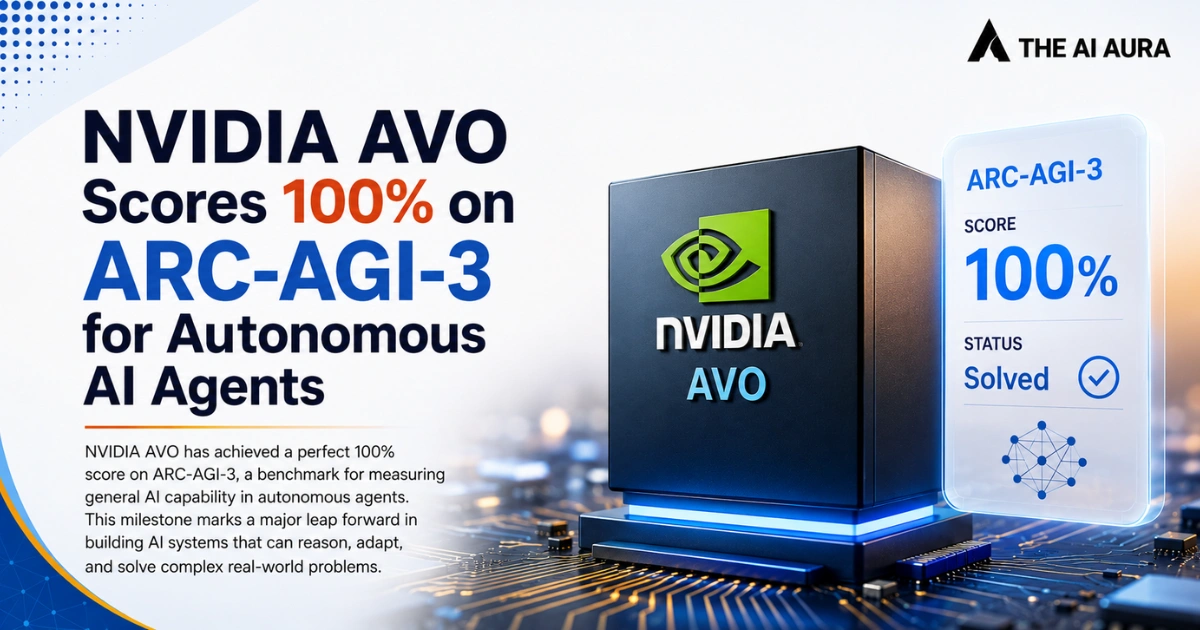
NVIDIA recently introduced Agentic Variation Operators (AVO). It elevated Claude Opus 5 from a 30% baseline to a perfect 100% on the ARC-AGI-3 public set.
This breakthrough proves a key principle of modern artificial intelligence: system architecture drives long-horizon reasoning, not raw model capability alone.
NVIDIA did not build AVO for game-like reasoning puzzles. Engineers designed it as a general-purpose coding agent. Its main purpose was tackling grueling hardware tasks, such as optimizing GPU kernels.
Yet, AVO smoothly adapted to an unfamiliar, ruleless environment without core code changes. It went on to solve all 183 levels of the ARC-AGI-3 benchmark. Here is how this architecture sustains long-term autonomous work.
The Mechanics of Memory and Supervision
To understand how AVO operates continuously such as its seven-day uninterrupted run exploring 500 optimization directions for attention kernels you have to look at how it manages state.
Standard LLMs degrade over long contexts because they lose the thread of their own logic. AVO bypasses this through a highly structured persistent memory system
It does not treat memory as a simple running transcript. Instead, AVO tracks previous code changes, compiler errors, profiler metrics, and reasoning steps. If an experiment fails, the agent does not restart from scratch. It resumes from its current state, which eliminates duplicate work.
However, persistent memory alone isn’t enough to prevent an agent from getting trapped in an unproductive logic loop.
This is where AVO’s dual-layer architecture becomes vital. While the main agent handles the microscopic tasks of inspecting code, executing tests, and committing changes, a secondary Supervisor model oversees the macro trajectory.
The supervisor actively monitors for stagnation. If the primary agent plateaus or begins repeating failed strategies, the supervisor intervenes, forcing the agent to abandon the dead end and pivot to a new hypothesis.
This separation of execution and oversight is what allows the system to operate autonomously for days without human correction.
A Universal Loop for Compounding Progress
The transition from optimizing cuDNN and FlashAttention-4 to acing ARC-AGI-3 reveals the true strength of AVO: the core execution loop is universally applicable.
In the ARC-AGI-3 benchmark, AVO was dropped into an interactive environment with zero instructions, no stated goals, and no visual rendering—operating strictly via a 64×64 text grid. It had to figure out the rules of the environment purely through trial and error.
Whether AVO is processing feedback from a C++ compiler or analyzing the state change of a text grid after executing a game action, the computational pattern remains identical.
The system inspects the current state, forms a hypothesis based on incomplete evidence, executes an action through an external interface, and critically observes the consequences. It then updates its internal model of the problem based on that exact feedback.
Because of its highly efficient memory retrieval and precise feedback integration, AVO required only 6,624 environment actions to solve the ARC-AGI-3 public set roughly 12% fewer actions than competing direct-interaction architectures like VISTA. What transfers across these wildly different domains isn’t specialized knowledge.
It is the mechanical ability to let reasoning and feedback compound over time. AVO proves that when an AI is equipped with the right machinery to test, remember, and adapt, the complexity of the environment ceases to be a barrier.
Source: Official NVIDIA, "NVIDIA AVO Reaches 100% on ARC-AGI-3, Demonstrating a Frontier-Level General-Purpose Architecture for Long-Horizon Autonomous Agents"