
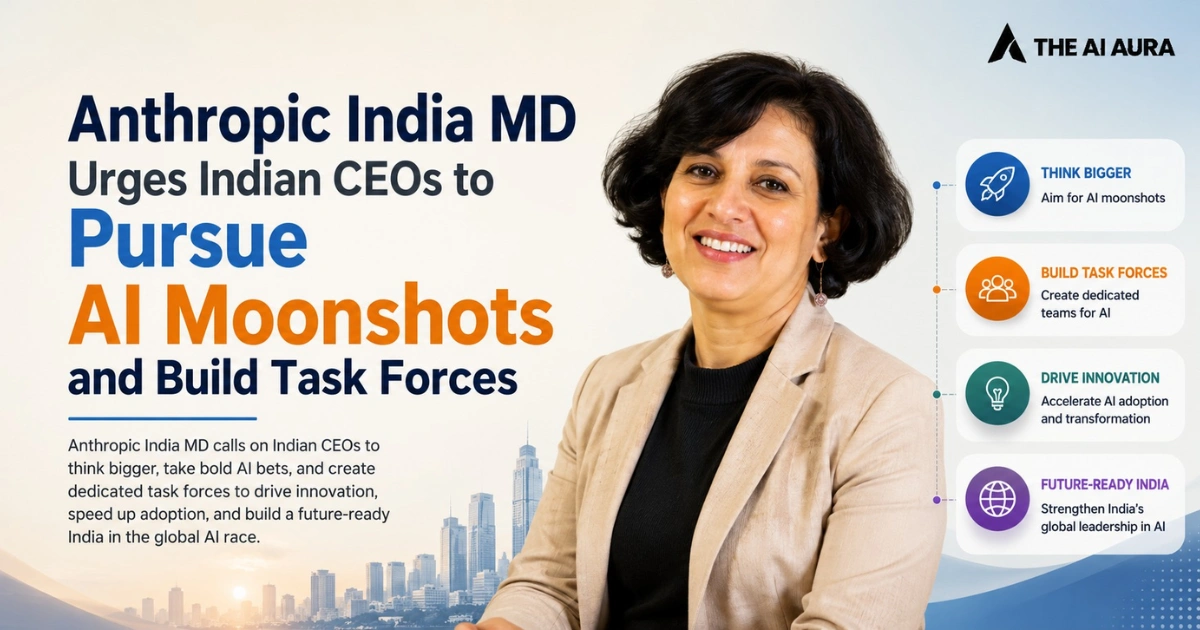

Indian boardrooms are treating artificial intelligence too safely. Rather than deploying AI as a glorified chatbot to summarize emails or answer basic queries, enterprise leaders need to recognize the shift from chatbots to agents and pivot toward solving their most intractable business problems.
This was the core message delivered by Irina Ghose, Managing Director of Anthropic India, who recently urged Indian CEOs to look beyond incremental gains and instead aim for massive AI “moonshots.”
Speaking at The Economic Times World Leaders Forum, Ghose laid out a highly pragmatic yet ambitious roadmap for Indian enterprises.
The directive is straightforward: identify the single most complex issue plaguing your organization, establish a dedicated, cross-functional task force, and build a mission strictly around solving it with AI.
When leadership targets massive structural inefficiencies, the smaller operational wins naturally follow suit.
This isn’t theoretical advice. Anthropic is already actively co-creating solutions within the Indian ecosystem, pushing beyond generic playbooks to build models specifically tailored for local nuances.
From engineering productivity initiatives with Kotak and Axis Bank to agentic AI frameworks for the National Payments Corporation of India (NPCI), the focus is squarely on heavy-lifting applications.
Furthermore, their partnerships extend into critical societal infrastructure, collaborating with the Indian Institute of Science (IISc) on antivenom discovery and Digital Green for multilingual farmer support.
Why Incremental AI Fails: The Case for Enterprise Moonshots
The economic stakes are massive. McKinsey estimates the overarching value of generative AI at a staggering $4.4 trillion globally.
Domestically, Indian corporations are already funneling between $2.6 billion and $2.8 billion into AI initiatives, with aggressive spending expansions projected over the next 24 months.
Yet, throwing capital at technology doesn’t guarantee a return on investment.
Cheryl Lim, a partner at McKinsey, highlighted a glaring disconnect during the forum: while up to 90% of companies report active investments in artificial intelligence, nearly the same percentage struggle to demonstrate any significant business value from it, falling into what is often called the AI adoption illusion.
The failure rarely lies in the technology itself. Instead, it stems from a lack of strategic integration.
Building products natively with AI requires a foundational shift in how a company operates.
When leaders treat AI as a plug-and-play accessory rather than a core infrastructural component, they stall out at the pilot phase. To cross the chasm from experimental to transformational, organizations need localized infrastructure.
Ghose noted that localized data residency and native inference capabilities are critical next steps, particularly for heavily regulated sectors like healthcare, insurance, and banking, to fully unlock AI adoption without compromising strict compliance standards.
The Human Element: Talent, Workflows, and Global Ambitions
The primary bottleneck for enterprise AI success in India isn’t compute powerit is change management. Deploying a moonshot task force is only effective if the workforce is prepared to operate alongside these new systems.
Companies that emerge victorious in this technological transition will be those that aggressively redesign internal workflows and prioritize employee upskilling while directly addressing the pervasive anxiety surrounding AI-driven job displacement.
We already witness this shift in high-leverage industries like management consulting. AI now executes tasks in minutes that previously consumed weeks of analyst time.
However, Lim pointed out that AI augments cognitive capacity rather than eliminating consultants. Automating routine grunt work frees professionals to focus on human relationships, culture, and nuanced capability building.
India is uniquely positioned to lead this global transition. SAP President for Asia Pacific Verena Siow noted that India is no longer just a delivery hub. In fact, roughly 40% of SAP’s global innovation originates from its Bengaluru labs.
Leading tech companies now pressure-test high-stakes AI models directly within India’s complex, high-volume market. Afterward, they will export those battle-tested playbooks globally.
Platforms like GIFT City act as a vital catalyst in this ecosystem. Rather than cloning hubs like Dubai or Singapore, GIFT City provides direct access to India’s domestic growth. As Indian enterprises build AI moonshots locally, GIFT City will serve as the launchpad for exporting solutions globally.
Source: Official The Economic Times, "Indian CEOs Must Target AI ‘Moonshots’, Build Task Forces: Anthropic India MD Irina Ghose"