
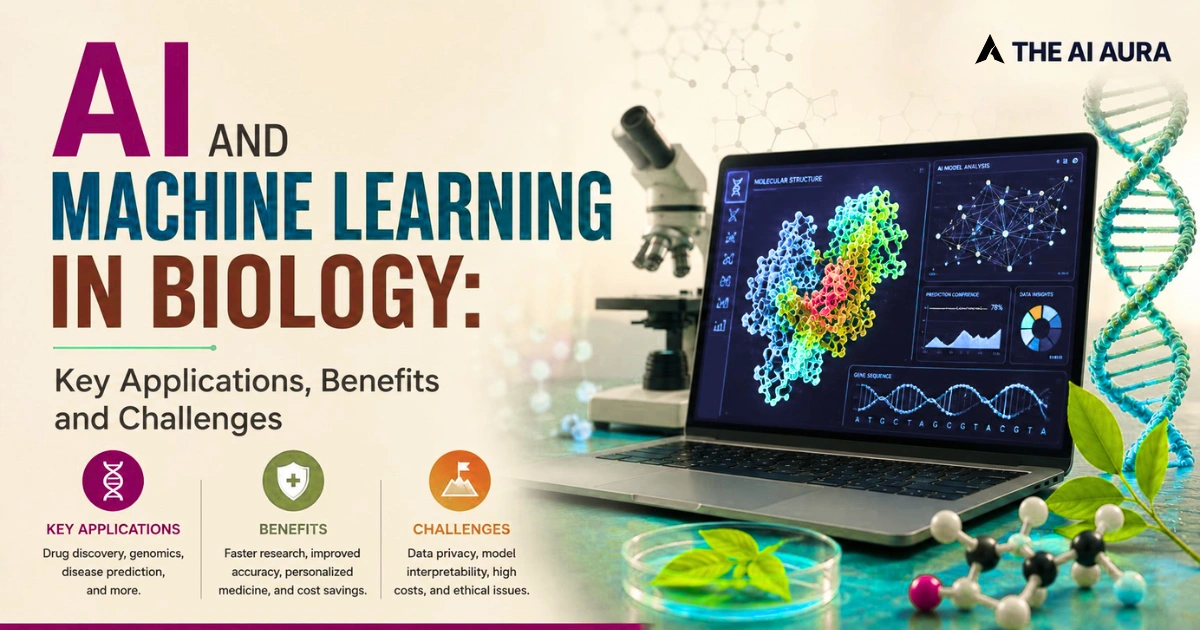

Biology has quietly transitioned into a rigorous data science. A decade ago, the primary bottleneck in biological research was simply generating data.
Today, high-throughput sequencing, advanced bioimaging, and decentralized health records produce massive datasets that easily outpace human analytical capacity.
The life sciences are no longer starved for raw information; they are severely starved for processing bandwidth.
This is exactly artificial intelligence and machine learning step in, migrating from theoretical computer science to become the foundational infrastructure of modern biology.
The shift goes far beyond automating repetitive laboratory tasks. Today’s research facilities deploy advanced pattern-recognition engines capable of finding subtle genomic associations and predicting molecular interactions that would otherwise take human researcher’s decades to uncover.
Transformative Applications and Their Core Benefits
The most visible impact of machine learning algorithms in the life sciences is their ability to ingest and interpret complex, high-dimensional datasets. In the rapidly advancing realm of genomics and personalized medicine, ML architectures are changing how researchers handle variant identification and gene-expression analysis.
Instead of relying on generalized, one-size-fits-all treatment protocols, predictive models now analyze a patient’s specific genetic sequence alongside clinical history and lifestyle data to guide highly personalized medical decisions.
These algorithms excel at mapping how certain genes activate or deactivate under environmental stress, providing early indicators of disease progression before clinical symptoms ever manifest.
Drug discovery represents another massive deployment area for these technologies, an industry traditionally plagued by high failure rates and astronomical research costs.
AI intervenes at the very first step of the pipeline: target identification. By scanning vast, interconnected networks of molecular interactions, machine learning models prioritize the most viable proteins and enzymes that could successfully alter a disease’s course.
From there, these systems simulate molecule design, accurately predicting binding affinity, drug solubility, and potential toxicity long before physical synthesis begins in a lab.
Recent computational leaps in protein structure prediction mapping complex 3D protein folds directly from 1D amino acid sequences demonstrate the sheer utility of these models.
The primary benefit across all these applications is velocity. AI accelerates the prioritization of viable drug candidates and diagnostic markers. It shifts the heavy computational lifting of data analysis, image segmentation in bioimaging, and hypothesis generation entirely to automated systems.
Researchers spend significantly less time manually sifting through raw data and more time validating computationally generated insights, shrinking the timeline from initial lab observation to real-world clinical application.
Data Bottlenecks and Implementation Challenges
Despite the aggressive adoption curve, integrating these deep learning technologies into biological workflows is not without serious friction. The most persistent hurdle is the quality, standardization, and cleanliness of the training data itself. Biological datasets are notoriously noisy, fragmented, and heavily siloed across different institutional formats.
Machine learning models are completely dependent on their foundational data; feeding a neural network incomplete or demographically biased clinical records guarantees flawed medical predictions.
This standard limitation is a severe roadblock in clinical environments where scientific precision is non-negotiable.
There is also the highly documented “black box” problem. Deep learning models often identify valid biological patterns or propose highly effective molecular structures without providing the underlying reasoning.
In regulatory and healthcare settings, raw accuracy isn’t enough explainability is a hard requirement.
Healthcare professionals and regulatory bodies hesitate to approve AI-recommended treatments if they cannot trace the logical, biological steps the algorithm took to reach its conclusion.
Validating these computational outputs in physical wet labs remains an expensive necessity, meaning AI is currently restricted to being an augmentation tool rather than an autonomous medical decision-maker.
Furthermore, training sophisticated language and predictive models on sensitive genomic and patient data invites intense privacy and ethical scrutiny. Ensuring robust data anonymization while maintaining enough granular detail for the algorithms to find meaningful correlations requires incredibly careful engineering.
Navigating the intersection of high-performance computing, biological complexity, and strict regulatory frameworks is the next major hurdle for the industry.
The underlying technology clearly works, but the surrounding infrastructure secure data pipelines, regulatory protocols, and explainability frameworks is still actively playing catch-up.
Source: Official BioTecNika, "AI and Machine Learning in Biology: Applications, Benefits & Challenges"