
If you want to engineer artificial intelligence capable of navigating the unpredictable chaos of the real world, you cannot start in the real world.
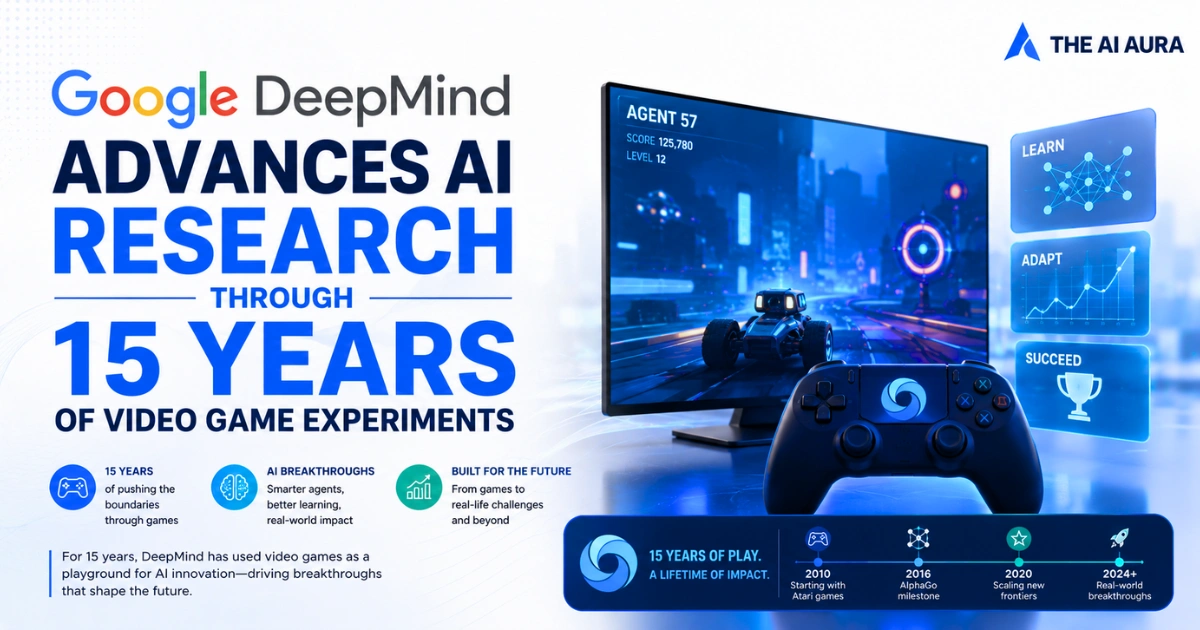
You start in a sandbox. For the past fifteen years, Google DeepMind has utilized the constrained, rule-bound universes of video games as the primary engine for AI breakthroughs.
From parsing the raw pixel inputs of Atari 2600 to navigating the sprawling, player-driven economy of EVE Online, these digital environments have served as the proving grounds for the cognitive architectures powering today’s frontier models.
From Score Optimization to Generalist Agents
The early era of DeepMind’s gaming research was defined by deep reinforcement learning systems optimizing for highly specific win states.
Architectures like the Deep Q-Network (DQN) learned to master classic arcade games without any bespoke engineering, while the AlphaGo lineage shattered centuries of human strategic paradigms in board games.
These systems were brilliant but narrow. They optimized for a single metric. Yet, the foundational logic forged in these games scaled outward to solve a 50-year-old biological hurdle through AlphaFold, proving that game-trained algorithms could unravel complex real-world data structures like protein folding.
However, the trajectory of AI research has fundamentally shifted from mastering a game’s mechanics to genuinely understanding its environment. The real world does not have a scoreboard, which makes traditional reinforcement learning brittle when deployed outside rigid parameters.
This architectural pivot is visible in the Scalable Instructable Multiworld Agent (SIMA). Unlike earlier bots that relied on direct access to a game’s source code or backend APIs, SIMA operates exactly like a human player.
Powered by the Gemini model family, SIMA 2 processes raw screen visuals and natural language instructions to execute standard keyboard and mouse commands.
It functions as a multimodal generalist across entirely different 3D engines from No Man’s Sky to Valheim without requiring specialized retraining for each physics system.
For developers, this enables robust, automated QA testing capable of adapting to erratic gameplay changes in real-time, removing the orchestration bottlenecks common in heavily scripted NPC systems.
Simulating Reality Through Multi-Agent Dynamics
As agentic workflows mature, the most significant hurdle is no longer navigating a static environment it is interacting with other unpredictable, intelligent actors. DeepMind’s recent partnership with Fenris Creations to test AI within the EVE Universe signals a critical evolution in how research labs are approaching open-ended problem solving.
EVE Online is a persistent, massively multiplayer simulation running continuously since 2003, driven entirely by human diplomacy, betrayal, and supply-and-demand economics.
Injecting AI into a living ecosystem like EVE forces researchers to confront the exact infrastructural limitations currently holding back enterprise AI deployment.
To survive in a player-driven galaxy, an agent must demonstrate continual learning the ability to acquire new behavioral weights without catastrophic forgetting when the environment shifts.
It requires memory retrieval architectures that can recall and apply context across timeframes that vastly exceed the limits of current LLM context windows
Furthermore, this environment demands long-horizon planning. An AI managing an interstellar supply chain or negotiating a territorial dispute is not making isolated, prompt-to-response decisions.
It must execute multi-step strategies spanning weeks or months, adapting to emergent social behaviors and economic friction.
By dropping agents into these high-stakes multi-agent dynamics, DeepMind is stress-testing the exact cognitive blueprints required for future autonomous systems to operate safely and effectively in our own reality.
Source: Official Google DeepMind, "From Atari to EVE Online: Building on 15 Years of AI Research in Games"