
When you look at the Indian IT landscape right now, there is a clear split in how the biggest players are tackling the artificial intelligence boom.
After a grueling three-year stretch of weak discretionary spending and agonizingly slow deal conversions, enterprise AI is finally moving out of the sandbox.
Companies are done playing with pilot projects; they want production-grade deployment.
But how clients choose to buy into this next cycle is going to dictate which IT firm captures the most value.
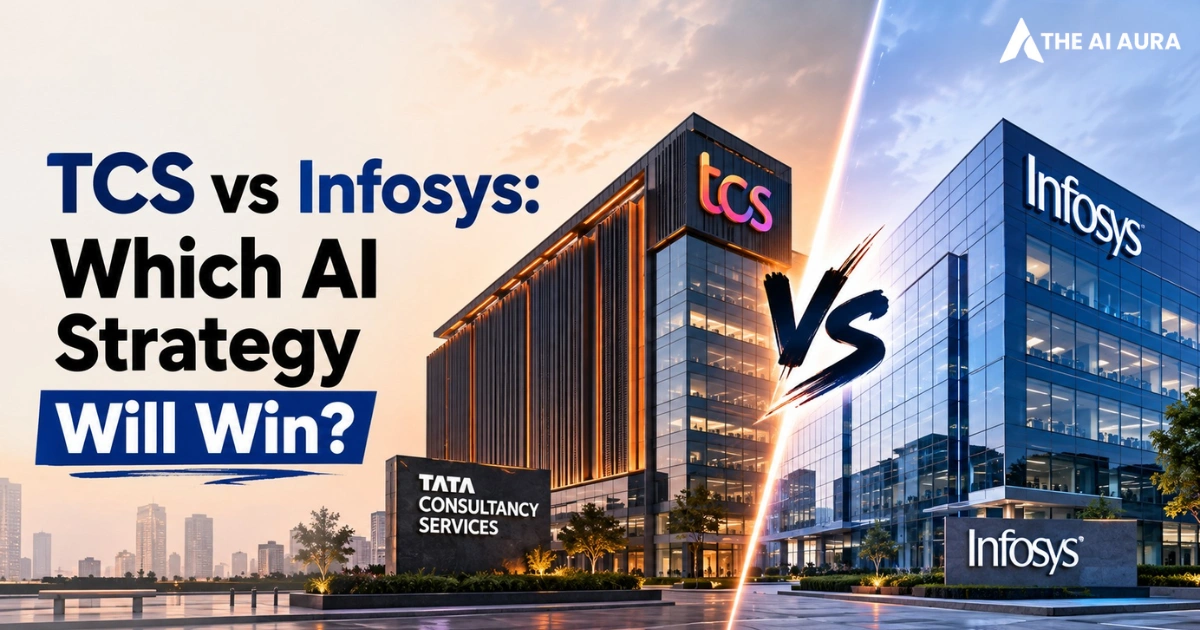
Tata Consultancy Services (TCS) and Infosys are both aggressively chasing the AI dollar, yet their playbooks couldn’t look more different. One is laying the physical groundwork, while the other is rewriting the software code.
The Heavy Lifting: TCS and the AI Infrastructure Play
TCS is not just trying to be a software vendor in this cycle; they are positioning themselves as an industrial powerhouse for AI. Their strategy, which they internally call “Infrastructure to Intelligence,” is a capital-heavy bet on the physical reality of artificial intelligence.
AI requires staggering amounts of computing power, and instead of leaving that revenue entirely to big public cloud providers, TCS is grabbing a piece of the hardware and data center pie.
Their 1 GW HyperVault data center initiative is the anchor of this approach. Backed by a massive $1 billion commitment from TPG, and scaled through multi-year deals with companies like OpenAI and AMD, TCS is building out the actual power grid for enterprise AI.
What makes this fascinating and incredibly difficult for smaller peers to replicate is how they leverage the broader Tata Group ecosystem.
By tapping into Tata Power for clean energy, Tata Projects for construction, and Tata Communications for the fiber network, they are creating a closed-loop infrastructure system.
I see this as a highly defensive, long-term move. As AI inevitably automates routine coding and testing which threatens to compress traditional software contract margins by 10% to 15% TCS is locking in multi-year, recurring revenue from physical infrastructure that software cannot cannibalize.
It is a slow burn, but if enterprise AI requires dedicated, localized, and secure compute environments, TCS will own the foundation.
The Software Fast Track: Infosys and AI-Native Transformation
Infosys is running in an entirely different direction. Instead of pouring capital into concrete and cooling systems, they are betting that the real money lies in pure-play software integration and legacy system modernization.
Their fundamental thesis is that global enterprises are currently running on fragile, decades-old code that simply cannot talk to modern AI models.
To bridge this gap, Infosys has rolled out its Topaz Fabric and Hexagon frameworks. They aren’t trying to build the data center; they want to be the specialized mechanics who rewire the enterprise to actually run on AI. With tens of thousands of developers actively using advanced coding assistants like
Claude Code and Codex, Infosys is aggressively attacking legacy architectures. They have also carved out a niche force of frontier engineers dedicated purely to integrating complex AI models with client-specific business logic.
This software-first strategy is already showing velocity. Pure-play AI services have steadily climbed as a percentage of their total revenue, proving that this approach is resonating with clients who want rapid deployment without massive upfront infrastructure commitments.
The market currently has both stocks trading at a discount to their historical averages, waiting for a definitive winner.
If corporate spending heavily leans toward modernizing existing software footprints with AI agents, Infosys will capture the immediate upside.
But if AI demands an entirely new wave of secure, dedicated computing environments, the infrastructure monopoly TCS is building will make them the undisputed heavyweight of the next decade.
Source: Official Financial Express, "TCS and Infosys Are Taking Opposite AI Bets. Which One Wins?"