

For decades, the concept of translating human thoughts directly into readable text belonged strictly to the realm of science fiction.
Early neuroprosthetics helped connect the brain and machines. However, they often placed a heavy burden on patients.
Patients with paralysis, stroke-related conditions, or neurological diseases often needed surgery to implant electrodes in the brain. Ironically, these were the people who could benefit most from BCIs.
These procedures carry serious risks. Infection, scarring, and brain bleeding have all limited wider adoption.
Today, that medical paradigm is shifting entirely. Advances in AI are helping researchers decode brain activity without surgery. What once seemed impossible is now becoming reality.
By combining advanced non-invasive neural imaging with transformer-based deep learning models, researchers are now decoding the silent language of the human mind from the outside in.
Decoding Thoughts Through Non-Invasive AI Models
The core breakthrough lies in how modern artificial intelligence handles the staggering complexity of raw neural data.
Rather than relying on surgically implanted chips to capture clean, direct signals from the brain’s cortex, newer systems utilize external, non-invasive tools like magnetoencephalography (MEG), electroencephalography (EEG), and functional magnetic resonance imaging (fMRI).
Historically, the brain signals captured through a patient’s skull were considered far too noisy, muffled, and distorted to be useful for precise communication. Artificial intelligence fundamentally changed this equation.
Pioneering architectures such as Meta’s Brain2Qwerty model and the University of Technology Sydney’s DeWave system process these external brain waves through sophisticated, multi-stage pipelines.
First, the systems capture brain activity while a user thinks about a specific sentence, listens to a story, or actively imagines typing on a keyboard.
Then, deep learning modules act as an advanced filter for the immense background noise, isolating the specific electrical patterns uniquely associated with language production.
Pre-trained large language models (LLMs) act as the crucial final layer, predicting, correcting, and assembling the intended words based on the semantic context of the neural data.
What once required direct brain contact can now be accomplished externally, with recent MEG-based AI models hitting character error rates as low as 18 percent for top-performing participants.
The Practical Future of Brain-Computer Interfaces
Removing the need for surgery makes BCIs safer and far more accessible.
For people with ALS, spinal cord injuries, or locked-in syndrome, non-invasive BCIs could help restore communication.
Users think about what they want to say. The AI then converts those brain signals into text on a screen.
Early systems relied on large MRI machines. Today’s research focuses on portable, everyday solutions.
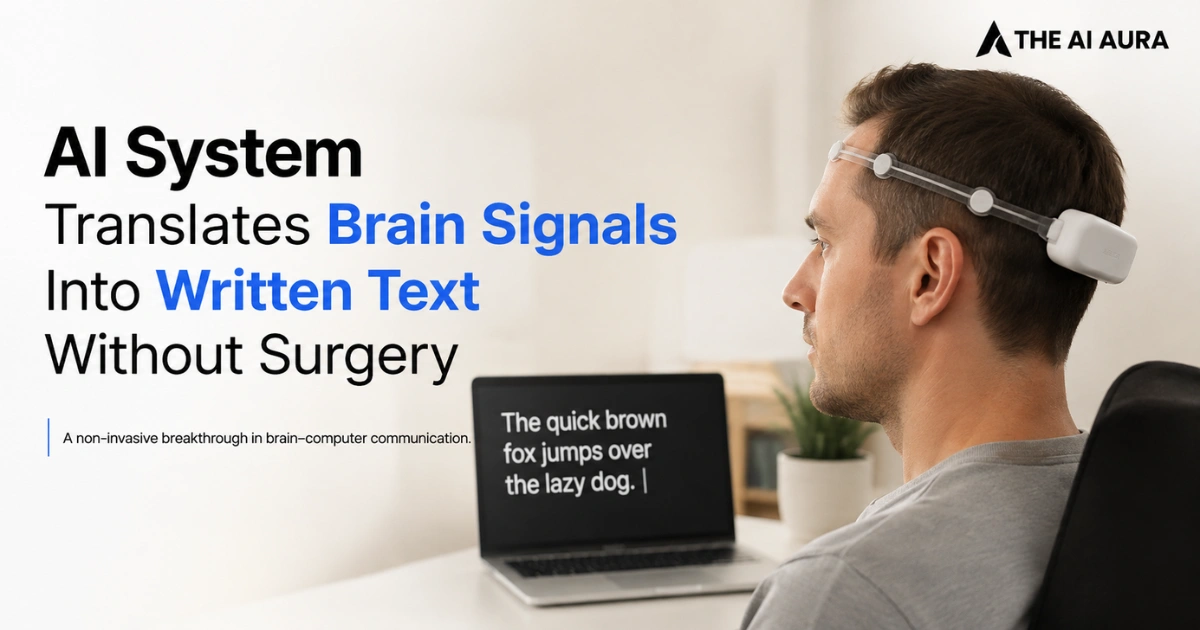
Researchers are now using lightweight EEG caps that people can wear comfortably at home. This reduces the need for bulky medical equipment.
Translation accuracy keeps improving as datasets grow and AI models become more sophisticated.
By removing the need for surgery, AI is making neuroprosthetics more accessible. The goal is simple: helping people communicate by wearing a headset and thinking their message.
Source: Official Tech Xplore, "Noninvasive AI-Based System Translates Brain Signals Into Written Text"