
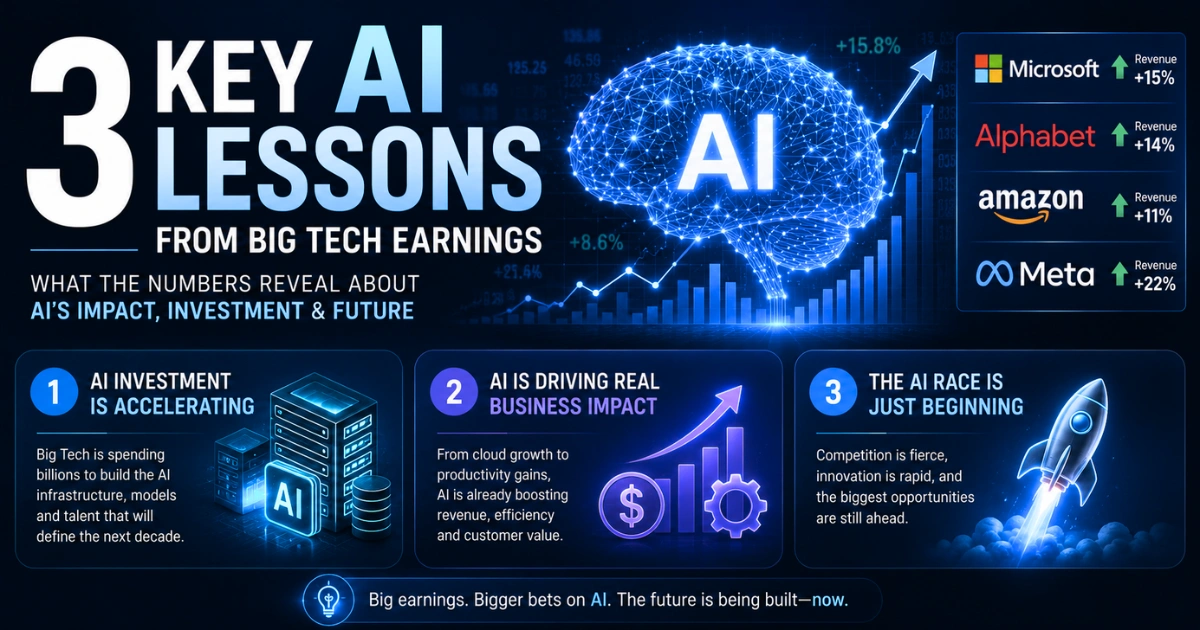

Earnings season just wrapped up for the titans of Silicon Valley, and if there is a single narrative driving the market right now, it is the sheer gravity of artificial intelligence spending.
Microsoft, Meta, Google, Apple, and Amazon laid their financials bare this week, revealing a collective AI investment strategy that is rapidly approaching the $1 trillion mark.
But pouring cash into server farms, next-generation microchips, and elite engineering talent is the easy part. The market reaction over the last few days tells a much more complex story.
Investors are experiencing severe sticker shock, and the days of blindly rewarding tech executives for merely mentioning the word “AI” on an earnings call are definitively over.
Based on this week’s data dump, the current state of the artificial intelligence arms race boils down to a brutal reality check on profitability, patience, and consumer appetite.
The Cash Burn and Wall Street’s Reality Check
The most glaring takeaway from this quarter is that consumer-facing chatbots are currently massive cash incinerators.
Ever since ChatGPT launched the arms race in late 2022, every major player has rushed their own flagship agent to market from Google’s Gemini and Meta AI to Amazon’s Rufus.
Yet, despite the staggering development costs, none of these tools are moving the needle on direct revenue.
In fact, the capital expenditure required to keep these AI models running is historically unprecedented. Alphabet essentially stress-tested its own balance sheet, reporting negative free cash flow on $118 billion in revenue a first in its history as a public company.
Meta wasn’t far behind, scraping together just $784 million in free cash on $61 billion in revenue, while its Reality Labs division bled nearly $9 billion in just six months.
Wall Street is no longer amused by this level of cash burn without a clear roadmap to profitability.
You can see this directly in how the market punished Meta. Mark Zuckerberg pitched a future of autonomous AI agents and enterprise tools but offered zero timeline for monetization. Despite this, he signaled a baseline AI spend of $140 billion this year. Investors dumped the stock.
Contrast that with Microsoft and Amazon. Both companies are spending exorbitant amounts $190 billion and $220 billion, respectively but their stocks rallied.
Microsoft proved that its enterprise AI integrations are actually driving core revenue growth, while Amazon’s traditional retail and cloud dominance provided enough financial cover to justify the aggressive AI spend. The lesson is clear: the market demands tangible execution, not sci-fi promises.
Undeniable Demand Meets the Hardware Bottleneck
Despite the financial friction and Wall Street’s impatience, the actual consumer appetite for AI integration is undeniable. We may not have reached a paradigm shift on the level of the internet yet, but the adoption metrics are staggering.
Google’s Gemini chatbot is now pulling in 950 million active monthly users, tripling its base in just one year. That level of engagement points to a massive, habitual reliance on generative tools that didn’t exist two years ago.
Apple’s earnings provided the clearest look at how this software demand translates to hardware sales. The company reported unexpected surges in Mac, iPhone, and iPad sales, explicitly constrained only by microchip supply chain bottlenecks.
Consumers are essentially trying to future-proof their hardware ahead of the massive, Gemini-assisted overhaul of Siri.
Apple’s strategy reveals exactly where the industry is heading next. Rather than bleeding cash on free compute power forever, Apple is already laying the groundwork to charge premium subscription fees for power users of the new Siri.
The underlying technology works, and the user base is hooked. The next phase for Big Tech isn’t about building the smartest AI it’s about figuring out how to make the user pay for it.
Source: BBC News, "3 Key AI Lessons From Big Tech Earnings"