
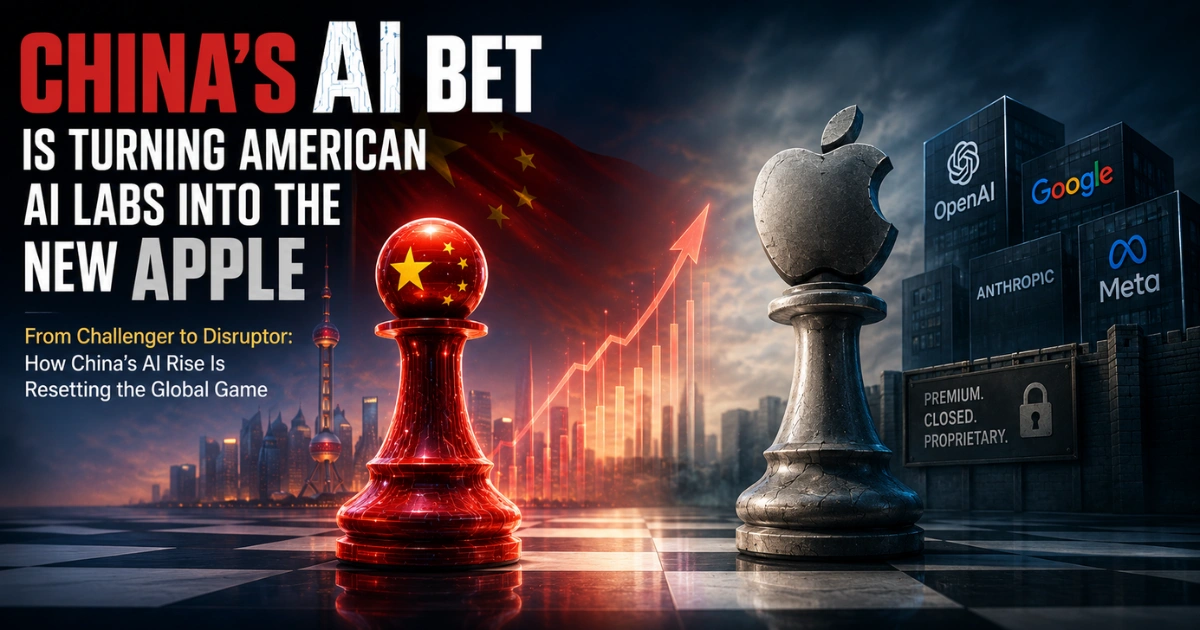

The artificial intelligence arms race between the United States and China has evolved far beyond a simple sprint for raw computational power.
What began as a contest to build the smartest machine has morphed into a battle of fundamentally opposing business models.
As American AI heavyweights double down on closed, highly guarded ecosystems, they are unintentionally adopting the historic “Apple playbook.”
Meanwhile, China has made a calculated, aggressive bet on open-source accessibility, quietly positioning its technology as the Android of the AI era. This architectural divergence a global showdown of open vs closed AI models is radically reshaping global tech dominance.
The Premium Enclosure of American AI
In Silicon Valley, the prevailing strategy is driven by scaling laws. Leading U.S. labs such as OpenAI, Anthropic, and Google are investing hundreds of billions of dollars in massive data centers to train frontier models.
The engineering philosophy assumes that throwing exponentially more compute and data at a neural network will inevitably yield unmatched capabilities.
However, this capital-intensive approach necessitates strict commercial control. To recover these enormous training costs, American AI developers keep their most advanced models behind proprietary application programming interfaces (APIs).
These platforms operate as walled gardens. They often charge premium rates of $30 to $50 per million output tokens for access to their AI models.
This mirrors Apple’s historic hardware strategy: technically superior, highly polished, vertically integrated, and firmly closed.
American AI models are undeniably the luxury sports cars of the tech world. They deliver top benchmark scores and advanced reasoning capabilities.
Yet, just like the iOS ecosystem, this premium positioning creates steep barriers to entry.
However, most global businesses and independent developers need something simpler. They want reliable and customizable tools that can automate daily workflows. For many of them, the American tech stack is becoming too expensive and restrictive.
China’s Open-Source Android Strategy
Constrained by stringent US export controls on advanced semiconductors, Chinese AI developers realized they could not win a brute-force compute war. Instead, they pivoted to a strategy that prioritizes ubiquity, rapid iteration, and aggressive pricing.
Labs like DeepSeek, Moonshot (with its Kimi models), and Alibaba (Qwen) have opted to go all-in on the open-source approach, releasing highly capable open-weights models to the global public.
These Chinese models frequently hit the “good enough” threshold, routinely delivering 90% of the reasoning capabilities found in top-tier American models, but at a fraction of the cost often just a few cents per million tokens.
By removing the financial and technical friction, China is executing a classic market-share grab.
Developers worldwide are actively downloading Chinese models because they can be run locally, heavily customized for specific enterprise data, and operated without the exorbitant overhead of Silicon Valley APIs, eliminating one of the biggest hurdles for companies trying to figure out how to reduce AI API costs in production.
This dynamic creates an interlocking innovation flywheel. As more global developers adopt Chinese open-source AI, the sheer volume of real-world deployment generates diverse data and rapid community-driven improvements.
China is effectively weaponizing accessibility, embedding its AI ecosystem into the foundational layer of global digital infrastructure and proving that the most advanced technology doesn’t always win if a cheaper, more flexible alternative is available to the masses.
Source: The Hindu, "Is China’s AI Bet Turning American AI Labs Into the New Apple?"