

Human-wildlife conflict remains one of the most stubborn challenges in modern conservation, especially in regions where agricultural settlements overlap with ancient animal corridors.
In India, sudden encounters between villagers and migrating elephant herds frequently result in devastating crop destruction, property damage, and tragic fatalities for both humans and wildlife.
Managing these volatile borders has historically been a reactive process. However, a recent operation near West Bengal’s Jaldapara forest highlights a fundamental shift in strategy: using artificial intelligence as an invisible, proactive barrier to protect both sides.
The Invisible Fence: Bridging Technology and Conservation
To appreciate why this development is critical, you have to understand the limitations of traditional wildlife monitoring.
For decades, tracking nocturnal movement relied heavily on exhausting manual foot patrols, physical barriers that are easily breached by large mammals, or camera traps that only provided data hours or days after an animal had already passed through.
Those analog methods leave massive blind spots, particularly in the dead of night when most movement occurs.
A recent field operation shared by Indian Forest Service (IFS) officer Parveen Kaswan showcased exactly how modern interventions are changing this dynamic.
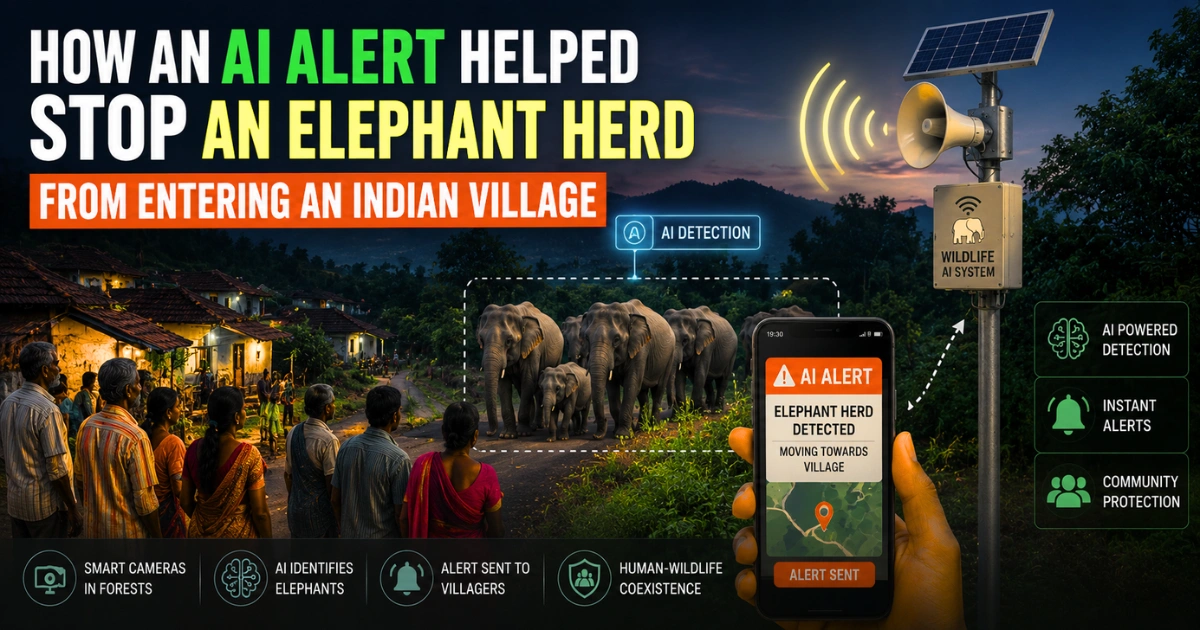
The new operational standard utilizes strategically placed night-vision surveillance cameras equipped with live AI processing. Unlike basic motion sensors that trigger for falling branches or stray livestock, these specific AI models are trained on wildlife morphology.
They can instantly recognize the distinct silhouette and movement patterns of an elephant moving through dense brush in pitch darkness.
When a herd approached the Jaldapara forest boundary at 12:32 AM, the system performed flawlessly.
Instead of merely recording video footage to a local drive, the AI analyzed the visual data in real time and immediately transmitted an automated, high-priority alert directly to the Division Control Room.
By removing the human bottleneck from the initial detection phase, the technology essentially acts as a highly trained virtual sentry.
It processes environmental threats instantly, allowing wildlife managers to transition from passive observation to active, real-time threat mitigation.
The 15-Minute Response That Averted Disaster
An early warning system is ultimately only as valuable as the ground team mobilized to act on it. The Jaldapara incident proved that combining advanced AI with dedicated frontline personnel is the key to genuinely minimizing conflict.
Because the automated system bypassed traditional, slower communication chains, a stationed rapid response team received the exact coordinates of the herd instantly.
Within exactly 15 minutes of the digital alert, forest officials arrived at the scene. This crucial head start allowed them to assess the situation, monitor the herd’s trajectory, and safely intercept the animals.
They effectively steered the massive mammals away from the nearby sleeping village before they could cross into residential zones.
There was no panic, no property damage, and no harm to the elephants just a quiet, coordinated interception in the dark.
What makes this technological integration so promising for India’s broader conservation efforts is its practical application.
As Kaswan noted, this specific interception was not a one-off publicity stunt but part of a routine effort. Forest personnel are now utilizing this exact infrastructure to respond to multiple alerts every single night.
By leveraging AI to give rapid response teams the critical gift of time, conservationists are building a sustainable framework for coexistence.
It is a highly practical solution to an age-old problem, proving that while we cannot stop wildlife from roaming, we can use smart technology to ensure human and animal paths safely bypass one another.
Source: NDTV, "IFS Officer's Video Shows How AI Alert Helped Stop Elephant Herd From Entering Village"