

I’ve been doing SEO long enough to remember when “AI-powered” meant a keyword density checker with a fancier UI. So, when the wave of actual AI SEO tools hit around 2023–24, I was skeptical. I’d seen too many tools promise rankings and deliver reports.
But 2026 is a different situation. Search has changed. Google’s SGE rollout permanently altered how featured snippets and zero-click results work.
Bing’s AI integration is pulling real search share now. And most importantly, content volume has exploded — so if you’re not using AI somewhere in your stack, you’re just spending more hours doing the same volume of work as competitors who are.
That said — and I want to be direct about this — not every AI SEO tool deserves a spot in your workflow. Half of them are basically wrappers around GPT with a “publish to WordPress” button slapped on.
The 7 below I’ve either used personally across client projects or evaluated rigorously for specific use cases. They’re not the same tools everyone else is listing.
Quick Comparison Table
| Tool | Best For | Pricing (2026) | Free Trial | AI Model Used | Integrates With |
| Surfer SEO | On-page optimization | From $89/mo | No (7-day money back) | Proprietary NLP + GPT-4o | WordPress, Google Docs |
| Semrush Copilot | Full-funnel SEO + audit | From $139/mo | 7-day free | Proprietary + Claude | GA4, GSC, Semrush Suite |
| Alli AI | Technical SEO automation | From $299/mo | 10-day free | Proprietary | Any CMS via JS snippet |
| NeuronWriter | Content briefs + NLP | From $23/mo | Free plan | NLP + GPT-4 | WordPress, Zapier |
| Frase | Research + outlining | From $45/mo | 5-day trial ($1) | GPT-4o | WordPress, GSC |
| SE Ranking AI | All-in-one + AI writing | From $65/mo | 14-day free | Proprietary + OpenAI | WordPress, GA4, GSC |
| Keyword Insights | Keyword clustering | From $58/mo | Free (limited) | BERT-based clustering | CSV export, Zapier |
1. Surfer SEO — Still the On-Page Standard, But with Caveats

If you’ve been in content SEO for more than two years, you already know Surfer. The question in 2026 isn’t whether it works — it’s whether the gap it once had over competitors has narrowed.
My take: it has narrowed, but Surfer still has the most refined on-page scoring engine I’ve used. Their Content Score system has been updated to account for entity coverage, not just keyword frequency — which matters because Google’s understanding of topical authority has gotten significantly sharper post-HCU.
- What I use it for:
Before any major content piece goes live, the page runs through Surfer’s editor. I’m not chasing a 90+ score blindly (that path leads to keyword-stuffed garbage), but the NLP term suggestions catch gaps I’d genuinely miss — especially for technical content where semantic coverage matters. - What it does well:
The SERP Analyzer is accurate. The Content Editor gives real-time guidance without making you guess. The Topical Map feature (added in late 2024) actually helps structure pillar/cluster content in a way that’s defensible. - Where it falls short:
The AI-generated first drafts are still mediocre. Use Surfer for the framework, not the prose. And at $89/month for the base plan, you’re paying for the scoring engine — not a dedicated AI writing assistant for bloggers and content creators. - Who it’s for: Content teams doing 10+ pages/month where consistency in on-page optimization is a real operational challenge.
2. Semrush Copilot — Best If You’re Already in the Semrush Ecosystem
Semrush launched Copilot as an AI layer on top of their existing suite, and it’s actually more useful than most “AI assistant” features I’ve seen bolted onto legacy tools.
Here’s what made me pay attention: Copilot doesn’t just surface data — it prioritizes it. When I run a site audit, instead of getting 300 issues dumped in a spreadsheet, Copilot ranks what to fix first based on traffic impact estimates.
For client reporting, that alone saves a significant chunk of time.
The AI writing assistant inside Semrush has also improved considerably. It pulls SERP data directly into the content workflow, so your brief is actually grounded in what’s ranking — not generic topic suggestions.
- What I’ve tested it on:
Mid-size e-commerce sites (5k–50k pages) where audit prioritization is genuinely hard. Copilot handled it better than manual triage in several cases. - Honest limitation:
You’re locked into the Semrush ecosystem. If you’re using Ahrefs as your primary backlink tool, you’ll lose signal. And the base Semrush plan doesn’t include Copilot’s full features — you need at least the Pro tier, which pushes costs up quickly for small teams. - Who it’s for:
Agencies or in-house teams already paying for Semrush who want AI-assisted prioritization without adding another tool to the stack.
3. Alli AI — The One Tool That Actually Touches Your Code
Most AI SEO tools are advisory. They tell you what to fix. Alli AI does something different: it actually makes the changes on your live site via a JavaScript snippet, without needing developer access.
This sounds wild, and honestly the first time I saw it demonstrated, I was skeptical about the implementation. But for large sites — think 10,000+ pages — the ability to deploy schema markup, meta tag changes, or internal link updates site-wide without touching a CMS is genuinely powerful.
- I tested this on:
A client’s Shopify store (around 8,000 product pages). We needed to roll out structured data changes that would have taken weeks through their dev queue. Alli deployed it in two days across all pages. Rankings for product-level queries improved within the next crawl cycle. - The catch:
Alli is expensive. The $299/month entry price is real, and the feature set gets more useful at higher tiers. This is a prime example of the AI cost trap companies don’t budget for. This is not a solo blogger tool; it’s for agencies with large technical SEO mandates or enterprises where dev bandwidth is the bottleneck. - What it doesn’t do:
Content creation. Alli is purely technical SEO automation. Don’t buy it expecting AI writing features. - Who it’s for:
Technical SEOs working on large-scale sites where implementation speed is the real constraint.
4. NeuronWriter — The Underrated One Nobody Talks About Enough
I started recommending NeuronWriter to clients about 18 months ago and it keeps punching above its weight class.
The pricing is absurdly low relative to what it does — the base plan sits around $23/month, which makes it the most accessible serious NLP tool I know of.
What NeuronWriter does well is entity-based content optimization. Unlike tools that just count keyword mentions, NeuronWriter uses Google NLP and competitor analysis to map semantic terms you need to cover for topical relevance.
In practice, this means you can take a draft and systematically close the entity gaps between your content and what’s already ranking.
- Where I use it:
For clients on tighter budgets who still need serious on-page guidance. Also for niche sites where topical authority building is the primary strategy. - Honest note:
The UI is not as polished as Surfer or Frase. If you’re onboarding a content team that needs low friction, there’s a learning curve. But for someone who knows what they’re doing, it’s one of the best values in the market. - Who it’s for:
Solo SEOs, niche site operators, small content teams who want NLP optimization without paying Surfer prices.
5. Frase — Best for Research-Heavy Content Workflows
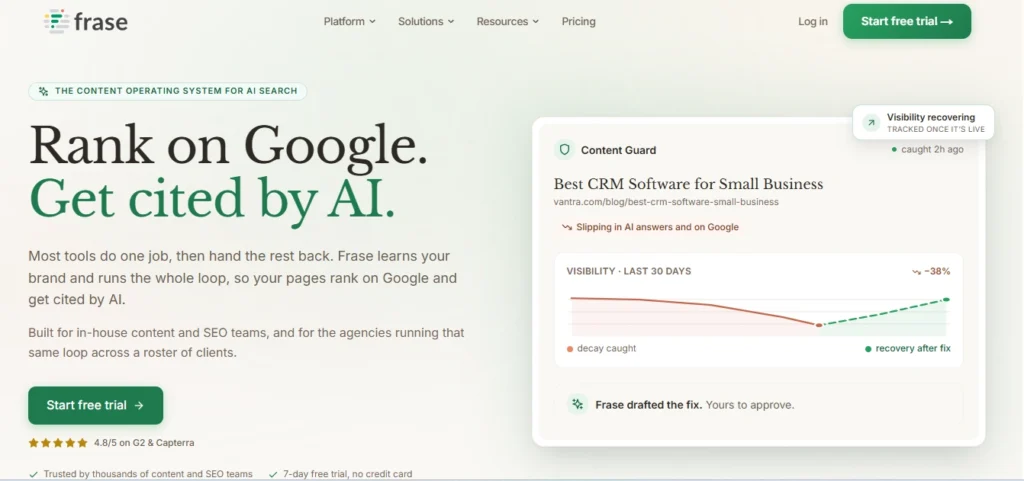
Frase built its name on research and outlining, and that’s still where it’s strongest. If your content process starts with “what questions is the audience actually asking” — Frase is built around that problem.
The tool scrapes SERP results and People Also Ask data, then organizes it into a research view that helps you understand the full information landscape around a topic before you write a word.
The AI writing features have gotten better, though I still use them for drafts that need heavy editing rather than anything ready to publish.
- What’s genuinely useful:
The brief-to-draft workflow. You build a research document in Frase, structure your outline, then generate section-by-section AI drafts grounded in the SERP data you’ve already collected.
The output is better than a cold GPT prompt because it relies heavily on competitor data, much like how RAG in AI systems anchor models to reality. - Where I use it:
For pillar content or long-form guides where research depth matters. Also for clients in regulated industries (finance, legal, health) where you need to see what competitors are claiming before you make any statements. - Limitation:
Frase’s backlink analysis and technical features are weak. It’s a content research and writing tool — pair it with Ahrefs or Semrush for the rest of the picture. - Who it’s for:
Content writers and strategists who want to do proper research before writing and want AI assistance that’s actually grounded in SERP data.
6. SE Ranking AI Writer — The Best All-in-One for Growing Teams
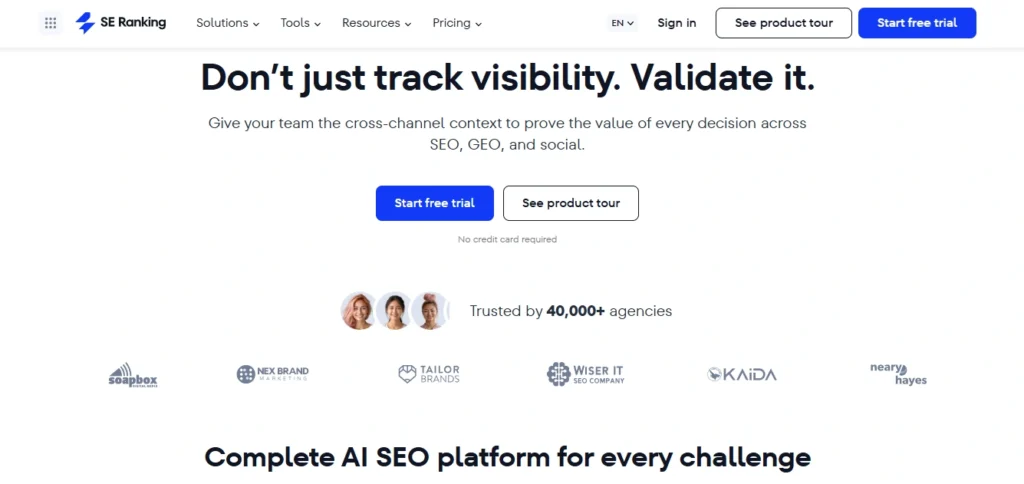
SE Ranking has been quietly building one of the more complete SEO suites, and their AI writing layer is now good enough to take seriously.
What I like about how they’ve implemented it: the AI features are built inside a full SEO platform, so the keyword data, competitor analysis, and content generation all talk to each other.
The AI content workflow pulls in keyword clusters you’ve already built in SE Ranking, generates outlines based on SERP analysis, and produces drafts with NLP term coverage baked in.
For a team running 20–40 pieces of content a month, the reduced context-switching between tools is a massive advantage—a perfect example of how AI won’t replace your team, but it will replace your workflow.
- What makes it different from Semrush Copilot:
SE Ranking is more accessible price-wise ($65/month vs $139/month) and the AI writing features are more developed relative to the core tool. Semrush Copilot is stronger on the analytics and prioritization side. Different tools, different strengths. - Limitation:
If you’re already invested in a different backlink database (Ahrefs, Semrush), SE Ranking’s link data is less comprehensive. Not a dealbreaker for most teams, but worth knowing. - Who it’s for:
Growing content teams that want an all-in-one platform with legitimate AI writing built in, without the Semrush price tag.
7. Keyword Insights — The Clustering Tool That Changes How You Build Site Architecture
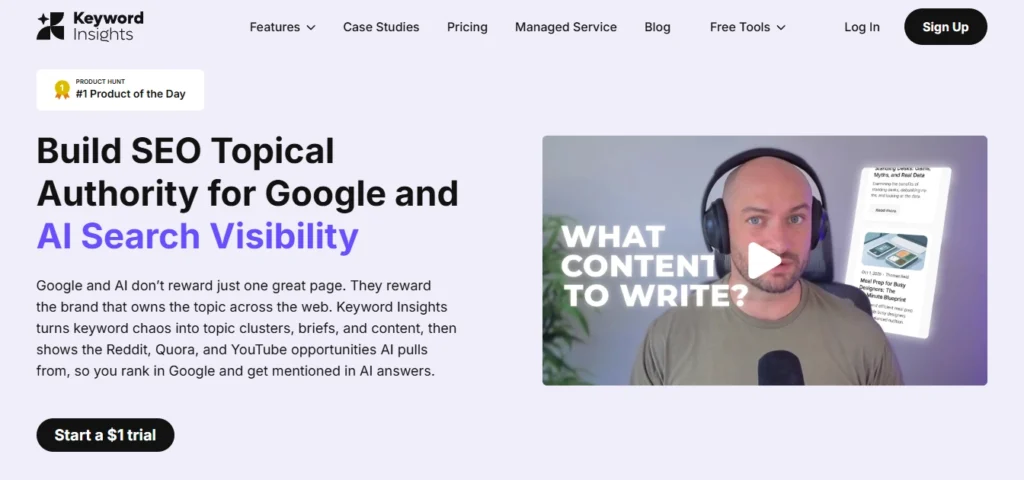
Keyword Insights does one thing and does it better than anything else I’ve tested: clustering large keyword lists by search intent using BERT-based semantic analysis.
Here’s why this matters. Most SEOs are still manually grouping keywords in spreadsheets — or using rough clustering logic based on word matching. Keyword Insights analyzes actual SERP overlap to determine which keywords Google considers semantically equivalent and which it treats as distinct queries requiring separate pages.
- In practice:
I fed it a list of 4,200 keywords for a SaaS client. It came back with 340 clusters, intent-labeled, with hub/spoke relationships mapped. What would have taken a junior SEO two weeks of spreadsheet work took about 20 minutes.
The resulting site architecture restructure drove a measurable improvement in crawl coverage and indexing depth within three months. - Why it’s not higher on the list:
It’s a specialist tool. If your keyword research is already mature and clustered, Keyword Insights has less marginal value. But if you’re building or restructuring site architecture, it belongs in the process. - Who it’s for:
SEO strategists working on site architecture projects, large content audits, or any project requiring intelligent keyword organization at scale.
How to Actually Choose
Here’s the thing about AI SEO tools in 2026: the best one is the one that removes your actual bottleneck — not the one with the longest feature list.
- If your bottleneck is content quality and on-page coverage, start with Surfer or NeuronWriter.
- If it’s research and outlining time, Frase.
- If it’s technical implementation on large sites, Alli AI.
- If it’s keyword strategy and site architecture, Keyword Insights.
- If you want one platform that covers most of it without stitching tools together, SE Ranking or Semrush depending on your budget.
None of these tools rank your pages. Good content, proper technical health, and earned backlinks still do that.
What these tools do is reduce the manual overhead on the parts of the process where AI is genuinely faster and accurate enough to trust. They help you push past busywork and reach the automation ceiling where human strategy and nuance finally take over.