


Most people have the wrong mental model of what’s happening when they type something into an AI tool.
It feels like you’re asking a system to “figure something out.” In reality, nothing like that is happening. What’s actually going on is much simpler—and a bit counterintuitive at first. This lack of true comprehension is exactly why AI still makes simple mistakes.
It’s Not Understanding. It’s Prediction.
When you enter a prompt, the model isn’t interpreting meaning the way a person would. There’s no internal moment of “oh, I get it.”
Instead, it’s running a continuous prediction process.
At each step, it looks at what you’ve written so far and tries to determine what usually comes next in similar situations. Not the correct answer. Not the best answer. Just the most statistically likely continuation. This mathematical reality is why AI “hallucinations” are a feature, not a bug.
That might sound limiting, but language itself is highly structured. Because of that, prediction alone can get surprisingly close to what feels like reasoning.
What Happens Right After You Hit Enter
The response you get looks smooth and intentional. Underneath, it’s built piece by piece.
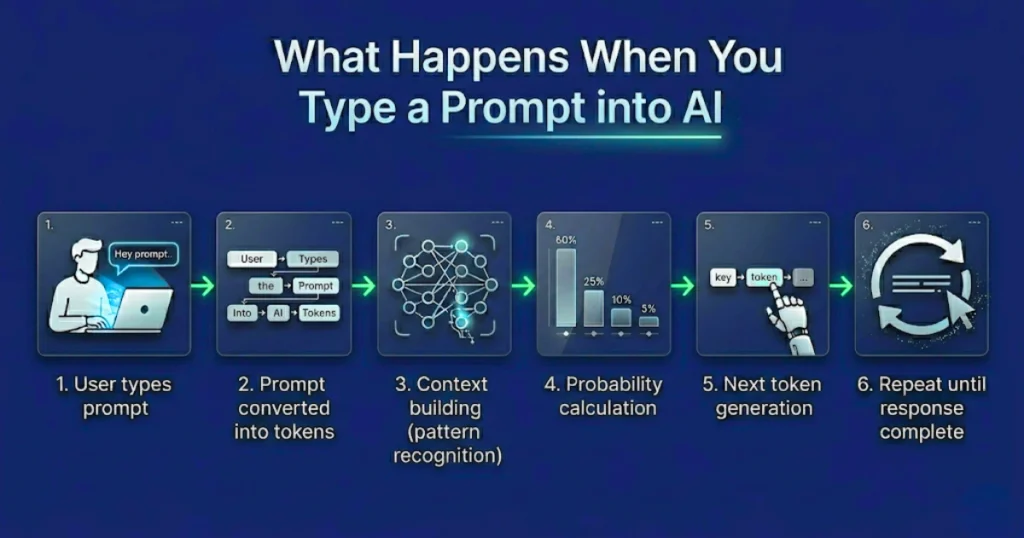
First, your prompt gets broken down into smaller units—tokens. These aren’t always full words. Sometimes they’re fragments, especially with longer or less common terms.
From there, the model starts building context. Not “understanding” in a human sense, but mapping relationships based on patterns it has seen during training. (Though it is important to remember that assuming a model can handle “unlimited context” is often a trap).
Then comes the part most people overlook: pattern activation. The model isn’t searching a database—it’s leaning toward familiar structures. Certain phrases, tones, and formats become more likely depending on how your prompt is framed.
Once that context is in place, it calculates probabilities for what should come next. Thousands of possibilities exist for the next token, each with a different likelihood.
One gets selected.
Then the process repeats.
Over and over, until you end up with a full response.
What reads like a paragraph is really a long chain of tiny probability decisions.
Small Prompt Changes, Big Output Differences
If you’ve ever tweaked a prompt and gotten a completely different answer, this is why. Whether you are relying purely on prompt engineering or exploring AI agents, every word you add shifts the probability landscape.
A vague instruction like “write about a tech product” leaves a lot open. The model fills in the gaps based on general patterns.
But if you say something like:
“Write a 300-word description of a premium SaaS analytics platform for a B2B audience in a professional tone”
You’ve done something important—you’ve reduced ambiguity. You’re not giving it more to work with. You’re removing degrees of freedom. That’s why specificity tends to produce better results.
Context Is Doing More Work Than You Think
A lot of prompts fail quietly because they skip context.
Take something simple like: “Summarize this.”
Summarize for who? At what level? For what use?
Without that, the model has to guess—and those guesses can vary a lot. Without a continuous thread of relevant details, you will quickly run into the hidden problem of why chatbots forget everything.
Add even a small hint—“for an internal report,” “in plain English,” “for a legal audience”—and the output tightens up immediately. You’re not just guiding the answer. You’re defining the conditions it has to satisfy.
Why You Rarely Get the Best Result First Try
There’s a tendency to expect a perfect response on the first attempt. That expectation doesn’t really match how these systems behave.
Because the output is probabilistic, the first result is just one possible version. Iteration is where things improve.
You look at what came back and adjust:
- make it shorter
- remove repetition
- shift the tone
- add a clearer ending
Each follow-up nudges the system again. Over a few turns, the response becomes more aligned with what you had in mind. It’s less like issuing a command and more like steering.
A Few Things That Consistently Help
Some approaches work better not because they’re “tricks,” but because they align with how the model operates.
Assigning a role, for example, changes the language patterns the model leans toward. Saying “act as a technical SEO specialist” pushes it toward terminology and structures it has seen in that context.
Breaking a task into steps also helps. Large, vague prompts give the model too much room to wander. Smaller steps reduce that.
And refining an existing output tends to work better than starting over each time, because you keep useful context in play.
What This Really Means
The model isn’t choosing answers from a hidden list. It’s generating them in real time, based on probability and pattern alignment.
When you write something like “imagine you are a consultant,” nothing actually “becomes” a consultant. The model simply shifts toward language that statistically matches that role.
Once you see it that way, prompt writing changes. Whether you are drafting a quick summary or building AI applications from prompt to production, you stop trying to be clever or overly complex, and start being precise about constraints, context, and intent.
And that’s usually the point where the outputs start getting a lot better.