
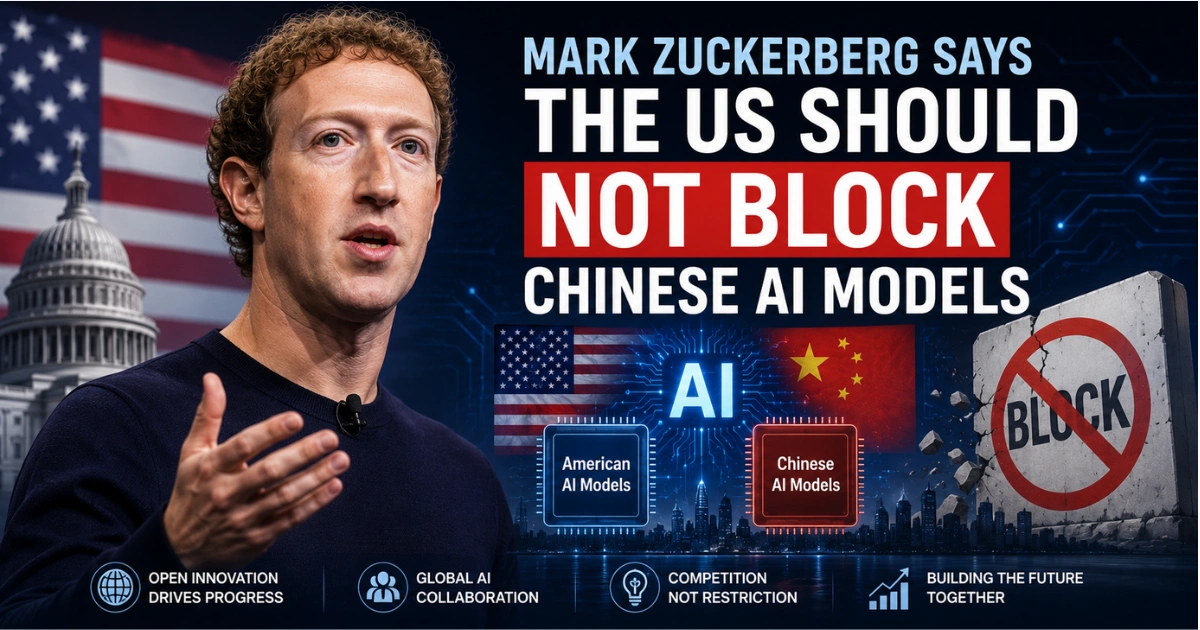

When Meta CEO Mark Zuckerberg argues against blocking Chinese AI models from the US market, it sounds entirely counterintuitive to the prevailing protectionist mood in Washington.
Right now, aggressive technological decoupling is the default political stance, with lawmakers eager to slap bans on foreign software. However, from a strictly technological and strategic standpoint, trying to build a walled garden around American artificial intelligence is a fundamentally flawed strategy.
Zuckerberg’s perspective is deeply tied to how rapid innovation actually works in the open-source machine learning ecosystem. Meta has staked its future on the Llama models, betting that an open, collaborative environment accelerates development faster than closed, proprietary silos.
He points out that American tech giants benefit directly from studying foreign advancements, particularly emerging players like DeepSeek.
Shutting out these models doesn’t protect US interests; it isolates American developers from crucial benchmarks and alternative engineering methodologies that are currently pushing the boundaries of computational efficiency.
The Strategic Value of Cross-Border Benchmarking
In the artificial intelligence space, isolation can limit long-term innovation. The core argument against banning foreign AI models is that regulators could restrict competitors’ access to capital and user data while protecting domestic companies.
But AI development is different from manufacturing steel or assembling hardware. It is an iterative field that depends heavily on competition and experimentation.
When U.S. developers can access Chinese models, they gain more than a finished consumer product. They can study the underlying architecture and training methods.
Recent industry shifts driven by models such as DeepSeek show why this matters. By testing and benchmarking foreign models, Silicon Valley engineers can discover new approaches to complex AI problems.
If the U.S. government blocks access, American companies could lose an important source of competitive pressure.
You cannot stay ahead in a marathon if you cannot see how fast the runner in the next lane is moving.
Zuckerberg understands that maintaining Meta’s competitive edge relies on continuous exposure to global breakthroughs.
When developers are shielded from outside competition by government fiat, development cycles slow down, and institutional complacency sets in. Protecting domestic tech companies from foreign models paradoxically makes them less equipped to compete on the global stage.
Why Hardware Constraints Drive Software Ingenuity
There is a highly specific technical reality driving Zuckerberg’s pushback against government bans: hardware constraints breed massive software ingenuity. Due to aggressive US export controls on high-end semiconductors, Chinese AI labs currently operate with significantly less raw compute power than their American counterparts.
To stay relevant in the AI race, they have been forced to obsess over algorithmic efficiency, discovering groundbreaking ways to train highly capable models on a fraction of the hardware.
This optimization is exactly why American tech leaders want these models kept accessible. The US tech sector currently throws massive, expensive clusters of computing power at AI problems, a brute-force strategy that is rapidly becoming financially unsustainable.
By observing how Chinese developers heavily optimize their code and architectures to bypass their hardware limitations, US engineers can adopt similar efficiencies to lean out their own bloated systems.
Banning Chinese AI from US servers doesn’t stop overseas labs from innovating; it simply prevents American developers from learning those hard-won efficiency lessons. A technological embargo works both ways.
If regulators cut the cord on foreign AI access, they inadvertently block the reverse flow of technical knowledge that US tech giants rely on to refine their own systems. Technological supremacy requires out-innovating the competition on an open field, not trying to legislate them out of existence.
Source: Softonic, "Mark Zuckerberg on Chinese AI Models: The US Shouldn’t Block Them"