

The tech industry’s insatiable thirst for computing power has collided head-on with one of the American West’s most fragile natural resources.
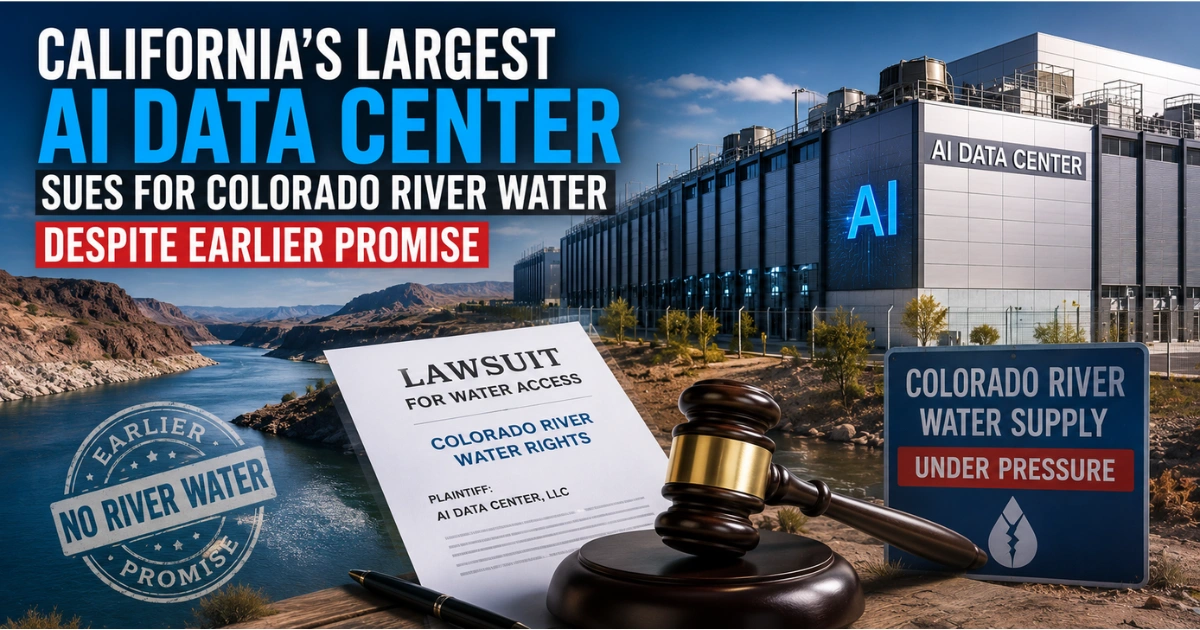
In a legal move that highlights the growing environmental footprint of artificial intelligence, the developer behind what is slated to be California’s largest AI data center has filed a lawsuit demanding access to the Colorado River.
Imperial Valley Computer Manufacturing initially pledged to cool its massive 330-megawatt facility strictly using recycled municipal wastewater. However, that environmentally friendly promise has evaporated.
With the original plan stalled, the company is now fiercely fighting for roughly 287 million gallons of river water annually, setting a precedent that has local communities and water experts deeply on edge.
The Pivot from Wastewater to Freshwater
It wasn’t supposed to play out this way. The facility’s initial blueprint was pitched as a sustainable compromise: tapping into reclaimed wastewater from the nearby cities of El Centro and Imperial.
This approach would have spared the region’s primary freshwater lifeline while supporting the massive cooling infrastructure required by modern AI servers.
But when both municipalities formally declined to supply the necessary cooling water, the developers found themselves backed into a corner.
Their subsequent pivot targeted the Imperial Irrigation District (IID), the powerful local agency that manages the region’s Colorado River distribution. When the IID also rejected the request, Imperial Valley Computer Manufacturing took the battle to court.
The facility would require roughly 750,000 gallons of water per day. That represents only about 0.028% of the ID’s annual allocation. However, in a desert region where water is fiercely contested, the source of that supply is highly controversial.
The Colorado River is already under severe pressure. It supplies water to 40 million people across seven states and serves 180,000 Imperial Valley residents. Diverting even a fraction of that water from established uses to cool AI chips has sparked immediate backlash.
The “Buy and Dry” Controversy
To bypass the river’s limits, the developer proposed a controversial workaround. It would purchase nearby farmland, remove it from agricultural use, and transfer its historical water rights to the data center.
Project attorney Sebastian Rucci defended the strategy. He said the 330-megawatt facility would use roughly the same amount of water as a standard 160-acre farm. He argued that the project would therefore add little strain to the river’s overall capacity.
However, the socioeconomic impact of this “buy and dry” strategy could be significant. Agriculture dominates the valley, accounting for up to 97% of locally distributed water and supporting much of the regional economy.
Water policy experts and community advocates warn that converting irrigated farmland into industrial server facilities could permanently reshape the region.
A senior fellow at the Pacific Institute noted that agricultural communities naturally resist these buyouts because they can directly affect local employment.
The tech firm expects to create 1,688 construction jobs and more than 100 permanent tech positions. It also projects a $2.95 billion economic impact over three decades. Still, many locals remain skeptical.
Selling farmland could benefit some landowners. However, it could also weaken local industries, including tractor repair shops, fertilizer suppliers, and harvesting crews.
For a region deeply rooted in agriculture, replacing farmland with cloud computing would be a major shift. The project’s economic benefits may not fully offset that change.
Source: The Times of India, "What Made California's Largest AI Datacenter File Lawsuit to Access 280 Million Gallons of Colorado River Water?"