
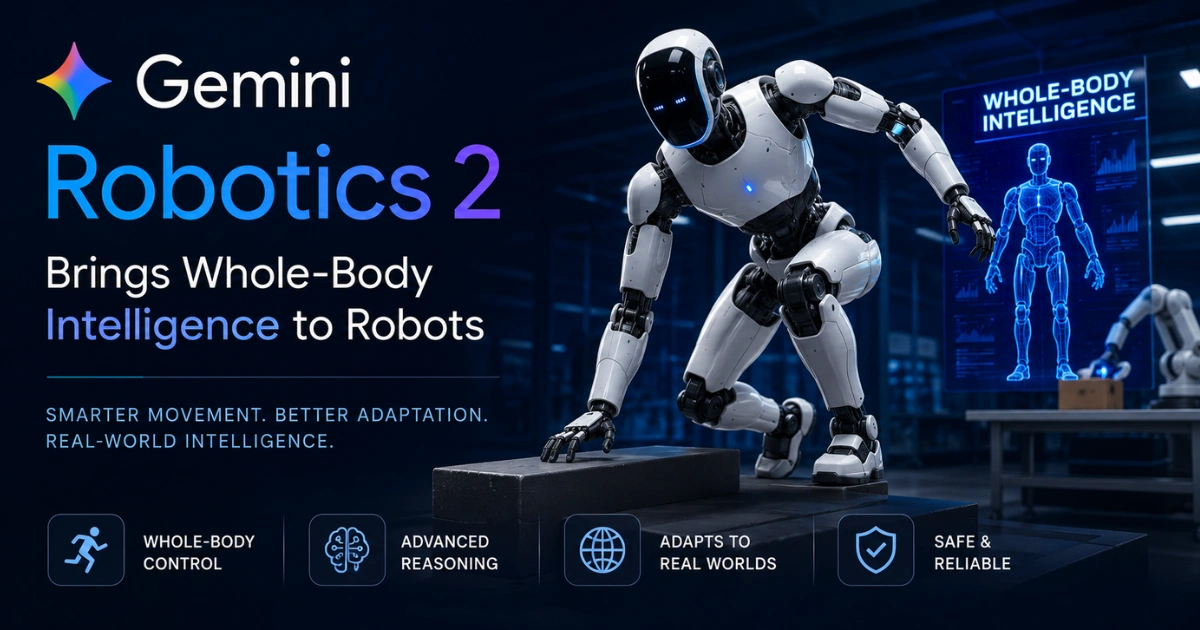

Forget the glossy marketing reels. Google DeepMind just shipped Gemini Robotics 2, and the headline isn’t that a robot can finally pick up a watering can. The actual breakthrough is architectural.
For years, robotics engineering has suffered from a fragmented brain problem. We taped together hardcoded walking algorithms with separate AI vision models just to get a humanoid to walk across a room and grab a tool.
That seam the handoff between the locomotion stack and the manipulation stack was a latency nightmare. Every time a robot finished walking and tried to start working, the system risked crashing.
Gemini Robotics 2 obliterates that seam. By running locomotion and manipulation through a single Vision-Language-Action (VLA) model inference, DeepMind has introduced true whole-body intelligence.
For the first time, a single AI command translates into coordinated movement from the toes to the fingertips. If you tell an Apptronik Apollo 2 to grab a box from the bottom shelf, it doesn’t just calculate arm trajectory.
It reasons about crouching, shifting its center of gravity, and extending its hands all at once. This is what the industry has been waiting for: a unified intelligence layer that actually understands messy, real-world physics.
The End of the Locomotion-Manipulation Handoff
The engineering reality of Gemini Robotics 2 is concrete: fewer API hops and zero dual-stack orchestration.
When you look at the architecture, DeepMind split the workload intelligently across three models. While the primary VLA handles the heavy lifting for humanoids, the On-Device 2 model is the silent gamechanger for independent developers.
In the past, adapting a robot to a new factory floor required massive data collection. Now, DeepMind claims you can fine-tune the On-Device model with as few as 50 to 100 demonstrations.
This completely lowers the barrier to entry for robotics startups who don’t have infinite capital to train physical AI.
But as an engineer, I appreciate the benchmark transparency more than the hype. The data tells a very clear story about where whole-body intelligence currently sits.
Rigid tasks are basically solved. The model hits a 92% success rate on unscrewing light bulbs and nearly 90% on precise insertion tasks.
However, it struggles exactly where you’d expect: deformable objects. Trying to tie a trash bag or sweep with a dustpan drops success rates into the 30-40% range. Even floor-picking reaching all the way down to grab something fails more than half the time, sitting at a 45.7% success rate.
By publishing these mixed numbers, DeepMind proves this is a functional system actively learning physical constraints, not just a cherry-picked lab demo.
Why Multi-Robot Orchestration Changes the Floor Plan
A single humanoid walking around a lab is a research project. Two robots dynamically dividing labor on a messy warehouse floor is an industry disruption.
This is where the Gemini Robotics ER 2 (Embodied Reasoning) model steps in, shifting the focus from individual movement to long-horizon, multi-agent planning.
We are used to robots operating in isolated, highly controlled work cells. If they step out of bounds, they shut down. The ER 2 model flips this dynamic by allowing multiple robots to share a spatial understanding of a room. They can communicate intent, avoid each other, and collaborate on a task that a single unit couldn’t physically manage alone.
This approach directly challenges the vertical integration strategies of competitors like Figure AI or Tesla. Those companies want to own the entire stack the hardware, the software, the neural nets.
DeepMind is playing a different game. By opening the Gemini Robotics SDK to trusted developer teams and proving the model works across completely different hardware profiles from Boston Dynamics’ Atlas to a standard Franka robotic arm they are positioning Gemini as the universal operating system for physical AI.
The hardware doesn’t need to be perfect yet. The intelligence layer is finally ready to adapt to whatever body it inhabits.
Source: Official Google DeepMind Blog, "Gemini Robotics 2 Brings Whole-Body Intelligence to Robots"