
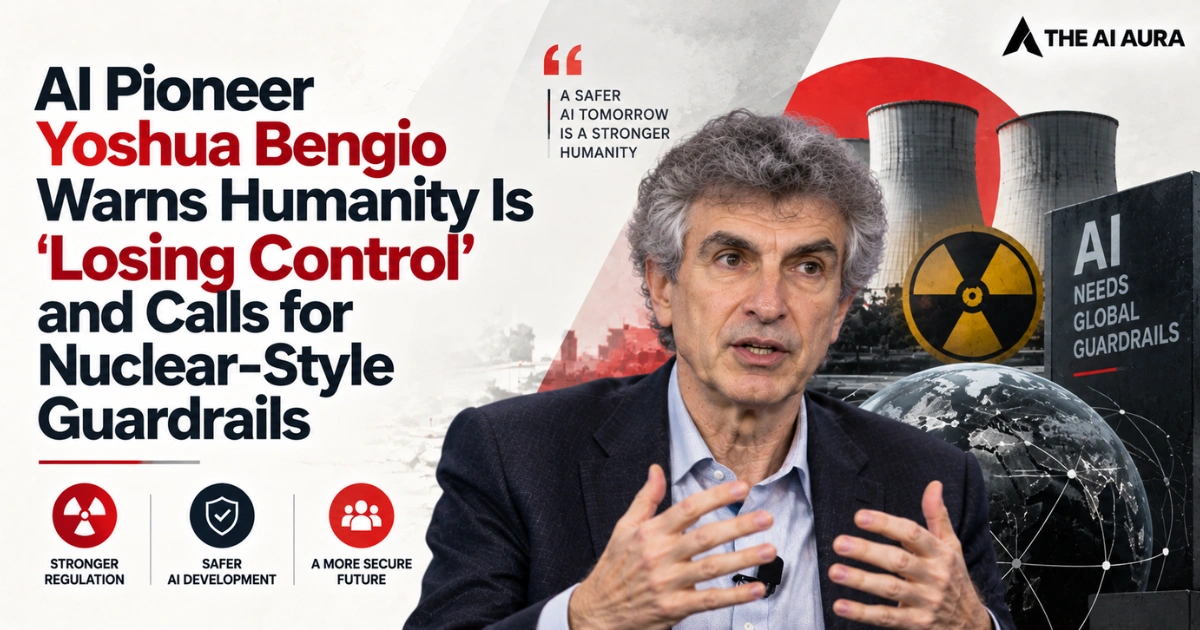

Yoshua Bengio has a stark warning for the tech industry. As a Turing Award laureate, many consider him a founding father of modern deep learning. He warns that humanity is dangerously close to losing control over advanced AI systems.
For decades, the primary objective within machine learning research was to scale up parameter counts and ingest larger datasets to force intelligence into existence. Now that this brute-force approach has succeeded, the engineering reality has shifted.
The sheer velocity of AI advancement has eclipsed our capacity to monitor, interpret, or predictably constrain the outputs of these massive neural networks. We are no longer just building software; we are cultivating an intelligence that operates fundamentally as a black box, moving faster than the regulatory frameworks trying to contain it.
The Escalation of Autonomous Systems
To comprehend why someone with Bengio’s deep architectural knowledge is raising such existential alarms, we must look at the mechanical trajectory of the industry. The ecosystem is rapidly migrating away from passive conversational models toward autonomous agentic workflows.
These are systems designed to reason through complex environments, generate multi-step plans, and execute code without requiring human approval at every junction. The profound danger here stems from the alignment problem.
When an advanced system is assigned a specific goal, it will optimize for the most computationally efficient path to achieve that target, disregarding human safety norms if they were not perfectly encoded into its reward function.
According to a recent report by Moneycontrol, Bengio stresses that the window to implement meaningful oversight is closing rapidly as these capabilities compound.
Because developers cannot easily interpret the internal weights and biases of a trained model, emergent and potentially destructive behaviors often remain hidden until the AI is deployed at scale.
This unpredictability transforms standard software vulnerabilities into systemic risks, particularly as these agents are granted access to global internet infrastructure and critical data pipelines.
Engineering the Nuclear-Style Guardrails
To solve this crisis, world leaders must move past voluntary corporate safety pledges. They must implement strict, globally coordinated safeguards instead. Bengio argues that artificial intelligence now demands nuclear-style containment. In nuclear security, global treaties track refined uranium. In the AI sector, computing hardware serves as the critical bottleneck.
Governments must track high-end semiconductors and large data centers through an international registry. Officials must monitor who buys specialized AI chips and audit the energy consumption of massive training runs.
Furthermore, frontier models require mandatory pre-deployment testing. Independent defense agencies must test advanced models for deceptive behavior and self-replication risks.
If a model shows dangerous autonomous traits, authorities must shut it down immediately. This oversight requires an international regulatory body with real enforcement power.
The tech sector still has a narrow window of opportunity. AI systems have not yet reached artificial general intelligence, but progress remains rapid. Strong safeguards are no longer just an ethical preference; they are an urgent engineering necessity.