

Many experts view healthcare as the ultimate proving ground for artificial intelligence. Here, theoretical algorithms directly impact real-world patient outcomes.
Developers now want AI to serve as a medical facility’s central nervous system. However, real-world clinics present major operational hurdles. Benchmark test scores often clash with messy clinical workflows. Meanwhile, top computer scientists warn about the unchecked growth of AI across the globe.
The Promise and Limitations of the AI-TEC Experiment
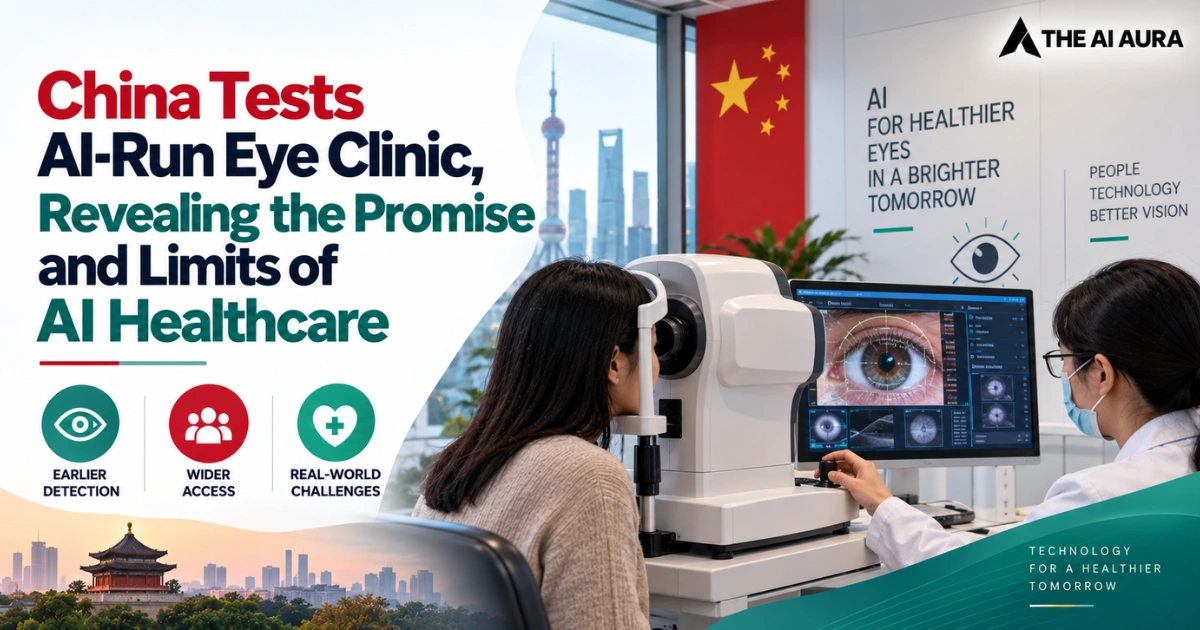
In a significant leap for medical technology, researchers from the Beijing Visual Science and Translational Eye Research Institute designed an entirely new type of facility called the AI-Agent Augmented Tsinghua Eye Clinic, or AI-TEC.
Instead of awkwardly bolting diagnostic algorithms onto existing hospital infrastructure, this clinic was built from the ground up to integrate AI across the entire patient journey.
The artificial intelligence handled pre-consultation interviews, managed eye scans, and formulated follow-up care strategies, operating alongside human ophthalmologists who stepped in to verify and correct its findings.
The early technical results were highly encouraging, but they revealed a counterintuitive truth about machine learning data.
The system initially trained on a massive dataset of nearly 27,000 images, yielding mediocre diagnostic accuracy.
According to a recent report by NDTV, the AI’s performance only improved significantly when ophthalmologists replaced that massive dataset with a highly curated, smaller batch of 1,426 precisely labeled, high-quality scans.
Following this adjustment, the system achieved an AUROC score exceeding 0.93 for conditions like glaucoma and age-related macular degeneration, putting it on par with the most advanced state-of-the-art scanning technologies.
Yet, the experiment quickly proved that algorithmic accuracy does not automatically translate to clinical success. Over a five-month period, staff adoption plummeted, with the AI being utilized in a mere 3.8 percent of examinations.
The technology simply required too many clicks and demanded too much manual input, bogging down the very medical professionals it was supposed to assist. It was only after researchers streamlined the interface and drastically reduced the operational friction that usage climbed back to 23 percent.
The trial exposed a fundamental philosophical divide: algorithms narrowly look for the presence of a specific disease in an image, while human doctors evaluate the holistic clinical picture, prioritizing patient symptoms and nuanced medical histories.
Why AI’s Rapid Ascent Triggers Calls for Nuclear-Style Guardrails
The friction observed in the Beijing eye clinic highlights a critical gap between raw computational power and safe, practical deployment. While clinical researchers are struggling to safely integrate narrow AI into hospital workflows, the foundational models driving the broader artificial intelligence industry are advancing at a breakneck, largely unregulated pace.
This relentless acceleration has prompted leading figures in computer science, including Turing Award winner Yoshua Bengio, to warn that humanity is actively losing control of its own creations.
These industry pioneers are now advocating for international regulations mirroring the stringent safeguards used to monitor and restrict nuclear technology.
The core argument is that the current trajectory of artificial intelligence introduces existential risks that far exceed the scope of conventional software development.
If an algorithm hallucinates or fails to understand a patient’s symptoms in an eye clinic, human doctors are present to catch the error. However, as artificial intelligence systems become increasingly autonomous and vastly more capable than the AI-TEC diagnostic tools, the margin for human correction evaporates entirely.
The contrast between these two narratives defines the current era of technology. On the ground level, integrating AI into society requires painstakingly slow iteration, optimized workflows, and rapid human feedback to ensure it does not harm patients.
At the macro level, the underlying technology is evolving so rapidly that it demands unprecedented geopolitical cooperation to prevent catastrophic misuse.
Navigating the future will require bridging this exact gap, ensuring that artificial intelligence remains a strictly controlled, highly functional tool rather than an autonomous force we can no longer govern.