

The modern battlefield is no longer confined to land, air, and sea; it is increasingly waged on social media feeds using synthetic media.
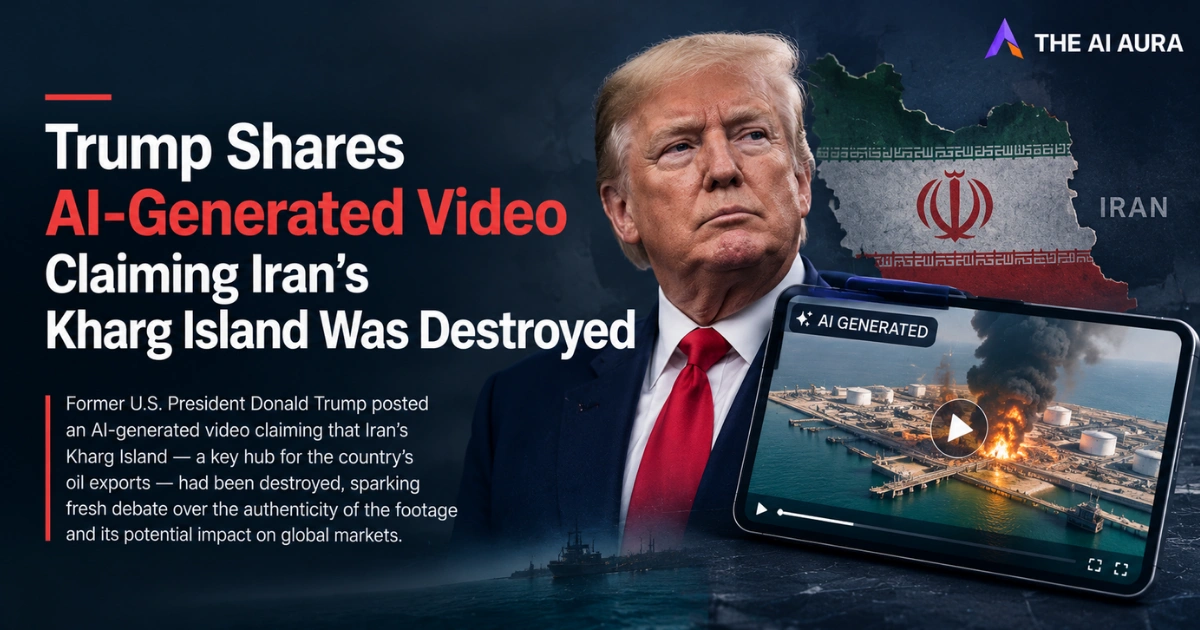
In a striking escalation of digital and psychological warfare, President Donald Trump recently took to his Truth Social platform to share an artificial intelligence-generated video depicting the violent destruction of Iran’s Kharg Island.
Trump claimed the oil hub was “being blown to smithereens.” However, the dramatic footage of hovering aircraft and exploding oil tanks is entirely fake.
The timing of this digital provocation connects directly to real-world clashes. Trump posted the clip hours after US air strikes hit Iranian rocket launchers on Larak Island.
This marked the first direct American strike against Iran since late July. While the explosions on Kharg Island exist only in pixels, this digital posturing carries severe geopolitical weight.
The Strategy of Digital Intimidation
Kharg Island holds immense economic importance for Iran. Located in the Persian Gulf, this small island handles up to 90 percent of Iranian crude oil exports.
It serves as the lifeblood of the nation’s economy. By sharing its simulated destruction, Trump used AI as an active psychological weapon rather than simple political theater.
The US military did not strike Kharg Island. Yet, sharing the hyper-realistic footage sends a clear visual threat to Tehran. It illustrates a worst-case scenario: the complete destruction of Iran’s main economic hub.
A US naval blockade has already reduced tanker traffic at the island’s deep-water ports. For the Trump administration, the AI video provides a frictionless tool for intimidation. It forces Iranian leaders to react to an imaginary strike, creating panic without launching a single missile.
Real Hostilities in the Strait of Hormuz
While the destruction of Kharg Island is synthetic, the regional fallout is intensely real. The AI video dropped against the backdrop of actual US strikes on Larak Island, a small but strategic outpost in the Strait of Hormuz.
According to US Central Command, those strikes neutralized an imminent threat from the Islamic Revolutionary Guard Corps (IRGC), which was reportedly preparing to deploy sea mines into the newly cleared commercial waterway.
Tehran did not let the actual US strikes go unanswered. Ignoring the AI video, the IRGC launched a swift retaliation, firing ballistic missiles at US-allied military bases in Jordan.
Jordanian air defenses intercepted several of the projectiles, though Iranian state media quickly claimed the strikes caused heavy damage.
The conflict rapidly expanded, with Tehran asserting it had also targeted US military personnel stationed at the Al Minhad Air Base in the United Arab Emirates, though the UAE dismissed reports of a successful strike.
We are currently witnessing a dual-track conflict. On one track, kinetic strikes and ballistic missiles are actively threatening lives and global supply chains in the Persian Gulf.
On the other, hyper-realistic, AI-generated content is being weaponized by heads of state to project power and manipulate enemy psychology.
The destruction of Kharg Island may be a digital illusion today, but in a region already defined by rapid military escalation, the line between synthetic threats and real-world devastation is growing dangerously thin.
Source: NDTV, "Trump's New 'AI' Attack on Kharg After US Bombs Iran's Larak Island"