

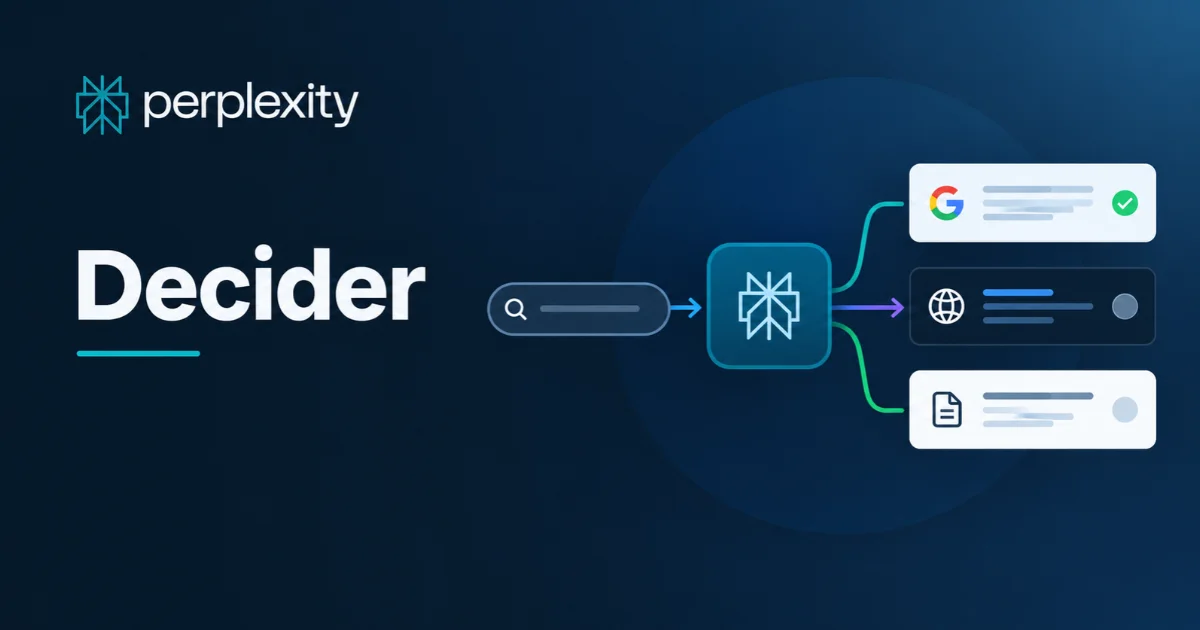
The landscape of artificial intelligence is rapidly shifting from models that simply generate text to systems that can make fast, reliable, and highly specific judgments. For a long time, developers relied on massive generative models to handle tasks they were not strictly built to do, such as deciding if an output was safe, evaluating factual accuracy, or ranking search results.
This approach often proved computationally expensive and inefficient, prompting engineers to seek out leaner alternatives. Recognizing the industry-wide need for a more specialized approach, Perplexity has introduced a significant architectural upgrade.
The company recently rolled out Decider v1.3 and its lightweight counterpart, Decider Flash v1.3. Inspired by earlier foundational frameworks like Jev and TypeSafe AI’s System One Model, these new releases represent a structural shift in how applications classify, route, and evaluate data.
Both versions are fully open-source and accessible under the Apache license through platforms like Hugging Face, OpenRouter, and the Perplexity Decisions API, signaling a broader push toward task-specific AI tools that bridge the gap between large language models and rigid traditional classifiers.
Moving Beyond Free-Form Text Generation
At its core, a decision model is a highly adaptable, general-purpose classifier. It evaluates a single input against a predefined set of questions. When you feed a traditional language model a prompt, it generates a response word by word. This is incredibly powerful for creative writing or conversational agents.
However, it is highly inefficient if you merely need the system to categorize a document or flag inappropriate content. Decision models strip away the unnecessary conversational fluff. Instead of generating sentences, they analyze an input and return a precise probability distribution over possible answer.
Whether an application requires a simple binary yes or no decision, a custom multiple-choice classification, or a sliding scale score to rank search relevance, these models handle the cognitive load seamlessly.
This makes them ideal for behind-the-scenes tasks. They excel at judging the faithfulness of an output or routing complex user requests to heavy-duty models. They also maintain platform security by detecting phishing attempts or prompt injections.
According to Perplexity, these models provide the dynamic flexibility of a standard language model because they are trained across diverse tasks in a shared natural language format.
Yet, they execute with the speed and computational precision of a dedicated classifier. This dual capability allows developers to maintain tight control over how data is processed, filtered, and organized across massive collections of content, entirely helping to reduce AI latency associated with token-by-token text generation.
The Architecture of Rapid Decision Making
Creating a tool like Decider involves fundamentally adapting strong generative backbones. This changes how they process and map information. The underlying architecture relies on a shared context, which the system treats as the foundational state of the request.
Instead of reprocessing the same source document for every single question asked about it, the model reads the shared state just one time. From there, the system introduces multiple question blocks. Each block contains a query and a set of possible answers assigned to specific label tokens like A, B, or C.
To extract the model’s judgment efficiently, the architecture employs a specialized marker token. This token tells the system exactly where to read out the final prediction.
At this precise point, a learned linear output layer maps the hidden state directly to the assigned scores. It instantly converts them into actionable probabilities in a single forward pass. Both the standard and Flash versions of the 1.3 update feature bidirectional attention and better-curated training data.
Furthermore, this latest iteration introduces a unique locate feature. This allows the model to actively highlight the exact content it used to make its decision. This visual highlighting is invaluable for complex tasks like identifying personal information or extracting specific answers from dense documents.
This seamless combination of shared computation, natural language prompting, and pinpoint extraction gives developers an incredibly intelligent engine.