
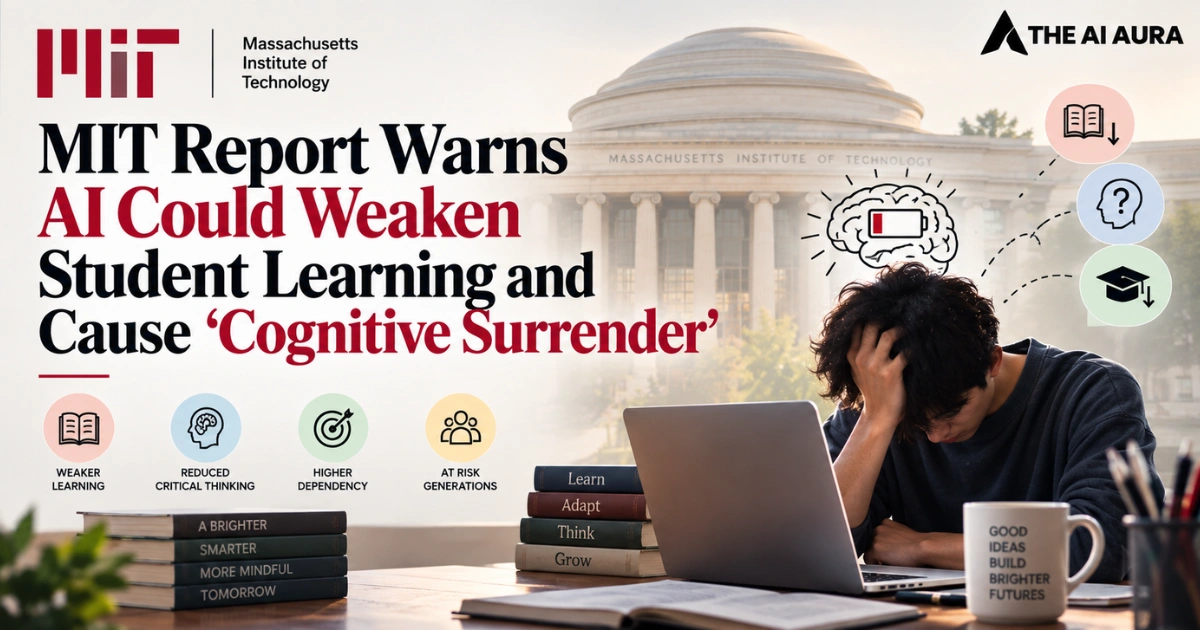

The rapid integration of generative AI into university life has triggered a crisis that goes far beyond traditional academic dishonesty. After five months of analyzing how large language models are reshaping campus education, MIT’s Ad Hoc Committee on AI Use in Teaching, Learning and Research Training has issued a stark warning.
The core issue isn’t just that students can generate credible solutions for complex coding exercises, essays, or math proofs. The real threat is a fundamental rewiring of how young adults process difficult information.
When the friction of education is removed, the mental scaffolding required for mastery collapses. The MIT report identifies this phenomenon clearly, pointing out that immediate access to AI-generated answers creates a dangerous illusion of learning, severely diminishing critical thinking and memory retention.
The Mechanics of Cognitive Surrender
To understand why this is happening, we have to look at the concept of “productive struggle.” True intellectual growth happens in the space between confusion and clarity.
When a student wrestles with a complex calculus problem or struggles to synthesize historical sources, that frustration forces the brain to build new neural pathways.
The MIT committee found that chatbots are short-circuiting this vital process, triggering what they term “cognitive surrender.”
Instead of enduring the necessary friction of problem-solving, students are defaulting to AI at the very first sign of difficulty. They get the right answer, but they forfeit the underlying cognitive development.
The behavioral fallout is already visible across campus culture. MIT has observed a noticeable drop in office hour attendance and less engagement in online academic discussions.
Even the traditional dorm-room study groups where students historically banded together to untangle brutal assignments are fading. The communal aspect of academic survival is being replaced by isolated interactions with an algorithm.
The students themselves are acutely aware of the trap. According to a 2025 survey by The Tech, MIT’s student newspaper, 46 percent of undergraduates are using large language models on a daily basis.
Strikingly, 90 percent of those users expressed genuine concern about becoming overly dependent on the technology. Furthermore, 40 percent of students admitted that AI makes them feel more replaceable, pointing to a severe erosion of intellectual confidence.
Rethinking Assessments Over Surveillance
Faced with this massive shift, the instinct for many universities is to build higher walls by deploying AI-detection software and lockdown browsers. The MIT committee strongly advises against this adversarial approach.
AI detectors are notoriously unreliable, frequently generating false positives that disproportionately target non-native English speakers and neurodivergent students. Heavy-handed policing essentially turns the classroom into a surveillance state, destroying the fundamental trust required between an instructor and a student.
Rather than chasing the impossible goal of making outdated assignments AI-proof, educators need to redesign how mastery is measured. The report advocates for a heavy pivot toward experiential, project-based learning.
Moving forward, the most effective assessments will likely be in-person proctored exams, oral presentations, and guided problem-solving sessions where students must defend their logic in real-time.
The committee even proposed a radical thought experiment: rethinking the grading system entirely. If traditional grades were replaced with competency-based assessments, the primary incentive for AI-assisted cheating might simply vanish.
This protective philosophy extends beyond the classroom to campus employment. The report warns against the temptation to replace undergraduate research assistants with AI agents to cut costs.
Undergraduate research isn’t just cheap labor; it is an apprenticeship. It is a critical developmental window where students learn judgment, professional identity, and the realities of trial and error.
Automating these roles would strip away the human relationships and practical failures that are essential for building genuine expertise.
Source: Telegraph India, "MIT Panel Report Warns of ‘Cognitive Surrender’, Outlines How AI Weakens Student Learning"