
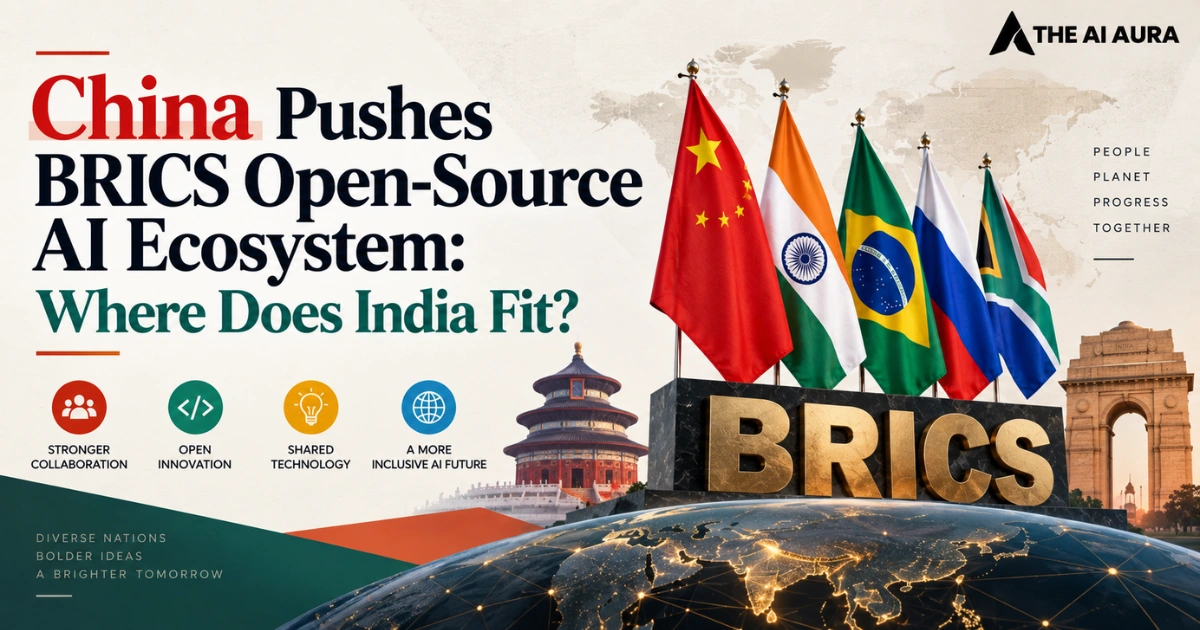

At the recent BRICS Summit in New Delhi, Chinese President Xi Jinping unveiled a calculated technological gambit. He proposed creating a BRICS open-source artificial intelligence community. This initiative challenges the AI dominance of American tech giants like OpenAI and Anthropic.
It goes beyond the diplomatic rhetoric of shared digital cloud platforms and joint training programs. Beijing is pitching a lower-cost, accessible AI ecosystem to the Global South.
They achieve this by leveraging highly capable models like Alibaba’s Qwen and DeepSeek. The proposition is straightforward. Developing nations should avoid expensive APIs and the stringent export controls that Silicon Valley dictates.
This strategy extends China’s broader World AI Cooperation Organisation framework. It attempts to scale this framework across the massive emerging markets of BRICS member states. The New Delhi Declaration side-stepped the official adoption of Xi’s open-source architecture.
Leaders opted instead for a broader consensus on AI safety and equitable access. However, the proposal exposed a shifting fault line in global technology governance. Economies lacking computational power find free access to frontier models deeply enticing.
The Architecture of the Chinese Proposition
Beijing’s open-source strategy isn’t merely about sharing code; it’s an integrated infrastructure play. The proposal envisions a common BRICS digital ecosystem cloud platform, joint large language model (LLM) deployment, and unified competency standards for engineers.
When we talk about “open-source” in this geopolitical context, we are primarily dealing with open-weight models. Unlike proprietary US systems securely locked behind web interfaces, open-weight architecture allows international developers to download the model’s parameters.
Users do not need to rely on foreign cloud infrastructure or fear that a sudden policy shift in Washington will sever their access. They can host the AI locally.
However, this isn’t pure open source. The training data and the core algorithms used to build these Chinese models remain entirely private, meaning independent safety and bias audits are severely limited.
Furthermore, adopting this ecosystem means importing the underlying alignment parameters of the developer.
China’s domestic AI regulations explicitly require models to reflect state objectives, raising fundamental questions about how these tools might behave when integrated into the critical infrastructure of foreign democracies.
The Strategic Dilemma for New Delhi
India finds itself in a complex position. Long an advocate for democratizing compute and datasets for the Global South, New Delhi recently launched the IndiaAI Mission, a massive public investment aimed at building indigenous foundation models and subsidized computational grids.
On paper, pooled resources and shared open-source AI models align perfectly with India’s demands for equitable tech access.
Yet, joining a Beijing-led ecosystem directly contradicts India’s pursuit of strategic autonomy. Earlier this year, India partnered with France to propose a “third way” in global AI governance a collaborative framework distinctly rooted in democratic values and human rights, deliberately positioned away from both the US duopoly and Chinese state-aligned systems.
Swapping a reliance on Silicon Valley for a dependence on Shenzhen does not solve New Delhi’s sovereignty concerns.
There is also a harsh commercial reality at play. India is aggressively nurturing its own ecosystem of domestic model builders, such as Sarvam and BharatGen. If Chinese frontier models are aggressively pushed into the Indian and broader BRICS markets for free via an open-source pact, the business models of these nascent Indian enterprises could collapse.
A domestic buyer has little incentive to pay for a local foundational model when a highly capable foreign alternative is heavily subsidized and readily available.
Ultimately, India must navigate a narrow path. It needs the democratized access that open-weight models provide to rapidly scale its digital economy, but it cannot afford to let its foundational technological infrastructure be captured by a geopolitical rival.
The coming years will demand aggressive domestic innovation to ensure New Delhi isn’t forced to choose between falling behind in the global AI race or adopting an ecosystem it cannot independently trust.
Source: The Indian Express, "China Wants to Create a BRICS Open-Source AI Ecosystem. Where Does India Fit?"