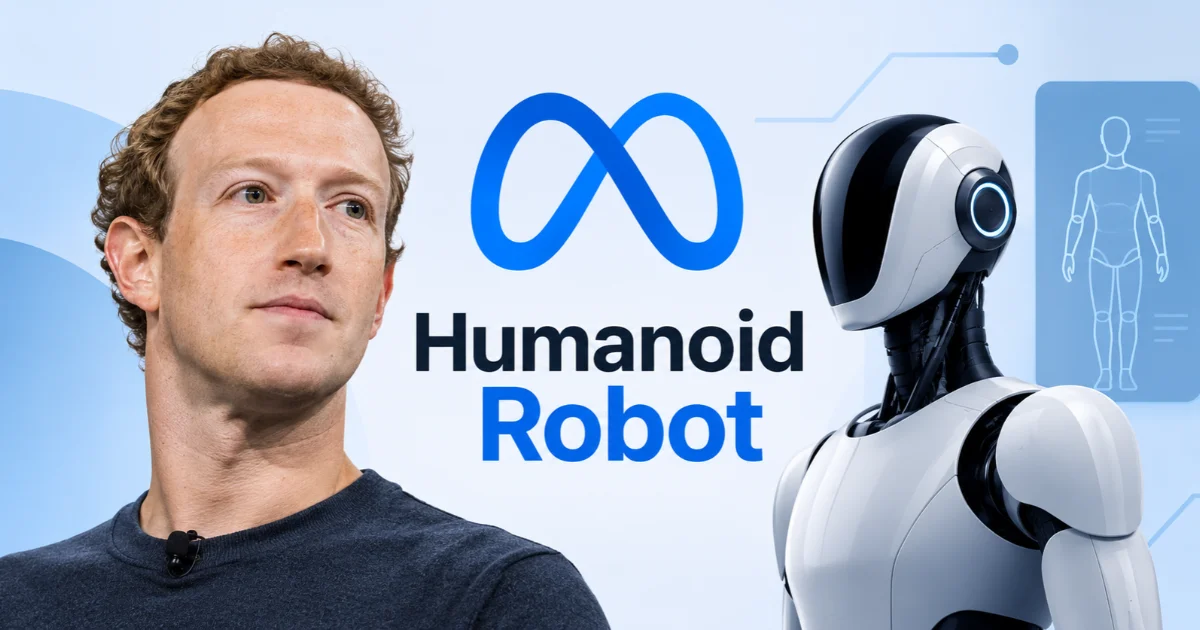

For years, Silicon Valley’s AI race lived mostly in the digital realm. It existed inside browsers, messaging apps, and smart glasses. But the endgame was always physical. Mark Zuckerberg is now accelerating this transition. He is shifting Meta’s focus from screen-based software to real-world hardware.
The company’s latest venture is a humanoid prototype named Max. Meta built this robot in a rapid three-month sprint alongside Fourier, a robotics startup. This represents a major architectural shift rather than a simple tech demo.
Meta’s robotics division views this five-foot-tall, 48-kilogram machine as the potential physical vessel for its core AI agent, Muse.
By taking the neural processing power that drives digital interactions and placing it inside a bipedal chassis, Meta is exploring exactly what happens when multimodal AI algorithms can finally make eye contact, read room dynamics, and physically manipulate the environment around us.
Engineering the Physical Avatar for Muse
Max is significantly more than a rebranded third-party unit with a corporate logo slapped on the chest.
While Meta leveraged Fourier’s existing hardware framework and manufacturing expertise to accelerate development, the engineering team heavily customized the machine’s skeletal proportions, sensory arrays, and digital interfaces.
Operating on Nvidia’s immensely powerful Jetson Thor computing platform, the robot is equipped with a facial display capable of mimicking subtle human expressions, including nuanced eye and mouth movements.
To make the interaction feel organic rather than deeply mechanical, Meta engineered highly specific behavioral thresholds.
According to a detailed breakdown of the development cycle at NDTV, the robot is strictly programmed to recognize specific voices from up to five meters away and interpret casual hand gestures from a three-meter distance.
It is also designed to maintain natural eye contact with users and use visual cues to signal whether it is currently listening, processing complex data, or uncertain about a command.
With five-fingered hands capable of gripping small household items and built-in chest speakers for vocalization, the current prototype is essentially a research baseline.
Meta is already deep into the development of a second-generation model featuring a redesigned torso, superior object manipulation capabilities, a built-in visual projector, and advanced spatial sensors specifically engineered for stair navigation.
Navigating Geopolitics and a Crowded Robotics Market
Building a fluid humanoid is only half the battle. Meta must also navigate a volatile supply chain and a fiercely competitive market. The company partnered with a Shanghai-based firm at a sensitive time. Washington and Beijing remain locked in a tense struggle over AI supremacy.
In July 2026, the US FCC restricted imports of new Chinese humanoid robots. They cited national security concerns and supply-chain vulnerabilities. Despite this friction, Meta aggressively pushed forward. They sent top product executives to Shanghai to finalize the build. Afterward, they showcased the robot at an internal summit.
Serious structural investments support this hardware push. Meta quietly launched the Meta Robotics Studio. They also acquired Assured Robot Intelligence. This startup helps machines adapt to unpredictable human environments.
Zuckerberg hired automotive executive Marc Whitten to lead the division.They are entering a brutally competitive arena where Tesla’s Optimus is actively refining its third iteration, and rivals like Figure and 1X Technologies are pushing toward consumer-ready models.
While Meta currently insists Max is purely for internal research, the aggressive development timeline and massive resource allocation point toward a future where Muse steps out of the smartphone and into the living room, cementing the rise of personal AI assistants as physical partners.